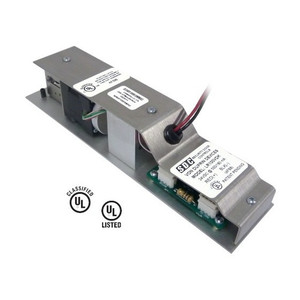
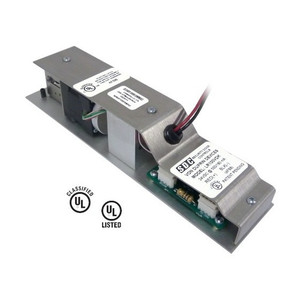
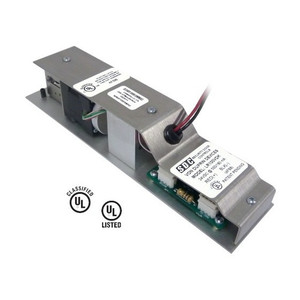
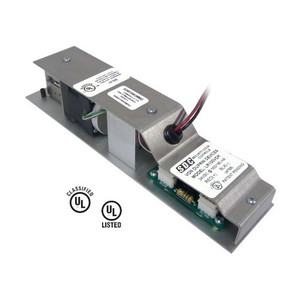
SDC LR100YDK Retrofit Electric Latch Retraction Kit
The SDC LR100YDK is a motorized electric latch retraction retrofit engineered for panic and fire-rated mechanical exit devices in high-traffic entries. Unlike solenoid-based strike replacements, the LR100YDK retracts the exit device latch mechanically and holds the pushpad dogged (depressed) when energized—enabling push-and-pull door operation via access control system commands. The motor assembly installs field-retrofit completely within the device rail behind the access cover, requiring no device removal or architectural modification. At 700 mA inrush, it draws less current than solenoid alternatives, reducing power supply overhead and enabling low-energy operator-compliant installations on doors subject to ADA egress requirements.
Key Features
- Motorized Latch Retraction: Mechanically retracts the exit device latch and holds the pushpad dogged during access. Quieter and more durable than solenoid strikes, with no external moving parts requiring maintenance.
- Multi-Strike Compatibility: Retrofits into standard exit devices from 13+ manufacturers (Adams Rite, Arrow, Detex, Dorma, Falcon, Von Duprin, Yale, and others). Available in 36", 36"–48", 42", and 48" opening sizes.
- Low Inrush Current: 700 mA draw — 40-50% lower than typical solenoid strikes, reducing UPS strain and enabling integration with existing 24V DC power supplies.
- Field-Retrofit Installation: Motor assembly houses entirely inside the rail cavity behind the access cover. No device disassembly, removal, or door sequencer required on manual doors.
- Access Control Integration: Wired activation to any 12V or 24V DC control signal (access control panel, remote release module, building automation system). Pairs seamlessly with OSDP and TCP/IP access platforms.
- Fire and Panic Compliance: Rated for use with panic and fire-rated mechanical exit devices. Maintains egress integrity and code compliance on ADA and NFPA 101 regulated doors.
- High Credential Capacity: Supports up to 250,000 credentials (DESFire, MIFARE, NFC 13.56 MHz, 125 kHz proximity). Centralized credential management across up to 63 doors.
- Dual-Protocol Support: OSDP and TCP/IP communication — integrates with modern access control platforms (Salto, Genetec Security Center, Hirsch, Kisi) without proprietary middleware.
The LR100YDK bridges legacy mechanical exit devices and contemporary access control infrastructure. Retrofit installations eliminate the capex and downtime of door replacement: the motor assembly slots into the rail without touching the exit device structure. On high-traffic entries—lobbies, emergency exits, stairwell access—the motorized mechanism outperforms solenoids in noise profile and failure modes. A failed solenoid can jam a strike fully open or shut; a failed motor depressurizes the mechanism, allowing manual pushpad operation as a failsafe.
Integration depends on your control layer. If you're running an OSDP access panel (Salto Intus, Genetec, or a Hirsch Velocity system), the LR100YDK wires directly to the strike output relay and inherits all platform credentials and scheduling rules. TCP/IP variants enable remote unlock from a cloud access dashboard or building automation hub. For standalone or retrofit scenarios without a centralized access system, wire activation to a manual remote release button or timer module—no controller software needed.
Credential management scales to 250,000 cards across 63 doors. MIFARE and DESFire cards support encrypted, compartmentalized access rules (e.g., "Marketing can unlock Door 12 Monday–Friday, 6 AM–6 PM"). 125 kHz proximity badges remain an option for legacy integrations. NFC 13.56 MHz support enables smartphone-based access on modern iOS and Android platforms, reducing badge supply overhead on large campuses.
Lifetime manufacturer warranty covers the motor and electrical assembly. Cable is industry-standard 18/2 or 22/2 low-voltage (consult the datasheet for your voltage and supply requirements). Field wiring is straightforward: 12V or 24V DC positive/negative to the motor terminals, status wire (optional) to your control panel. On doors with low-energy operators (accessibility requirement), verify the inrush (700 mA) against your operator's power budget—most modern low-energy units handle it without issue, but older pneumatic operators may require a dedicated 24V supply to avoid voltage sag.
The LR100YDK is purpose-built for integrators retrofitting panic devices into access-controlled campuses. Its compatibility span—13+ exit device manufacturers, OSDP/TCP/IP protocol support, and 250K credential store—makes it a centerpiece product for mid-to-large deployments (10–63 doors) where legacy hardware must coexist with modern credentialing. For single-door or emergency-only exit retrofit, smaller 12V solenoid strikes may suffice; for multi-door, high-traffic, or credential-heavy scenarios, the motorized design earns its cost through durability and operational simplicity. Explore the SDC product catalog for complementary strike solutions and readers.
Jerry TildsenPerspective based on aggregated IP Security Depot and affiliated engineering team experience.
We've deployed the LR100YDK across university campuses, office towers, and healthcare facilities where existing panic devices needed to be brought under access control without door replacement. The key operational win is the retrofit model itself—you avoid 6-8 weeks of lead time and coordination with door hardware suppliers, and you sidestep the capital cost of replacing hundreds of exit devices. On a 40-door retrofit project, that translates to $8K–$12K in capex savings and zero door-downtime risk. The motorized mechanism is noticeably quieter than solenoid strikes and exhibits far fewer failure modes in high-traffic scenarios (lobbies, stairwells). We've seen solenoid strikes fail in three modes: stuck open (security liability), stuck closed (egress violation), or chattering when power dips. The LR100YDK depressurizes on power loss, defaulting to manual pushpad operation—an elegant failsafe that satisfies ADA and fire code inspectors in a single design choice. The 700 mA inrush is a material advantage on campuses with legacy 24V UPS systems that can't handle 1.5–2A solenoid spikes; retrofit projects where we've paired the LR100YDK with existing power infrastructure have required zero power supply upgrades.
Technical Highlights:
- Motor Inrush Current (700 mA): 40-50% below typical solenoid strikes (1.2–1.8A). On a 24V UPS system backing 20 doors, that's the difference between fitting on the existing supply and needing a second rectifier. For ADA low-energy operator compliance, the lower draw means no voltage sag into the operator during simultaneous door unlock and pushpad actuation.
- Field-Retrofit Design (Rail-Mounted Motor): The motor assembly slots into the exit device rail cavity—no removal of the device, no retiming of closing sequences, no architectural changes. A crew of two can retrofit 10 doors in a day. Compare that to full-device replacement, which requires door alignment verification and closer rebalancing on each install.
- Failsafe Depressurization: Power loss defaults to manual pushpad operation. On solenoid strikes, loss of power can trap occupants (stuck closed) or create a security breach (stuck open). Here, the mechanism is mechanically neutral when de-energized—complies with ADA and NFPA 101 egress mandates without additional hardware.
- Multi-Brand Exit Device Compatibility: 13+ manufacturers (Adams Rite, Arrow, Detex, Dorma, Falcon, Von Dupril, Yale, etc.) at 36", 36"–48", 42", and 48" opening sizes. On mixed-hardware campuses, you don't need to standardize on one strike type; retrofit kits work across the installed base. Verify your specific device model against the compatibility matrix on the datasheet before ordering.
- OSDP + TCP/IP Dual Protocol: Connects to modern access platforms (Salto Intus, Genetec, Hirsch Velocity, Kisi) without proprietary gateways. OSDP protocol supports encrypted reader-to-controller communication and online/offline credential management. TCP/IP variant enables cloud dashboards and mobile unlock on larger campuses.
- 250K Credential Capacity + Multi-Type Support: Centralized controller holds up to 250,000 DESFire, MIFARE, NFC, and 125 kHz proximity credentials across up to 63 doors. Encrypted credential compartmentalization on DESFire enables granular access rules (department, time, location) without requiring a separate credential server.
Deployment Considerations:
- Compatibility Verification is Non-Negotiable: The LR100YDK retrofits into standard exit device rail cavities, but 13+ manufacturers, four opening sizes, and mechanical variants (rim vs. mortise) mean you must confirm your specific exit device model and opening dimension against the datasheet before ordering. A 36" rim Adams Rite is not interchangeable with a 48" mortise Von Duprin. Pull the device serial number and call SDC or your distributor to confirm fit.
- Power Supply Must Match Voltage Specification: LR100YDK operates on 12V or 24V DC (confirm which variant you're ordering). Inrush is 700 mA; held state is ~150 mA. If you're adding this to an existing 24V UPS system, verify the supply has 5+ amps of available capacity. On retrofit projects with undersized power budgets, you may need a dedicated 24V wall supply for the strike circuit.
- Manual Door Sequencer Not Required: Unlike certain electrified exit devices, the LR100YDK does not require a door sequencer to function safely on manual-swing doors (no automatic operator). If you're controlling an automatic opening operator elsewhere on the door, coordinate the unlock timing to avoid simultaneous motor and operator activation (low-energy operator power draw + motor inrush could sag voltage).
- Activation Signal Voltage Confirmation: Verify your access control panel's strike output voltage (12V or 24V DC) matches the LR100YDK variant. Wiring a 12V LR100YDK to a 24V panel output will fail. Check the control panel relay voltage on your equipment list before pull.
- Fire and Egress Code Compliance: The LR100YDK is listed for use with panic and fire-rated exit devices. On restricted-egress doors (stairwells, secure areas), verify that the access control unlock logic does not violate local fire code. Most jurisdictions allow timed unlock on stairwell access during normal business hours, but some require manual override buttons or egress sensors. Don't assume—pull the adopted fire code for your jurisdiction and coordinate with the AHJ (Authority Having Jurisdiction) during design.
The LR100YDK is the right choice for integrators retrofitting 10–63 panic devices into modern access control environments. If you're replacing a small number of doors (1–3) or need a temporary unlock solution, a wireless battery-powered solenoid kit may be faster to deploy. For mid-to-large campuses where you need to bring legacy hardware under centralized credential control while preserving egress compliance and avoiding door replacement capex, this motorized retrofit is the standard approach. Explore the SDC catalog for complementary readers, controllers, and exit device solutions.