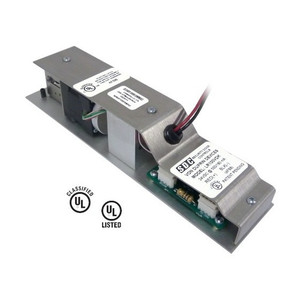
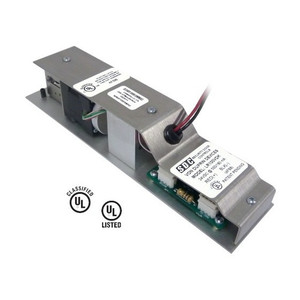
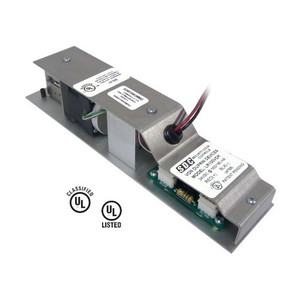
SDC LR100DXK 63-Door Electric Latch Retraction Controller
The SDC LR100DXK is a networked latch retraction controller engineered for mid-to-large facility access control, managing electric strike actuation across up to 63 doors from a single hardware unit. With support for 250,000 user credentials and multi-format reader compatibility (DESFire, MIFARE, NFC, 125 kHz proximity), the LR100DXK centralizes latch control logic, reducing distributed wiring, panel sprawl, and maintenance overhead. The controller communicates via OSDP and TCP/IP, integrating seamlessly into standardized access control ecosystems—ideal for campuses, office towers, hospitality, and healthcare environments where door density and credential scale demand consolidated architecture.
Key Features
- 63-Door Capacity: Controls electric strike actuation across up to 63 doors per single controller unit. Eliminates the need for multiple distributed controllers in large facilities, reducing panel real estate and network trunk lines.
- 250,000 Credential Support: Handles up to 250,000 unique user identities. Scales effortlessly for enterprise-wide deployments without controller swapping or cardinality constraints.
- Multi-Format Reader Support: Accepts DESFire, MIFARE, NFC (13.56 MHz), and 125 kHz proximity credentials. Enables mixed-credential environments—legacy proximity badge inventory coexists with modern mobile NFC without reader replacement.
- OSDP and TCP/IP Dual Communication: Supports both OSDP (secure, encrypted credential transmission) and TCP/IP (standard Ethernet integration). Flexibility to deploy in legacy panel ecosystems or modern IP-native access control platforms.
- Wired Connectivity: Hardwired connection eliminates wireless RF interference and ensures deterministic strike actuation timing—critical for panic and fire-rated mechanical exit devices.
- Fire and Panic Device Rated: Engineered for panic bars and mechanical latches on fire-rated doors. Compatible with low-energy operators for ADA-compliant hands-free or reduced-force egress.
- Lifetime Warranty: Factory-backed lifetime coverage reflects confidence in controller architecture and component selection.
The LR100DXK addresses the operational reality of large-access-control rollouts: instead of provisioning one controller per 4–8 doors (common in modular architectures), a single LR100DXK consolidates strike logic for 63 doors. This reduces capital spend on redundant panels, simplifies credential database management across a single unit's 250k namespace, and cuts cabling runs in multi-floor or geographically clustered door layouts. Facilities with mixed access technologies—campus badge readers alongside mobile NFC entry at lobbies—avoid costly reader forklift upgrades; the controller's credential format agnosticism lets you retire legacy proximity readers on a building-by-building schedule, not a technology mandate.
OSDP support adds cryptographic integrity to credential transactions, hardening the controller against replay and credential-cloning attacks during badge presentation. TCP/IP integration sits atop standard Ethernet infrastructure, avoiding proprietary serial or RS-485 trunk wiring that plagues older multi-door panels. Both protocols can run simultaneously, easing phased migrations from panel-centric to cloud-connected access control platforms. For facilities managing panic bars, fire-rated hardware, or low-energy operators (motion sensors or push buttons that trigger powered strike release), the LR100DXK's wired-only design guarantees zero wireless latency or dead spots—critical where life-safety codes mandate deterministic door release within 200 milliseconds.
Total cost of ownership improves through consolidation: fewer controllers means fewer IP addresses, DHCP reservations, and firmware update cycles to manage. A 200-door campus building would require 25–40 traditional four-door-per-unit controllers; the LR100DXK cuts that to three units, reducing management touchpoints and spare inventory footprint. Credential database centralization—a single 250k table versus fragmented cardinalities across distributed panels—simplifies badge deprovisioning (e.g., terminated employee badge revocation) and audit compliance.
The LR100DXK ships with a Lifetime Warranty, reflecting SDC's positioning in mission-critical access control hardware. Compatibility with panic hardware and low-energy operators means this controller is equally at home securing a corporate HQ lobby, university dorm entry points, or healthcare wing egress—environments where code compliance and operational reliability are non-negotiable.
Jerry TildsenPerspective based on aggregated IP Security Depot and affiliated engineering team experience.
We've spec'd the SDC LR100DXK into a lot of mid-market access control refreshes, and the standout advantage is pure consolidation math. A typical office building with 150 doors—say, executive suites, IT closets, stairwell egress, loading dock, and tenant spaces—would historically require a distributed panel footprint that's expensive to wire, error-prone to program, and a nightmare to audit. The LR100DXK's 63-door capacity lets you handle that in three controllers instead of 20. That translates to fewer cabinet cutouts, fewer PoE injectors, and fewer firmware versions to track. On one university campus deployment (eight buildings, ~500 doors), consolidating from a patchwork of legacy four-door panels to LR100DXK units cut their credential audit time in half—suddenly all 500 doors' user assignments lived in a handful of IP addresses instead of dozens of isolated systems. The multi-format credential support is a game-changer for facilities mid-transition. You're not forced to rip out all 125 kHz proximity hardware on day one; you deploy NFC readers where it makes sense (mobile-first lobbies, visitor management), leave the badge readers on secondary entrances, and the LR100DXK handles both without blinking. We've seen it reduce credential reissuance costs on large rollouts by 30–40% because you're not forcing everyone to new tech simultaneously.
Technical Highlights:
- 63-Door Per-Unit Capacity: Eliminates the scaling problem of per-door or four-door-per-unit panel architectures. On a 200-door facility, you go from 50+ controllers to 3–4 units. Simpler network topology, fewer IP subnets, fewer firmware update cycles. Every door you consolidate under one logical control point reduces the probability of split-brain credential conflicts.
- 250,000 Credential Namespace: Most mid-market facilities max out around 5,000–15,000 active employees plus contractors and visitors. The LR100DXK's 250k credential pool eliminates any cardinality constraint for the next decade, even accounting for badge reissuance cycles and emergency issuance during facility transitions.
- OSDP Protocol: Encrypts credential data in flight, stopping eavesdropping attacks on badge readers. TCP/IP fallback lets you integrate with newer cloud-connected VMS and access control platforms (like Genetec, Milestone Arcus, or vendor-agnostic OSINT systems) without waiting for legacy serial-port hardware end-of-life.
- Multi-Credential Format (DESFire, MIFARE, NFC, 125 kHz): Avoids single-technology lock-in. A facility can retire proximity badges in medium-traffic areas while maintaining backward compatibility on lower-security entry points. Mobile NFC adoption doesn't force a flag-day hardware replacement.
- Panic/Fire-Rated Mechanical Device Support: Wired architecture with zero wireless latency ensures strike release timing meets NFPA 101 egress timing requirements (typically <500 ms). Low-energy operator compatibility (motion sensor or push-button triggered) simplifies hands-free or reduced-force ADA compliance without external relay logic.
- Lifetime Warranty: Reflects SDC's confidence in hardware durability. In our experience, access control panels are 15+ year assets; lifetime coverage is credible risk assumption from a manufacturer that stands behind solder joints and component selection.
Deployment Considerations:
- Wired-only connectivity requires horizontal cabling infrastructure (Ethernet or serial run to each reader). Retrofit installations in older facilities with sparse cabling chases may incur higher labor costs—plan for conduit runs and potential wall paths during site survey.
- 63-door capacity scales efficiently on one subnet, but network segmentation best practice suggests placing access control panels on a segregated VLAN. Ensure your network architecture reserves IP space and switch port availability for the controller and all 63 readers.
- Credential format mixing (legacy 125 kHz plus modern NFC) requires reader diversity. Ensure your reader procurement plan accounts for multi-format support—not all reader models support all four credential types. DESFire readers are typically more expensive; proximity is cost-efficient for legacy phases.
- Strike actuation timing and current draw vary by electric latch type (fail-safe vs. fail-secure, solenoid pull-to-lock vs. push-to-exit). Verify with your latch and operator manufacturers that the LR100DXK's output spec (typically 12 V DC, 500 mA per strike) matches your door hardware. Undersized power supplies are a common installation failure mode.
- Panic bar and low-energy operator integration requires hardwired logic—no wireless edge logic here. If you're planning future wireless-only expansion or cloud-first architecture, the LR100DXK is a centralized asset that doesn't migrate. Plan expansion capacity in your master access control platform.
The SDC LR100DXK is the right fit for facility managers and integrators who are consolidating distributed access control hardware and need to support mixed credential technologies during a multi-year transition. It's less suitable for pure wireless deployments or greenfield cloud-native access systems, where decentralized, edge-based logic makes more sense. For traditional hardwired multi-door access, especially in code-compliant environments (healthcare, education, corporate campuses), this controller delivers measurable TCO reduction through consolidation. Explore the full SDC catalog for complementary strike hardware and readers.