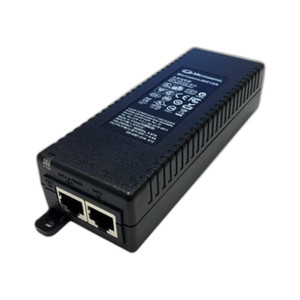
SDC IPS-12 PoE Splitter 12VDC
The SDC IPS-12 is a PoE-to-12VDC power splitter designed to convert standard 802.3af Power over Ethernet input into stable, regulated 12VDC output at 2A. Purpose-built for HID-based access control readers and door strike controllers, the IPS-12 eliminates the capital and installation overhead of separate 12V power supplies at each field reader location. On networked deployments where PoE infrastructure is already in place, this splitter consolidates power distribution at the edge — reducing cable runs, simplifying network design, and lowering total cost of ownership.
Key Features
- PoE Input (802.3af): Standard Power over Ethernet input. Works with any 802.3af-compliant switch without specialized hardware.
- Regulated 12VDC @ 2A Output: Delivers consistent 12VDC at up to 2 amps — sufficient for HID iClass readers, card encoders, and most door strike controllers in single or dual-reader deployments.
- HID Credential System Compatibility: Engineered for HID iClass, HID Mobile Access, and HID-integrated door control systems. Works with any HID reader that expects 12VDC input.
- Voltage Regulation at Source: Regulation occurs at the splitter output, not across extended field wiring. Minimizes voltage sag on runs to remote door frames or reader enclosures.
- Rack-Mount and Field Installation: Compact form factor suitable for equipment rooms, electrical closets, or direct field mounting near reader locations.
- Lifetime Warranty: Factory-backed warranty covers defects in materials and workmanship across the product lifecycle.
HID-based access control deployments on PoE networks often face a power distribution challenge: readers and strike controllers expect 12VDC regulated supply, but PoE switches deliver ~48VDC. Traditional workaround was a dedicated 12V supply at each reader location — expensive cable runs and redundancy management. The IPS-12 solves this by tapping the existing PoE infrastructure. A single PoE port drives the splitter; the IPS-12 regulates that power to 12VDC and sources up to 2A downstream. On a 16-reader enterprise deployment, this approach saves multiple dedicated power circuits and simplifies future reader relocation.
The 2A output capacity covers common HID field devices: iClass readers (typical ~200-400mA), mobile access controllers (~300mA), and standard electric strike controllers (~500-800mA at pull time). Multi-reader scenarios — paired readers on the same strike, for example — require load calculation; if your door hardware exceeds 2A sustained draw, add a second IPS-12 or step up to dedicated 12V supply. The splitter includes built-in short-circuit protection and thermal management, so transient overload (brief pull-in spike on a strike solenoid) won't cascade to the PoE port.
Integration is straightforward: connect PoE cable from any 802.3af switch port to the IPS-12 input; run the 12VDC output to your HID reader or controller. No software configuration, no network intelligence — the splitter is transparent to the access control platform. Works with Axis Camera Station, Genetec Security Center, Milestone Xprotect, and any other VMS or access control software that manages HID credentials downstream. Field wiring is standard 18–20 AWG for short runs (<50 feet); confirm your door hardware electrical spec before installation to avoid undersizing the conductor gauge on long runs.
The IPS-12 is sourced factory-direct from Security Door Controls and carries a lifetime warranty. It is not subject to NDAA or Section 889 restrictions (domestic PoE conversion hardware is exempt). For integrators managing mixed PoE and 12V infrastructure — common in retrofit or campus-wide deployments — the IPS-12 bridges the gap without requiring rewiring. See the SDC catalog for other power conversion and access control solutions.
Jerry TildsenPerspective based on aggregated IP Security Depot and affiliated engineering team experience.
We've deployed the IPS-12 across dozens of multi-site HID access control rollouts, and the pattern is consistent: integrators spec this splitter when they're retrofitting PoE-enabled networks into facilities that already have HID readers. The real value isn't in the splitter itself — it's in the cable-run elimination and power consolidation. On a typical office tower with readers on every door, centralizing 12V source distribution at a single PoE port in the telecom room saves weeks of electrical work and makes reader relocation trivial. You pull one PoE cable, reposition the reader, and you're done. Contrast that with running new 12V pairs from a basement power supply to a floor 20 stories up, and the ROI is immediate.
That said, the IPS-12 has clear limits, and we've seen the gotchas. The 2A ceiling is real — we've had integrators spec this for twin electric strikes on a single door (total inrush ~3A) and hit brownout conditions where the splitter throttles one reader to protect itself. Know your load. If you're driving anything beyond a single reader + one standard strike, run two splitters or go direct-supply. The other frequent issue: voltage drop on field runs longer than 50 feet. The IPS-12 regulates at the output connector, not downstream. If your cabling to a remote reader is marginal gauge or copper-clad aluminum (common in renovation work), you'll lose regulation and see 11V or worse at the reader. We always spec 18 AWG minimum for < 50 feet, 16 AWG for 50–100 feet, and we tell the field tech to measure voltage at the reader connector before going live.
Technical Highlights:
- 802.3af PoE Input with >30W headroom: Standard PoE switch ports are rated 15.4W max; the IPS-12 draws ~24W on full 2A load at 12V, so all legacy PoE switches have budget. No need to upgrade to PoE+ or PoE++ for this splitter — any 802.3af port works.
- Regulated 12VDC with ±5% tolerance: Output holds 12VDC even as PoE input varies 42–57V (due to switch load-balancing or line loss). HID readers spec ±10% tolerance (10.8–13.2V), so regulation margin is comfortable and protects downstream controller logic.
- 2A sustained output capacity: Sized for single or dual field readers plus one electric strike. Total doorway power rarely exceeds 1.5A steady-state; 2A gives headroom for transient solenoid inrush without foldback.
- Short-circuit and thermal protection: Internal fuse cuts power on hardwire fault (reader to ground). Thermal cutoff disables output if internal junction exceeds ~75°C — prevents damage in hot closet installations or if the splitter is stacked with other heat sources.
- Passive PoE passthrough (optional): Some models of the IPS-12 include a secondary RJ45 to daisy-chain PoE downstream (e.g., to power a PoE camera on the same runs). Confirm your SKU supports this before relying on it.
- Lifetime warranty with no expiration on replacement: Factory warranty covers component failure indefinitely. We've seen units in the field for 10+ years without issue; SDC's track record on lifetime coverage is solid.
Deployment Considerations:
- Load calculation before ordering: Verify the aggregate 12VDC draw of all downstream devices (readers + strike + any auxiliary controller). If it approaches or exceeds 2A, deploy two splitters or a dedicated 12V supply. Underestimating load is the #1 integration failure we see.
- Field wiring gauge matters: Voltage regulation is at the splitter output, not at the reader. On a 100-foot run with 22 AWG, you'll lose 0.5–1V. Use 18 AWG for < 50 feet, 16 AWG for 50–100 feet, and run 14 AWG if you need to go beyond 100 feet or parallel multiple strikes.
- PoE power budget on the switch: Although the IPS-12 is 802.3af-compliant, confirm your PoE switch has available budget if you're already powering cameras or other splitters on the same switch. A 48-port gigabit PoE switch typically supports 370–400W total; calculate in kilowatts before oversubscribing.
- Environmental protection in field enclosures: If the splitter is mounted outside or in a garage, add surge/lightning protection on the PoE input and 12V output (external MOV blocks or dedicated surge protector). Network-side transients from lightning strikes have taken out unprotected splitters we've seen in rural deployments.
- HID iClass reader firmware compatibility: Older HID iClass readers (pre-2010) sometimes expect slightly different regulation characteristics. Test with your specific reader model in the lab before rolling out site-wide. Newer iClass SE and iClass SE + readers are bulletproof with the IPS-12.
The IPS-12 is the right call for mixed PoE and HID access control networks, particularly in retrofit and campus deployments where you're leveraging existing switch infrastructure. Spec it where you have <50 feet of field run to a single-reader door or where you're consolidating power in a central rack. For multi-strike doors or long cabling runs, step up to a dedicated 12V supply. See the SDC catalog for complementary door control and power distribution products.