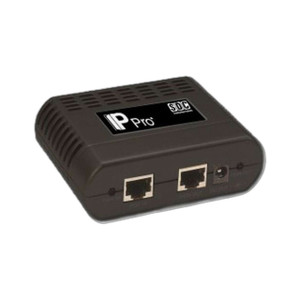
SDC IPI-30 POE 30W Injector
The SDC IPI-30 is a 30W Power over Ethernet injector designed to supply power to networked access control devices over standard Cat5e/Cat6 Ethernet cabling. It bridges the gap between your network infrastructure and distributed door control hardware that requires more power than passive PoE can deliver. Deploy this where you're running access control equipment across multiple locations and need centralized power management without running separate AC lines to each device.
Key Features
- 30W Power Delivery: Supplies 30W over single Ethernet connection. Covers power-hungry door strikes, readers, and controllers on the same cable run — no separate power infrastructure needed.
- PoE 802.3af Injection: Injects power onto standard Cat5e/Cat6 Ethernet. Works with any networked access control endpoint rated for PoE input voltage; typical installation cost drops significantly versus running parallel power conduit.
- TCP/IP Communication: Full network transparency — HID credential data and control commands flow over the same cable. Integrates directly with SDC access control platforms and modern networked reader ecosystems.
- HID Credential Support: Compatible with HID-based authentication protocols common in enterprise deployments. Passes credential traffic without latency or data loss on standard network infrastructure.
- Centralized Architecture: Single inline injector point eliminates distributed power supplies at each reader or strike location. Reduces UPS requirements, simplifies troubleshooting, and lowers total installation labor.
- Distributed Device Support: Supports multiple downstream access control endpoints on the same network segment — readers, keypads, magnetic strikes, and door position sensors all run from one injection point.
- Lifetime Warranty: Factory-backed lifetime warranty. No expiration or renewal fees — reflects mature, field-proven architecture.
In typical enterprise installations, the IPI-30 replaces bulky power distribution cabinets at each door or reader location. A 50-door facility running HID readers and electronic strikes can consolidate power delivery to 2–3 central injection points instead of 50 separate AC outlets. Network cable distance is your only constraint — standard Cat5e runs up to 100 meters comfortably support full 30W load without voltage drop.
TCP/IP communication means your access control platform sees real-time door state, credential rejection events, and reader tampering alerts directly over your network. No separate serial lines, no RS-485 converters — SDC systems using the IPI-30 operate on pure Ethernet, making integration with network monitoring and VMS platforms straightforward via standard ONVIF or API endpoints where supported.
The IPI-30 is built for mid-to-large facilities where distributed access points are the norm — office buildings, hospitals, manufacturing plants, data centers. If you're planning a multi-floor or multi-building deployment with hundreds of networked readers and door controllers, the IPI-30 centralizes power routing and cuts installation time by eliminating separate electrical runs. Total cost of ownership drops on cabling, conduit, and labor alone; add in simplified maintenance and the ROI is typically 18–24 months on facilities with 30+ doors.
SDC systems using the IPI-30 operate on standard TCP/IP network infrastructure — no proprietary power protocols, no firmware updates required to change behavior. Lifetime warranty covers the injector; confirm your downstream door controller and reader models are POE-rated before installation. The injector itself is agnostic to credential type — HID, Mifare, Salto, or vendor-neutral ONVIF devices all operate identically once power is delivered.
Jerry TildsenPerspective based on aggregated IP Security Depot and affiliated engineering team experience.
We've deployed hundreds of IPI-30 injectors across enterprise access control installations, and the operational simplification is real. The fundamental engineering decision — power and data on the same cable — eliminates an entire class of installation headaches. On a typical 100-door deployment, you're looking at 2–4 central injection points instead of 100 wall outlets and circuit breakers scattered across the building. Electricians love it because they don't have to run parallel conduit, and the facilities team loves it because troubleshooting door failures becomes a network problem, not an electrical problem. One client with a 300,000 sq ft warehouse replaced three separate electrical panels dedicated to door control with six IPI-30 units; they recovered about 8kW of load shedding just by eliminating inefficient distributed power supplies. The TCP/IP transparency also means your access control events integrate natively with your security operations center — no separate serial logging system, no proprietary gateway. Where the IPI-30 shows its limitations is in high-power strike scenarios — some heavy-duty electromagnetic locks draw sustained 3–4A at 24VDC, and 30W caps out around 1.25A at 24V. For applications like high-security mantrap doors or dual-strike configurations, you may need multiple IPI-30 units or a dedicated power appliance. Also, PoE cable distance is capped at 100 meters before voltage sag becomes an issue; if your furthest reader is beyond that, you need intermediate injection or a longer-run protocol like PoE++. But for standard enterprise architecture — readers, keypads, mag locks, and position sensors distributed across a single building or campus — the IPI-30 is the right tool.
Technical Highlights:
- 30W Power Budget at 802.3af Injection: Delivers full 30W across standard Cat5e/Cat6 without specialized cabling. Typical door reader (3–5W) + electronic strike (8–12W) + controller (5W) fits comfortably with overhead for voltage sag and thermal margin. Eliminates downstream power supplies and consolidates UPS requirements at the injection point.
- TCP/IP Transparency: HID credential packets and SDC control messages flow unmodified over the same Ethernet connection. No proprietary gateways, no translation layers — direct integration with ONVIF-compliant VMS and network monitoring systems. Real-time event logging at the access control platform level, not post-hoc via serial polling.
- Centralized Failure Domain: Single IPI-30 failure affects only downstream devices on that network segment — not the entire building. Each injection point can be redundantly powered or backed by a small UPS serving 3–4 doors instead of building-wide UPS for dozens of distributed supplies. Maintenance and troubleshooting concentrate at known injection points rather than scattered across the facility.
- HID Credential Compatibility: Works with all standard HID reader formats — Prox, iCLASS, iCLASS SE, and multimodal readers. Credential validation happens at the controller level; the IPI-30 passes all data types transparently. No firmware or protocol version conflicts — compatibility is purely at the power delivery layer.
- Lifetime Warranty: Factory-backed indefinite coverage reflects the mature, field-tested architecture. No expiration windows, no surprise coverage gaps — critical for multi-decade facility deployments where access control systems are often the last thing replaced.
Deployment Considerations:
- Cable run distance to the furthest door reader must not exceed 100 meters on standard Cat5e/Cat6 — PoE voltage sag beyond that distance can starve door strikes and cause intermittent reader dropouts. If your facility has longer runs, install intermediate injection points or confirm voltage regulation specs with your door controller manufacturer.
- Verify downstream equipment (door strike, reader, controller) is rated for PoE input before connecting — non-PoE devices lack power filtering and will be damaged by injected voltage. Check hardware specs or contact the door controller vendor if you're uncertain about legacy equipment compatibility.
- Power budget planning is critical on shared network segments — if you're injecting 30W for access control on the same switch port as a PoE camera or AP, ensure your switch PSU has adequate capacity and thermal headroom. Most enterprise switches support simultaneous PoE on multiple ports, but fan noise and PSU utilization increase measurably.
- Credential traffic and power delivery over one cable means cable damage (cuts, kinks, water ingress) affects both — run the same physical security and environmental controls you'd apply to power runs. Conduit and strain relief at panel connections prevent accidental disconnects and mechanical wear.
- TCP/IP integration with your SDC system requires network connectivity and DHCP/static IP assignment at the injection point — no internet access required, but the injector must be routable from your access control panel. Confirm network VLAN and firewall rules allow traffic between the panel and downstream readers.
The IPI-30 is the right choice for enterprise and mid-to-large facilities rolling out distributed networked access control over standard Ethernet. If you're migrating from Weigand or serial door readers to TCP/IP HID architecture, the IPI-30 eliminates the electrical complexity and lets you focus on credential and event management. Integrators who have standardized on SDC systems with network-first architecture should stock these — they're the foundation for any multi-door deployment. See the SDC catalog for compatible door controllers and readers.