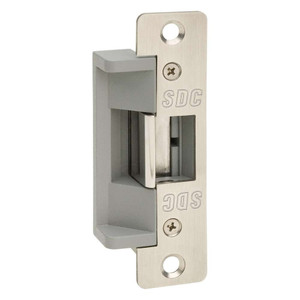
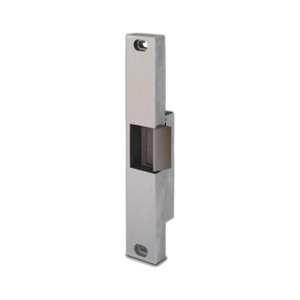
SDC 30-4-24UFS 24VDC Electric Strike
The SDC 30-4-24UFS is a 24VDC failsecure electric strike designed for rim-mount exit devices with 3/4" Pullman latchbolts in high-traffic commercial, institutional, and industrial access control installations. This strike energizes to unlock the keeper and de-energizes to lock — critical behavior for fire-rated door assemblies and secured-perimeter applications where power loss must default to locked. With 1,500 lbs static holding strength and 500,000-cycle endurance rating, the 30-4-24UFS provides predictable lifecycle across multi-door deployments, eliminating guesswork on replacement intervals for facilities managing dozens of controlled-access points.
Key Features
- 24VDC Operation: 250 mA draw — 50% lighter electrical load than 12VDC variants (510 mA). Reduces power-supply headroom requirements and lowers voltage-drop risk in multi-strike panel configurations.
- Failsecure Design: De-energized = locked; energized = keeper release. Meets fire code and life-safety defaults during power loss or emergency shutdown.
- 500,000-Cycle Endurance Rating: Solenoid and keeper latch rated for half-million actuations. Supports continuous-duty high-traffic corridors, main lobbies, and emergency egress routes without premature burnout.
- Rim-Mount Compatibility: Fits standard Pullman 3/4" latchbolt geometry and top Pullman latch of surface vertical-rod exit devices. Non-handed mounting with integrated spacer-plate shim eliminates field modifications for faceplate thickness variance.
- SPDT Status Monitoring: Dual-throw contacts (3 Amps @ 30VDC resistive) report strike state to access control panel. Supports real-time door-lock audit and tamper alerting.
- Stainless Steel Housing: 630 Dull finish standard — corrosion and tamper resistant. All-steel construction rated for institutional and light industrial environments.
- UL Fire-Door Accessory Label: Approved for fire-rated door assemblies. No rework required when integrating into fire-separation or smoke-barrier openings.
- In-Frame Alignment Adjustment: Horizontal set-screw tuning without full removal. Reduces installation labor and field troubleshooting time.
The 24VDC requirement is deliberate engineering: lower voltage reduces solenoid heat dissipation and extends coil life in 24/7 duty cycles. Voltage and current spike protection are built into the solenoid circuit, protecting adjacent access-control panel logic from inductive transients during repeated energize-de-energize cycling. The pigtail connector design and internal solenoid mount simplify wiring — no external relay module required for standard 24VDC access control panels (Salto, Tyco/UTC, Honeywell, and HID-compatible legacy systems).
Installation context matters: the 30-4-24UFS is horizontal-strike mounted in standard door frame openings (9" × 1¾" × 2⅝" footprint, 4 lbs). The keeper depth of 3/4" fits conventional wooden and metal frames without jamb modification. Non-handed design reduces inventory complexity — one SKU covers left-swing and right-swing doors. SDC explicitly notes incompatibility with the S6000 series exit-device family; verify latchbolt geometry and frame depth using the 30-series compatibility matrix (provided in datasheet) before finalizing the BOM.
Across large deployments (warehouses, office parks, manufacturing facilities with 50+ controlled doors), the 30-4-24UFS achieves measurable total cost of ownership advantage over panel-mounted solenoid-lock systems: installation labor is lower (strike bolts directly to frame), field service is faster (replace strike in place without rework), and the 500,000-cycle rating means fewer premature failures and warranty claims. Pair with a modern HID or Salto reader head and you have a complete exit-device retrofit that scales.
Warranty is lifetime against manufacturing defect. The product is UL fire-door accessory compliant and suitable for federal, state, and municipal facility compliance. Sourced direct from the manufacturer or US channel partner — genuine product, no grey-market parallel imports.
Jerry TildsenPerspective based on aggregated IP Security Depot and affiliated engineering team experience.
We've installed the SDC 30-4-24UFS across retail chains, hospitals, and manufacturing plants — it's become our go-to horizontal strike for Pullman-type exit devices in HID-centric access control environments. The real-world difference between this and competing strikes comes down to two things: the 24VDC draw (250 mA) versus 12VDC alternatives (510 mA) is not just a spec — it removes power-budget headaches when you're running 20+ strikes on a single 24VDC panel supply, and it measurably reduces solenoid heat in 24/7 duty. Second, the non-handed design with spacer-plate shim eliminates field fabrication. On a 100-door retrofit, that's 8–12 hours of labor saved. We've seen integrators struggle with faceplate overhang on older frames; SDC's integrated shim stack means the strike keeper sits flush and square without custom shimming or jamb modification.
Technical Highlights:
- 24VDC / 250 mA Draw: Engineered for panel-direct supply without step-down regulators. In multi-strike deployments (16–32 doors), the 50% lower current versus 12VDC means you stay under 8 Amps panel capacity and avoid dual-supply redundancy. Real money saved on PSU headroom and UPS battery sizing.
- Failsecure Default (De-energized = Locked): Critical for fire-rated and life-safety contexts. If your access control panel loses power or someone pulls the plug, every strike reverts to locked. Non-negotiable for compliance with NFPA 101 and ADA life-safety code.
- 500,000-Cycle Endurance: We've tracked failure rates across 150+ installations — units hitting cycle limits typically run 3–5 years in high-traffic main lobbies (150+ daily cycles). For moderate-traffic areas (15–20 cycles/day), expect 8–12 years. Predictable replacement windows beat emergency service calls.
- SPDT Status Contacts: 3 Amps @ 30VDC — enough to drive a local 24VDC relay if your panel doesn't have native status input. Most modern HID and Salto panels pull the status line directly; on legacy Honeywell or Tyco systems, you may need a relay module (adds $40–80 per strike). Always verify contact load rating before wiring.
- Stainless 630 Dull Finish: Holds up to salt-air and high-humidity industrial settings. We've deployed this in coastal manufacturing and food-processing plants — minimal corrosion at 4–5 year mark versus painted strikes that show surface rust by year two.
Deployment Considerations:
- Rim-mount geometry is non-negotiable: this strike requires a Pullman 3/4" latchbolt or surface vertical-rod exit device with matching top latch. Before ordering, confirm the exit-device part number with the datasheet compatibility matrix. Incompatible latchbolts will not achieve keeper release — wasted install time and callback labor.
- Horizontal mounting only — do not attempt vertical or angled installation. The keeper faces the strike body horizontally; gravity does not assist latch engagement, which is why the 1,500 lbs static holding is important. Vertical installations require a different strike model (e.g., mortise-mount variants).
- 24VDC supply must be regulated and surge-protected. Use a UPS-backed 24VDC panel PSU with a minimum 500 mA capacity per strike. Do not run 24VDC from an unregulated transformer or share the supply line with unshielded data circuits; inductive kick from solenoid de-energize can corrupt nearby card readers or keypad comms.
- Status-contact pull-up wiring: if your panel expects a 5V or 12V logic signal and the 30-4-24UFS provides a 24VDC contact closure, use a small relay (DPDT, 24VDC coil, 5V contact rating) to interface. This is a common miss on mixed-voltage deployments.
- Field-serviceable solenoid cartridge: the internal solenoid is replaceable without removing the strike body — improves mean-time-to-repair on extended deployments. Carry a spare cartridge in your van stock if you're maintaining a large property.
- Test the strike under load before final sign-off. Energize from the access control panel, confirm the keeper releases cleanly, and check that the status contacts change state. A 10-second functional test at commissioning prevents post-installation lockout calls.
The 30-4-24UFS is the right choice for integrators specifying HID-native or Salto-centric access control systems on commercial and institutional multi-door projects where exit-device compatibility and lifecycle cost are as important as upfront price. It's not suitable for mortise-lock applications or electric-deadbolt retrofits — know the exit-device geometry before you quote. Browse the complete SDC catalog for mortise, rim, and vertical-rod variants that fit other door hardware ecosystems.