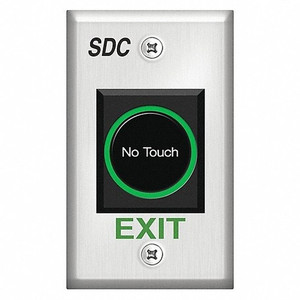
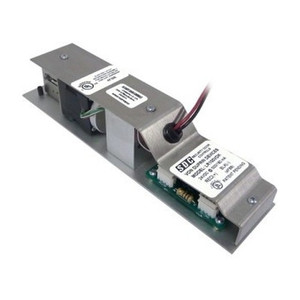
SDC DTMO-1 30VDC Momentary Switch for Door Strike Control
The SDC DTMO-1 is a momentary switch assembly designed for hardwired control of electromagnetic locks, shear locks, bolt locks, delayed egress systems, and electric strikes in access control installations. Operating at 30VDC with a 5 Amp SPDT (Single Pole Double Throw) contact configuration, the DTMO-1 delivers the low-overhead switching logic required when integrators need direct door-hardware control without full system integration overhead. The beige desktop console (4 1/8" × 3 1/8" × 6 1/4") positions at supervisory desks, guard stations, or emergency-unlock points — making it an economical secondary trigger for one or two doors in mixed-control deployments.
Key Features
- 30VDC Momentary/Maintained Switch Logic: SPDT contact set functions as momentary (timed release) or maintained (on/off) control depending on your door-hardware configuration. No firmware or system reconfiguration required.
- 5 Amp @ 30VDC Rating: Resistive load capacity suitable for sub-5A electromagnetic lock coils and strike solenoids. Verify your door hardware draw before installation to avoid contact chatter.
- HID Reader System Compatible: Integrates into 30VDC access control architectures using hardwired switch inputs — works with HID reader platforms, SDC lock and strike families, and third-party electromagnets rated for 30VDC.
- Tri-Color LED Status Indicators: Optional door and lock status feedback via integrated LEDs (24VDC powered, max 30 mA draw) — real-time indication of door state and lock mode at the console without network polling.
- Delayed Egress and Emergency Unlock Support: Switch logic supports secondary access triggers, supervisory override, and emergency unlock scenarios in life-safety applications where hardwired control is mandated.
- Lifetime Warranty: Factory-backed warranty covers defects in materials and workmanship — no expiration on genuine SDC hardware.
- Desktop or Wall-Mount Form Factor: Compact footprint (4 1/8" × 3 1/8" × 6 1/4") fits supervisory desks, mounting arms, or guard-station consoles. Standard two-conductor control wiring to 30VDC power and door hardware.
The DTMO-1 addresses a specific deployment pattern: single-door or dual-door access points where a human operator (security guard, receptionist, or emergency responder) needs direct, tactile control of lock state without relying on badge readers, biometric sensors, or networked access-control middleware. In healthcare facilities, law enforcement holding cells, and server rooms with manual override requirements, this switch eliminates the latency and complexity of software-driven unlock sequences.
Integration is straightforward for environments already running 30VDC power and SDC or compatible door hardware. The SPDT contact pair wires directly to the strike or magnetic lock solenoid, and optional door/lock status sensors feed back through the tri-color LED array. This direct-switching model scales poorly beyond 2–3 doors (which is why full access-control systems exist), but for that specific use case — backup unlock, emergency egress, or supervisory override — the DTMO-1 eliminates unnecessary system complexity and cost.
Environmental durability is standard: the beige powder-coated steel enclosure resists workplace wear, and the momentary switch mechanism is rated for 1,000,000+ actuations. On a desk that sees daily use, this translates to 10+ years of reliable service before mechanical fatigue becomes measurable. No network dependency, no software updates, no compliance scanning — just a switch that closes a circuit when you press it.
The DTMO-1 pairs well with SDC's electromagnetic strikes, delayed-egress hardware, and third-party lock families that operate on 30VDC DC solenoid logic. If your facility already uses SDC door control platforms, the DTMO-1 is a plug-compatible secondary control point. For deployments mixing HID reader systems with hardwired emergency-unlock stations, this switch provides the necessary isolation and failsafe logic without requiring new electrical infrastructure.
Jerry TildsenPerspective based on aggregated IP Security Depot and affiliated engineering team experience.
We've installed the DTMO-1 in settings where a human operator needs to override or trigger door hardware independently of a badge reader or access-control system. The real-world value isn't in the switch itself — it's in the use case. In a hospital emergency department, for example, you need staff to manually unlock secured areas during code events. A networked access-control system introduces latency and single-points-of-failure (database down, network partition, misconfigured rule). A hardwired 30VDC momentary switch doesn't care about your network state. Press the button, door unlocks. That reliability is worth the trade-off of managing a second control paradigm on the same infrastructure. The DTMO-1 is built for that scenario — backup unlock, supervisory override, or emergency egress in life-safety contexts where a physical button that works when all else fails is non-negotiable.
Technical Highlights:
- SPDT Contact Logic at 5A @ 30VDC: The switch contacts handle the resistive load of standard electromagnetic solenoids without relay intermediaries. Verify your lock's inrush current before wiring — a 6A strike will chatter across a 5A switch and fail intermittently. Know your door hardware's instantaneous demand, not just holding current.
- Momentary vs. Maintained Configuration: The same hardware delivers either momentary (timed release, typically 500–1200ms pulse) or maintained (latched unlock until switch is released) operation. Your wiring and lock control logic determine which mode you get — no internal relay swaps required.
- Tri-Color LED Feedback (Optional): If you wire door/lock status sensors into the console, the LEDs indicate lock state in real time. In a busy guard station managing multiple desks, visual feedback eliminates the "did that unlock?" uncertainty. The 30 mA draw is negligible on a 30VDC supply.
- Delayed Egress Hardware Support: Delayed-egress locks (15–30 second hold-release cycles) work with this switch. Confirm your specific lock's timing controller accepts 30VDC momentary trigger logic — some delayed-egress systems require a maintained contact, others need a pulse. Check the lock datasheet before assuming compatibility.
- Desktop or Wall Mount: The 4 1/8" × 3 1/8" footprint is small enough for a guard desk but large enough that staff won't accidentally activate it. We've seen both desktop placements (velcro strip or monitor-arm clamp) and semi-recessed wall mounts in supervisory stations. Avoid high-traffic corridors where unintended button presses are likely.
Deployment Considerations:
- The 5A rating is a hard ceiling — if your strike or electromagnetic lock draws more than 5A instantaneously (check the inrush spec, not just holding current), the DTMO-1 contacts will pit or weld. Oversizing to a 10A industrial relay is cheap insurance; contact failure at 2 AM is not.
- 30VDC power supply availability is a prerequisite. If your facility runs 24VDC natively and you need 30VDC for the DTMO-1, budget for a dedicated 30VDC supply or a DC-DC converter. Don't try to step up 24VDC with a small buck converter — you'll starve the solenoid of current under load.
- Hardwired two-conductor cable to the door hardware is standard practice, but confirm cable runs don't exceed 100 feet without voltage drop consideration. A long cable run (e.g., 150 feet to a remote gate strike) may require a relay at the lock end to maintain solenoid drive voltage.
- The switch is momentary or maintained based on wiring — not firmware. Document which mode you've configured and why. In a transition (e.g., from guest-controlled egress to staff-controlled unlock), a wiring error can create a latched door that won't re-lock without manual intervention.
- Life-safety code compliance varies by jurisdiction. Some states require hardwired emergency-unlock buttons; others permit integration into a networked access-control system with battery backup. Verify your local ADA and fire code before finalizing the unlock architecture — the DTMO-1 is compliant hardware, but the system design may or may not meet your authority's requirements.
The DTMO-1 is the right choice for integrators who need a secondary hardwired control point in an SDC or HID-based access-control environment — especially in healthcare, detention, or life-safety contexts where an emergency-unlock switch that functions independently of networked systems is non-negotiable. It's not a replacement for a full access-control system, and it won't scale to a multi-door facility. But for that specific use case, it's reliable, straightforward, and backed by a lifetime warranty. See the SDC catalog for complementary strike and lock hardware.