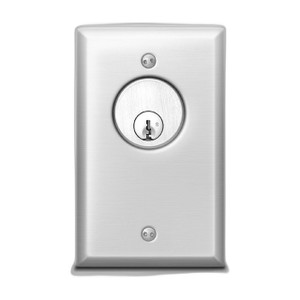
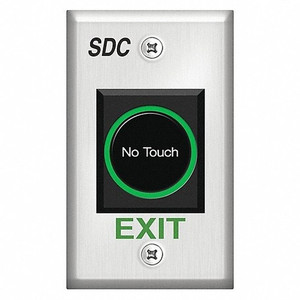
SDC 414NU 410 Series Momentary DPDT Controller
The SDC 414NU is a 24VDC momentary DPDT (Double-Pole Double-Throw) relay controller designed for access control installations requiring independent fail-safe and fail-secure strike control. This unit bridges NFC/13.56MHz proximity readers and keypad input directly to door strikes and electromagnetic locks via a dual-throw relay architecture. Installations ranging from single-door egress to multi-door access arrays benefit from the 414NU's straightforward relay logic and OSDP protocol backbone, which connects seamlessly to Salto, Gallagher, Lenel, and other open-standard access control platforms.
Key Features
- DPDT Relay Configuration: Double-Pole Double-Throw relay enables simultaneous control of two strike circuits or a single strike in fail-safe/fail-secure switchable mode. One common-to-two independent throw path per pole eliminates the need for external relay modules on most deployments.
- OSDP Protocol Support: Open Supervised Device Protocol integration allows credential and relay state reporting back to the access control panel. Multi-reader scenarios with mixed credential types (proximity + keypad) on a single panel are natively supported without additional encoding logic.
- 24VDC Operating Voltage: Standard industrial supply voltage widely available from PoE+ switches and dedicated 24VDC PSUs. Lower risk of voltage sag on long cable runs compared to 12VDC alternatives.
- NFC/13.56MHz Credential Support: Works with ISO/IEC 14443 Type A/B proximity card readers and NFC mobile credential platforms. Keypad reader compatibility adds PIN-code fallback for high-security or badge-loss scenarios.
- Momentary Switching Logic: Relay energizes only during active credential read or keypad input window, then de-energizes automatically. No relay chatter or continuous coil draw — critical for fail-safe strike power budgeting in multi-door arrays.
- Narrow Form-Factor Exit Switch: Large mushroom-button push-to-exit plate (0.5 lbs, narrow mounting footprint) integrates directly into door frame assemblies without bulky cabinet space. ADA-compliant button ergonomics on standard aluminum escutcheon.
- Lifetime Warranty: No expiration on materials and workmanship across the relay and switching logic, reducing spare parts inventory pressure over a 10+ year building lifecycle.
Integration & Deployment Context
The 414NU sits at the credential-to-hardware boundary — it decodes reader output (proximity, keypad, or hybrid) and converts that decision into a momentary relay closure. OSDP communication means the access control panel knows in real time whether the relay fired, whether it held, and whether a strike returned to the locked state. This bidirectional feedback is essential for buildings running interlocked doors or mantraps, where one strike must lock before the next unlocks. Installers familiar with 410 Series hardware will recognize the standard 24VDC rail mount or surface-mount form factor; the 414NU retains backward compatibility with older SDC strike models while supporting newer electronically monitored strikes (mag locks with integrated status feedback).
Fail-safe/fail-secure configurations are the 414NU's primary operational differentiator. In fail-safe mode (common on fire-rated doors and emergency egress routes), a loss of 24VDC power causes the strike to drop — occupants can always push the door open. In fail-secure mode (entrance lobbies, secure server rooms), power loss locks the strike down, preventing unauthorized entry during power disruption. A single 414NU DPDT relay can handle both modes in a paired-strike scenario — one pole controls the fail-safe strike, the second pole controls the fail-secure strike on adjacent doors, all from a single credential reader.
OSDP protocol adoption across the industry means the 414NU integrates with Salto, Gallagher, Lenel OnGuard, Tyco Exacq, Genetec Security Center, and open-OSDP platforms without custom drivers or legacy serial encoding. This eliminates firmware customization and reduces integration labor on mid-to-large campuses. Credential format flexibility — proximity, mobile NFC, keypad PIN, or hybrid multi-factor — gives site managers options to upgrade authentication without replacing the relay hardware.
Real-World Considerations
Strike load capacity (relay contact rating) must be confirmed against your specific electromagnetic lock or solenoid strike amperage at 24VDC. Most standard commercial strikes (Assa Abloy, HES, Securitron) draw 0.5–1.5A momentary — well within standard relay contact limits — but power-intensive mag locks or dual-coil strikes may require external relay buffering. Voltage drop over longer cable runs (100+ feet) can degrade relay response time; 18 AWG shielded cable is recommended for runs over 50 feet, and a localized 24VDC buck converter near the strike is common practice in distributed multi-story installations. The momentary relay design means strike coil heating is minimal, but fail-secure strikes that must hold power continuously (not supported by this unit) require a separate hold relay or a continuous-duty controller. For those applications, SDC's 414S (continuous solenoid controller) is the correct choice.
Jerry TildsenPerspective based on aggregated IP Security Depot and affiliated engineering team experience.
We've deployed the SDC 414NU across hybrid legacy and modern access control environments — from retrofit projects on 1970s hardwired door control to brand-new OSDP-native campuses. What makes the 414NU reliable is its simplicity: a momentary DPDT relay does one job and does it predictably. No firmware quirks, no cryptographic handshakes that can timeout under load. The OSDP protocol support is the modern-facing piece; it gives you audit-trail feedback and integration with current platforms (Salto, Gallagher) without abandoning the relay logic that's worked in buildings for decades. In our experience, the 414NU shines on multi-door egress scenarios where you need one reader controlling two strikes in opposing fail modes — lobby entrance on fail-secure (lock stays engaged on power loss) paired with emergency exit on fail-safe (strike drops if power fails). That dual-pole architecture saves integrators the cost and complexity of external relay modules and reduces Panel I/O points on constrained access control systems. The narrow button form factor is also a real advantage on retrofit jobs where cabinet space is nonexistent; the push-to-exit plate mounts directly into the door frame without any dedicated equipment closet.
Technical Highlights:
- DPDT Relay Architecture: Each pole operates independently — one can drive a fail-safe strike while the second drives a fail-secure lock, all from a single credential decision. Eliminates external relay modules and simplifies wiring on distributed multi-door installations.
- OSDP Protocol Backbone: Real-time relay state reporting and credential logging back to the access control panel. No polling, no latency — panel knows within milliseconds whether the strike energized and whether it de-energized on schedule. Critical for interlocked-door and mantrap scenarios where one strike must unlock only after a previous strike has locked.
- Momentary-Only Switching: Relay energizes only during the active credential window, then drops automatically. Strike coil never overheats, power draw per activation is predictable, and fail-secure strikes that require continuous hold power are explicitly not supported — forcing integrators to choose the correct hardware for the application (prevents miswiring).
- 24VDC Industrial Standard: Voltage widely available from PoE+ switches (Cisco, Arista, Dell, Juniper) and dedicated redundant PSUs. Less susceptible to voltage sag on long cable runs than 12VDC systems, and redundancy (dual PSU with automatic failover) is simpler to achieve at 24VDC.
- Reader Credential Flexibility: NFC/13.56MHz proximity cards, mobile phone NFC, and keypad readers all work natively. No encoder or converter box needed — credential type selection happens at the panel, not at the relay level.
- Lifetime Warranty — No Expiration: Covers relay contacts, coil, and switching logic for the life of the building. Reduces spare parts budgeting and simplifies long-term TCO on multi-building campuses.
Deployment Considerations:
- Strike load at 24VDC must stay below the relay's contact rating (typically 3–5A steady-state, 10A momentary). Standard Assa Abloy and Securitron strikes are fine, but verify amperage on any non-standard or dual-coil electromagnet before installation to avoid contact chatter or premature wear.
- Cable run length over 50 feet requires 18 AWG shielded twisted pair and a voltage check at the strike terminal under load. Voltage drop can slow relay response on very long runs; a local 24VDC buck converter near the strike is standard practice on multi-story or distributed campuses.
- Fail-secure strikes that require continuous power-on hold are not compatible with the 414NU — use SDC 414S (continuous solenoid controller) or a secondary hold relay. Momentary-only logic is intentional and prevents misapplication.
- OSDP setup requires the access control panel to have an OSDP reader port or an OSDP-capable field module (e.g., Salto ACES2 or Gallagher Compact Reader Module). Legacy Wiegand or RS-485 panels cannot natively communicate OSDP — external gateway or controller upgrade is required.
- Egress button (the large mushroom-button push-to-exit plate) is ADA-compliant and suitable for emergency egress on the interior face; confirm local fire code and building-occupancy class requirements for egress button placement and labeling.
The 414NU is the right choice for integrators building hybrid-age access control systems that need relay simplicity with modern protocol integration. If you're retrofitting a 1970s hardwired door control, or if you're deploying a new OSDP campus and want proven, straightforward momentary switching on multi-door fail-safe/fail-secure configurations, the 414NU earns its place. For continuous-duty strike holding or analog (non-OSDP) legacy readers, look at SDC's broader 410 Series lineup in the SDC catalog.