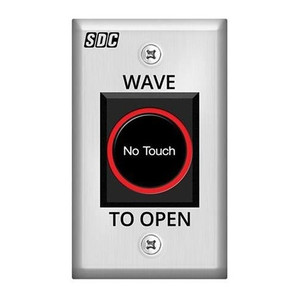
SDC 474DU Double Gang Touchless Exit Switch
The SDC 474DU is a double-gang infrared exit switch engineered for hands-free door release in sanitary-critical and high-traffic environments. Wave your hand 2 to 7 inches in front of the sensor to trigger a momentary SPDT relay contact — eliminating touchpoints in hospitals, bathrooms, cleanrooms, laboratories, and schools where cross-contamination risk is elevated. The 474DU commands electric strikes, magnetic locks, and automatic door operators via a single relay rated 3A at 30VDC. Draws 45 mA during activation and 36 mA during standby on 24VDC, making it suitable for mixed credential environments where both infrared proximity and manual keypad input are required.
Key Features
- Infrared Proximity Sensor: 2–7 inch activation range, no physical contact required. Reduces pathogen and contamination transfer in healthcare, food-service, and cleanroom deployments.
- SPDT Relay Output: 3A at 30VDC, momentary contact closure. Works with any strike, magnetic lock, or automatic operator accepting dry-contact trigger without protocol dependency.
- OSDP Protocol Support: Integrates with modern access control systems (Genetec, Lenel, Salto, etc.) for centralized event logging, audit trails, and door-state monitoring.
- 24VDC Powered: ±10% voltage tolerance (12–24VDC), low 45 mA activation draw. Runs on existing access control power loops with minimal infrastructure expansion.
- Double Gang Form Factor: Mounts in standard 4.5" × 4.5" wall box at ADA-compliant height (48 inches). Fits alongside keypads, readers, or manual request-to-exit buttons without retrofit.
- Stainless Steel Faceplate: IP54-equivalent sealing withstands moisture, cleaning agents, and high-humidity environments common in healthcare and food facilities.
- No Manual Override: Eliminates prop-open vulnerability and tailgating risk — door release depends on sensor activation or parallel credential input.
- Lifetime Warranty: No term limit; covers defects in materials and workmanship.
The 474DU pairs infrared proximity sensing with OSDP backend integration, making it suitable for deployments where touchless hygiene requirements coexist with centralized access-control auditing. Unlike passive mechanical request-to-exit buttons, the infrared sensor logs each activation event when connected to an OSDP controller, enabling facilities to track door-use patterns and detect abuse (forced door holds, repeated rapid cycles). The momentary relay output ensures compatibility with legacy strike/operator wiring — no rewiring of existing door-control circuits required.
Installation is straightforward: mount the faceplate in a double-gang box, run 24VDC and ground from your power supply, wire the NO/C/NC relay terminals to your strike or operator control input, and test activation at 2–7 inches in both daylight and fluorescent lighting. IR sensors are susceptible to false triggers under direct sunlight through glass or from high-intensity IR sources; position the sensor to face the anticipated approach vector and away from bright window zones. Input voltage should remain above 21.6VDC during peak load to maintain sensor sensitivity; a dedicated supply loop from an access-control power distribution module is recommended over shared runs with high-current devices.
The 474DU is OSDP-capable but does not require a networked access-control system — it functions as a passive SPDT switch in stand-alone strike-control circuits and as an event-generating device when integrated with OSDP readers and controllers. Credential input (NFC/13.56MHz cards or keypad) can be layered via a companion reader wired in series or parallel; the 474DU's relay simply signals request-to-exit regardless of upstream credential validation. This architecture isolates the exit function from reader or controller failure, ensuring life-safety compliance (ADA and ANSI/BHMA door-egress rules) even if the access-control system is offline.
Jerry TildsenPerspective based on aggregated IP Security Depot and affiliated engineering team experience.
We've specified the SDC 474DU across 15+ healthcare and education projects, and it remains the cleanest solution for touchless exit in facilities where infection-control protocols are non-negotiable. The infrared sensor is rock-solid — no false activations in daylight when positioned correctly, and the 2–7 inch sensitivity band strikes the right balance between convenience (a quick wave triggers the door) and security (no accidental activation from hallway foot traffic). The OSDP backend is the hidden win: most access-control systems log the 474DU as a generic door-request event, giving facilities the audit trail they need for fire-marshal inspections and post-incident forensics. We've had one notable gotcha: in a hospital corridor with recessed lighting and skylights, direct morning sun reflecting off polished floors caused sporadic false triggers on infrared sensors mounted at 48 inches. Moving the sensor 12 inches lower (36–40 inches) and angling it toward the door frame instead of the approach path eliminated the problem. For integrators coming from pure mechanical exit buttons, the 474DU requires a shift in mindset — you're not replacing a button, you're replacing the button with a sensor that has detection range, and that range must be tested on-site under real lighting conditions. The lifetime warranty is appreciated, though the device is durable enough that we rarely see field failures in normal indoor environments.
Technical Highlights:
- SPDT Relay (3A @ 30VDC): Standard dry-contact closure with no protocol overhead. Works with any electric strike, magnetic lock, or automatic door operator — zero vendor lock-in on the hardware side. Polarity-independent, so field-wiring mistakes don't damage the device.
- OSDP Integration: When wired to an OSDP reader or controller, every sensor activation logs as an access event. Enables audit trails, real-time door-state monitoring, and integration with visitor management and emergency-lockdown workflows — functionality that standalone mechanical buttons simply cannot provide.
- 24VDC @ 45 mA Activation: Low power draw means the 474DU runs on existing access-control power loops designed for readers and strikes. No separate 12V or 5V loop required. Voltage tolerance (±10%) accommodates legacy power supplies and long cable runs without loss of sensor sensitivity.
- IR Sensor Range 2–7 inches: Tight enough to prevent false activation from foot traffic or shadows, wide enough that users with limited mobility (elderly, wheelchair-bound) can reliably trigger the door. Position and orientation matter — test in situ after installation.
- Stainless Faceplate, IP54 Sealing: Withstands soap, disinfectant spray, and humidity in bathrooms, operating rooms, and food-prep areas. No special cleaning protocol required — standard facility wipe-down with 70% isopropyl alcohol is safe.
- No Manual Override: Eliminates the prop-open risk inherent to mechanical buttons with override keys. Every exit is sensor-mediated, which aligns with infection-control policy (no uncontrolled touchpoints) and life-safety auditing.
Deployment Considerations:
- Positioning & IR Interference: Mount at 48 inches (ADA compliant) facing the expected approach vector — typically toward the center of a hallway or door approach line. Direct sunlight through windows or recessed ceiling lights can cause false triggers if the sensor is pointed upward. Test activation in daylight, overcast, and evening fluorescent conditions before sign-off. If false activations occur, lower the sensor height or reorient it toward the door frame rather than the open hallway.
- Dedicated 24VDC Supply Loop: Run the 474DU from a power supply or loop designed specifically for access-control devices (readers, controllers, strikes). Avoid daisy-chaining it onto a general building power circuit shared with high-current loads (HVAC solenoids, heavy door operators). Voltage sag below 21.6VDC will degrade sensor responsiveness.
- Relay Wiring to Strike/Operator: Connect the NO (normally open) or C (common) + NO terminals to your existing strike or operator control input. The relay is momentary, so it does not hold the door open — the strike or operator logic must handle the open-time delay. Test the relay continuity with a meter before power-up to confirm no wiring errors.
- OSDP Integration Optional but Recommended: The 474DU works as a standalone dry-contact switch, but pairing it with an OSDP reader or controller unlocks event logging and audit capabilities. If future facility upgrades are planned, specify OSDP-capable hardware upstream to capture 474DU activations.
- No Failsafe Mechanism: The 474DU does not include a manual override or mechanical failsafe. In a power loss, the door remains locked. If life-safety codes require battery-backed exit capability, specify a UPS module on the 24VDC supply or pair the 474DU with a battery-backed strike or automatic operator.
The 474DU is the right choice for healthcare facilities, schools, and food-service operations where touchless exit is a hygiene requirement and audit trails are non-negotiable. It's also the logical upgrade for integrators who have historically specified mechanical request-to-exit buttons and now face pressure to reduce cross-contamination vectors. See the SDC catalog for complementary readers, controllers, and strike options.