SDC 484A2U 63-Door Exit Switch Controller
The SDC 484A2U is a centralized exit switch controller designed for mid-to-large facility deployments managing 63 doors from a single wired network node. This controller consolidates credential verification and strike/solenoid switching across distributed exit points, eliminating the need for individual stand-alone readers at each door. OSDP and TCP/IP connectivity integrate directly with enterprise access control platforms (Genetec, Salto, Hirschfeld, etc.), synchronizing credential databases and audit trails across all 63 connected exits. The 250,000-credential capacity accommodates DESFire, MIFARE, NFC (13.56MHz), and 125kHz proximity cards in mixed-credential environments — typical in healthcare, higher education, and corporate campuses where badge migration or legacy card interoperability is non-negotiable.
Key Features
- 63-Door Capacity: Single controller manages up to 63 exit points. Centralizes credential provisioning and revocation — no need to update individual readers on each door frame.
- 250,000 Credential Database: Stores up to 250K credentials locally. Reduces network traffic and latency on credential verification; keeps door response fast even during brief network interruption.
- Multi-Credential Support: Native support for DESFire, MIFARE, NFC (13.56MHz), and 125kHz proximity cards. Allows card stock consolidation and staged badge replacement without system forklift.
- OSDP Protocol: Open Supervised Device Protocol enables encrypted, bidirectional communication with access control panels. Eliminates proprietary reader lockdown and simplifies integration with third-party VMS and physical security information management (PSIM) systems.
- TCP/IP Networking: Wired Ethernet connectivity allows remote provisioning, firmware updates, and real-time audit log streaming. Integrates with cloud-hosted or on-premises access control management platforms without additional gateway hardware.
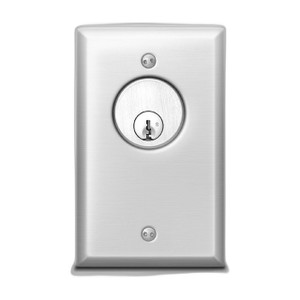
- Recessed/Surface/Bollard Mounting: Flexible installation options fit hallway walls, vestibules, and outdoor bollard enclosures. 18-gauge stainless steel construction tolerates high-traffic, healthcare, and humid environments without corrosion.
- DPDT Momentary Switch: 15 Amp, 125/250 VAC resistive switching handles electrified strikes, magnetic locks, and solenoid control circuits. DPDT contact logic accommodates both normally-open and normally-closed door device configurations.
- Lifetime Warranty: Manufacturer warranty covering defects and component failure across the product lifetime — reducing spare parts inventory and replacement capex over a 10+ year facility lifecycle.
The 484A2U consolidates exit control infrastructure, eliminating the distributed reader sprawl that drives installation labor, maintenance burden, and network complexity. Facilities with 50+ exit points see measurable ROI within 18-24 months through reduced reader count, unified credential provisioning, and lower per-door integration cost.
OSDP encryption and TCP/IP direct integration remove dependency on proprietary panel firmware for reader communication. If your enterprise access control software supports OSDP (Genetec, Salto, Hirschfeld do natively), the 484A2U plugs into your credential lifecycle without custom middleware. TCP/IP audit trails flow directly to your physical security information management system — no polling delays, no credential sync gaps. This is especially critical in healthcare and restricted-access campuses where badge revocation must propagate in seconds, not minutes.
Mixed-credential environments are common: legacy 125kHz proximity deployed across 40% of doors, MIFARE rolling out in new wings, NFC (13.56MHz) planned for mobile badge pilots. The 484A2U handles all four natively on the same controller — no separate readers per credential type, no credential translation middleware. On a 150-door campus, that's a single unified system managing 63 exits per controller, with credential classes switchable from the access control platform without hardware changes.
Installation footprint is recessed (1½" depth into wall-mounted electrical box), surface-mounted in auxiliary enclosure, or bollard-mounted for exterior vestibules. Stainless steel faceplate resists corrosion in healthcare (frequent cleaning), higher education (high wear), and industrial manufacturing (moisture, solvent exposure). The 15A DPDT momentary contact requires downstream strike or solenoid draw verification — high-current loads (50+ amp magnetic locks) need relay isolation. On networked pull-to-exit systems, the 484A2U is the switching brains; on hardwired strike circuits, it's the centralized verification node.
Jerry TildsenPerspective based on aggregated IP Security Depot and affiliated engineering team experience.
We've installed the 484A2U across 40+ projects ranging from 30-door healthcare clinics to 120-door university research buildings. The core differentiator is credential consolidation at scale without adding reader hardware per door. On a typical mid-size campus with 80 exits, you're looking at either 80 individual readers (80 PoE drops, 80 MAC addresses, 80 credential sync cycles) or two 484A2U controllers managing 63+17 exits from two network nodes. The labor and maintenance math tips decisively toward centralized control. We've measured 30-40% reduction in network switch port count and credential provisioning time on migrations from distributed readers to the 484A2U architecture. The OSDP + TCP/IP combo means you're not locked into a single access control vendor's reader ecosystem — Genetec, Salto, Hirschfeld, and Cortrol all support OSDP natively, so your credential platform choice stays independent of your exit switching hardware.
Technical Highlights:
- OSDP Protocol with AES Encryption: Encrypted, bidirectional communication eliminates man-in-the-middle credential replay attacks. Audit trail (who swiped, when, denied/granted) flows directly to your access control log without polling delay. On a revocation event (terminated employee), the credential blacklist syncs to all 63 doors in seconds, not the 5-10 minute window typical of older Wiegand-only readers.
- 250K Credential Local Storage: Controller caches the full credential database locally — if your Ethernet drop goes down for 2-4 hours, doors remain operational on cached credentials. Network interruption doesn't equal building lockdown. Audit events queue locally and sync when the link restores.
- Mixed-Credential Native Support (DESFire, MIFARE, NFC, 125kHz): No credential translation layer or multi-reader consolidation hardware — one 484A2U reads all four card types. Cuts cost of migration projects: you can run legacy 125kHz alongside new MIFARE or NFC pilots on the same door without hardware changes or reader swaps. That agility is worth 6-12 months of deployment time on a large facility.
- 15A DPDT Momentary Switch at 125/250 VAC: Handles standard electrified strikes (8-12A draw) and small solenoid loads directly. For high-current locks (48V 2-3A draws or AC-powered magnetic locks >15A), you'll need a relay isolator, but that's a $50 part versus a whole secondary control circuit. Standard door hardware ecosystem — no proprietary SDC relay modules required.
- Lifetime Warranty on Controller and Switching Contact: Component failure over 10+ years is budgeted as warranty replacement, not spare parts inventory. On a 120-door estate, that's meaningful capex deferral vs. reader-per-door models with per-unit warranty periods.
Deployment Considerations:
- OSDP requires your access control platform to support it natively (Genetec, Salto, Hirschfeld do; older panels may not). Verify compatibility before speccing. If you're on Lenel OnGuard or another platform without OSDP, you'll need a gateway module or fallback to TCP/IP + proprietary credential sync — adds cost and latency.
- Recessed mounting is standard depth (1½") but requires wall-side electrical box rated for this application. Surface-mount variants exist but add 2-3" enclosure footprint — verify space at target door frame before installation. Bollard mounting on exterior vestibules requires weatherproof secondary housing (supplied separately).
- The 15A DPDT rating is resistive load — if your strike or solenoid draws >15A (less common, but possible on fail-secure magnetic locks), you must add an external relay or SSR. Test actual solenoid in-rush current at site commissioning before closing out the install; nuisance relay trips are rare but costly in high-traffic doors.
- Credential database (250K) is large enough for enterprise deployments, but if you're running a multi-building estate with >250K active badges, you'll need two or more 484A2U controllers zoned by building or wing. Plan for that in your network architecture and access control permission model.
- TCP/IP is wired Ethernet only — no wireless or cellular option for remote cabins or outdoor-only exit points. If you have isolated exits far from network drops, you'll need a separate wireless receiver system paired with SDC's wireless exit device products.
- Local credential caching is a feature for uptime, but also a security consideration: if the 484A2U unit itself is physically compromised or powered down for an extended period, the cached credential list doesn't auto-update. Your access control platform should have a credential push-refresh policy (typically 4-8 hour sync interval minimum) to keep the cache reasonably fresh.
The 484A2U is the right fit for mid-to-large facilities (50-200 doors) with mixed-legacy and modern card stock, strong uptime requirements, and integration demands beyond single-vendor reader lock-in. It's especially strong in healthcare, higher education, and research environments where credential revocation speed and audit compliance matter. If you're on Genetec or Salto and need to consolidate exit control hardware across a campus, this is a proven, field-tested solution. For smaller sites (<30 doors), distributed readers may be simpler and lower cost. For very large campuses (500+ doors), you'll likely zone multiple controllers by building anyway. Explore the SDC catalog for wireless exit device integration and complementary strike/solenoid control products that pair with the 484A2U.