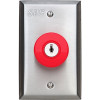
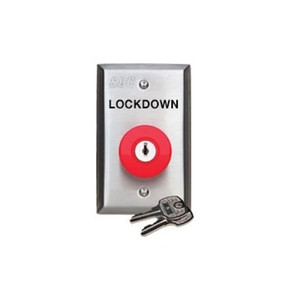
SDC 432KUR Mushroom Exit Switch Controller
The SDC 432KUR is a 1-1/2" mushroom exit switch controller purpose-built for secure door access applications where mixed-credential authentication matters. This device bridges proximity and keypad readers with NFC/13.56MHz support, enabling facilities to enforce multiple credential types — cards, keyfobs, mobile wallets — across the same exit control zone without panel-level logic complexity.
Key Features
- OSDP Protocol Support: Communicates via Open Supervised Device Protocol to OSDP-compliant access control panels. This matters because OSDP isolates reader traffic from IP network broadcast, reducing credential interception risk compared to Wiegand or RS-485. Direct panel integration means faster event throughput and lower latency on door release commands.
- NFC/13.56MHz Credential Reading: Handles proximity cards, Mifare-based keyfobs, and NFC-enabled mobile devices. Useful in mixed-BYOD deployments where some users carry corporate badges and others authenticate via smartphone — one reader handles both without substitution.
- Keypad Input Support: Accepts numeric or alphanumeric PIN entry alongside contactless credentials. Combines something-you-have (card/phone) with something-you-know (PIN) in a single device — ideal for high-security exit points or facility egress where dual authentication is mandated.
- 30VDC Operating Voltage: Powered directly from standard institutional access control power supplies. Eliminates need for auxiliary 12VDC supplies or PoE injection on access control circuits — simplifies cabinet wiring and reduces redundant power feeds.
- Mushroom Button Form Factor: 1-1/2" mushroom switch design fits standard US and international exit device cutouts. Emergency egress compliance built into the physical design — no additional certification work on the door assembly itself.
- Mixed-Credential Zone Support: Allows the same exit controller to enforce different authentication rules per credential type — e.g., badge-only for routine departure, PIN-required for after-hours. Configurable at the panel, not at the reader hardware level.
Integration & Compatibility
The 432KUR operates as an OSDP slave device, requiring an OSDP-capable access control panel (Lenel, Salto, Genetec, or equivalent backbone). It does not function as a standalone reader — panel integration is mandatory. Compatible with any facility already running OSDP door controllers, and it pairs well with multi-door zone deployments where centralized credential policy enforcement is preferred over distributed reader logic.
NFC credential compatibility includes standard ISO 14443 Type A and Type B cards, Mifare Classic/Plus, and NTAG variants. If your environment uses proprietary or encrypted credential systems (e.g., Salto or Kaba), confirm format compatibility with your panel vendor before deployment.
When considering access control door controllers, evaluate whether this single-reader approach meets your redundancy and failover requirements. Some high-traffic facilities need dual readers (card + PIN simultaneously) or backup readers on the same door zone — this 1-1/2" device handles single-point egress control, not load-balanced multi-reader scenarios.
Deployment Considerations
Mount the 432KUR in an accessible egress location — operator height, clear of obstructions. OSDP cable runs to the access control panel should be shielded if run alongside high-current power lines (motor controls, lock solenoids). Verify panel-side credential database includes any NFC cards or fobs you intend to use; unregistered credentials will trigger denial logs but not bypass the reader.
Frequently Asked Questions
Q: Does the 432KUR work with mobile wallet tap-to-open functionality?
A: If your panel and credential system support NFC mobile credentials (Apple Wallet, Google Pay with access control enrollment), the 432KUR can read them. This depends on your panel's NFC database and credential issuance workflow — not a reader limitation.
Q: What happens if the OSDP panel loses power?
A: The 432KUR itself remains powered (assuming the 30VDC supply is backed up), but it cannot communicate with the panel. Depending on your panel configuration, the door may fail-secure or fail-open based on your programmed failsafe state. Verify your panel's offline behavior before deployment.
Q: Can I use the 432KUR for entry control, or is it exit-only?
A: The form factor and mounting are optimized for emergency egress (exit application), but the reader logic itself is bidirectional. Entry-side use is possible if integrated into an entry vestibule or stairwell controller — confirm with your panel integrator that your layout supports credential reading in both directions.
Q: How do I reset a lost or compromised NFC credential?
A: Credential revocation happens at the panel level, not at the reader. Deactivate the credential in your access control database, and the 432KUR will deny it on the next read.
Q: Is the 432KUR NDAA-compliant or subject to supply chain restrictions?
A: No supply chain or NDAA compliance information is published for this model in available documentation. If your deployment requires NDAA Section 889 compliance, confirm with the manufacturer or your integrator before procurement.
Q: What's the maximum read distance for NFC credentials?
A: NFC proximity is typically 4–10 cm (1.5–4 inches), depending on card type and antenna design. Keypad entry has no range limit — it's contact-based (physical button press).
Ted PerryPerspective based on aggregated IP Security Depot and affiliated engineering team experience.
The SDC 432KUR addresses a specific integration gap: facilities that need to enforce mixed-credential exit control without adding reader intelligence to the door panel itself. The 30VDC direct-powered design means you're not burning PoE budget or running auxiliary power feeds — the device draws from your existing access control power supply, which simplifies installation on retrofit projects where panel capacity is already tight.
Technical Highlights:
- OSDP Protocol: Direct encrypted panel communication reduces the attack surface compared to Wiegand or RS-485 readers. Event latency is lower because credential decisions stay between panel and reader — no network broadcast of card IDs.
- NFC 13.56MHz + Keypad Combo: Single-unit credential acceptance means less hardware per door zone. You avoid the cost and wiring complexity of bolt-on PIN pads or separate card readers.
- 30VDC Operating Voltage: Standard access control supply voltage. If you're already running 30VDC to locks and strike plates, the 432KUR taps that same rail — no additional PSU investment.
Deployment Considerations:
- This is not a standalone reader. OSDP panel integration is non-negotiable — if your facility runs older Wiegand-only or RS-485 panels, the 432KUR will not function without panel upgrade.
- NFC credential format must match your panel's database. Mifare-based cards are widely supported, but proprietary encryption (Salto, Kaba HID) requires explicit codec support on the panel side — verify before ordering.
- The mushroom button form factor assumes a standard US or international exit device cutout. Non-standard door hardware may require fabrication or repositioning of the reader mounting plate.
Deploy the 432KUR in facilities where you're consolidating reader types across exit zones and centralized credential policy enforcement is a priority — warehouses, data centers, or healthcare campuses with standardized door hardware and modern OSDP panel infrastructure. If your facility has mixed legacy panels (some OSDP, some Wiegand), this reader is incompatible with the non-OSDP devices and will require a separate reader strategy for those zones.