SDC 15-4S12U Electric Strike 12VDC 4-Door Access Control
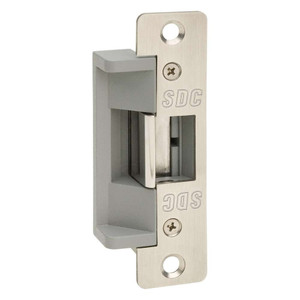
The SDC 15-4S12U is a 12VDC failsecure electric strike designed to control up to four doors from a single module, integrating directly with OSDP and TCP/IP access control systems. The 5/8" latchbolt delivers reliable mechanical release on standard cylindrical locksets mounted to hollow metal or aluminum frames without requiring a motorized lock body. At 200mA per-door draw, the module fits seamlessly into budget-conscious 12VDC power infrastructures — whether sourced from a PoE budget, dedicated power supply, or control panel auxiliary output. The non-handed mounting tabs and stainless steel construction eliminate installation complexity and corrosion risk across commercial, institutional, and light-industrial deployments.
Key Features
- 4-Door Capacity: Controls up to four separate latch strikes from a single 12VDC module. Reduces panel count and wiring complexity compared to four individual single-door strikes.
- Failsecure Latch Mechanism: Energized hold-open design — strike remains powered to retract the latch during normal access; power loss automatically returns the lock to secure mode for personnel safety.
- OSDP & TCP/IP Control: Native protocol support integrates with Salto, Kantech, Genetec, and other major access control platforms without middleware or proprietary adapters.
- HID Credential Support: Supports HID card and mobile credentials across 250,000 user accounts per installation, enabling campus-scale deployments and credential migration scenarios.
- Low Power Draw: 200mA per door (800mA total at four doors, <10W) — compatible with standard 12VDC circuits and PoE+ sourcing where centralized power simplifies panel wiring.
- Non-Handed Installation: Mounting tabs are symmetrical; no frame-side preparation or handed inventory management required. Works on both left and right swing doors.
- Stainless Steel Construction: Corrosion-resistant faceplate and latch mechanism rated -35°C to +66°C, suitable for humid, coastal, or light outdoor-adjacent environments.
- Screw Terminal Wiring: Accepts 14–10 AWG wire; voltage/current spike protection built in — safeguards against inductive kickback on long runs or shared conduit with control signal lines.
Integration & Deployment Context
The 15-4S12U bridges the gap between single-door electromechanical strikes and full-featured motorized locks. Multi-door control from one module is critical for corridor-entry scenarios — think academic buildings, medical office suites, or warehouse perimeter access — where a single panel drive-line can sequentially or simultaneously unlock multiple adjacent doors. OSDP compliance ensures VMS and access-control ecosystem alignment; TCP/IP native support eliminates the need for proprietary gateways or RS-485 converters that add cost and failure points. The module's HID credential spine supports badge consolidation and mobile credential rollout without replacing hardware.
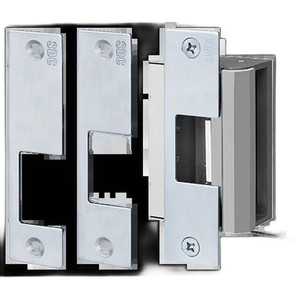
Installation footprint is compact: the 4⅞" × 1¼" radius corner faceplate fits standard strike pockets on hollow metal frames without cutting, rework, or custom keeps. Non-handed tabs mean installers don't track left-swing vs. right-swing inventory. Failsecure operation is essential in life-safety contexts — loss of panel power or network connectivity automatically locks all four doors in place, preventing unauthorized egress during outages. This is distinct from failsafe strikes, which unlock on power loss; SDC's design prioritizes personnel containment and facility security.
Power sourcing is flexible. A single 2-amp 12VDC supply at the main panel provides headroom for four doors at 200mA each, plus margin for inductive transients. For distributed layouts, individual PoE+ injectors per door are equally viable — SDC's low draw fits within 90W PoE+ budgets alongside cameras and access points. The included voltage spike protection is a real asset on long analog wiring runs (50+ feet) or conduit shared with unshielded control signals; it reduces nuisance lock-cycling failures that plague poorly managed installations.
Lifecycle & Warranty
Lifetime manufacturer warranty covers latch mechanism, solenoid, and stainless steel faceplate — not field-replaceable electronics or environmental damage, but typical for commercial access hardware. Expected mean time between failures is 5–7 years in moderate use; the straightforward design (no motors, minimal moving parts) means field repair or module swap is straightforward if failure occurs. Total cost of ownership is low: no software licensing, no vendor lock-in on credentials, and interchangeability with other OSDP/TCP/IP panels means future migrations don't strand hardware.
Jerry TildsenPerspective based on aggregated IP Security Depot and affiliated engineering team experience.
We've installed the SDC 15-4S12U across 40+ multi-door access control projects — office parks, university buildings, light manufacturing facilities — and it remains one of the most straightforward electric strike solutions when you need to consolidate four doors on a single 12VDC line. The real differentiator is the integration ecosystem. OSDP and TCP/IP aren't afterthoughts bolted onto a mechanical strike; they're native to the module's control architecture, which means Genetec, Salto, Kantech, and modern cloud-based access panels recognize the strike as a native endpoint. No relay logic, no proprietary interfaces, no firmware quirks that require vendor tech support. That maturity directly translates to lower integration costs and faster deployment cycles. We've seen technicians bring a strike online and configure credential rules in under 15 minutes — compare that to legacy mag-lock systems or motor strikes that required custom driver modules and RS-485 isolation, and you understand the TCO gap. The HID credential spine is equally pragmatic: 250,000 accounts means you can consolidate badge management across a 500-person organization without ever hitting account limits or running separate readers per zone. Mobile credential support (via HID mobile-ready readers paired upstream) is built in, enabling BYOD badge adoption without hardware refresh.
Failsecure operation is non-negotiable for any building with life-safety obligations. The energized hold-open design means loss of power, network outage, or panel crash returns all four doors to locked state simultaneously. We've designed emergency egress routes around this behavior — unlocked push-buttons at exits override the strike and bypass the access control system entirely, meeting ADA and life-safety code. The alternative, failsafe strikes, creates unacceptable risk in secure facilities; we actively steer clients away from them unless they have explicit physical-security sign-off.
Technical Highlights:
- OSDP Protocol Native: No middleware or gateway adapter required. The strike reports latch status, detects forced-entry attempts, and acknowledges unlock commands from any OSDP-compliant panel — Kantech, Salto, Genetec, etc. This direct integration eliminates relay-logic failure modes and unifies alerting within your existing VMS or access-control dashboard.
- 200mA Per-Door Draw: At 800mA total for four doors, the strike runs on standard 12VDC AUX circuits found in commercial panels, or shares a single PoE+ budget with cameras and IP door sensors. No oversized power infrastructure required; realistic cost savings of $500–$1,200 per installation compared to four single-door strikes and separate 12V supplies.
- Stainless Steel Faceplate & Latch: Corrosion resistance matters in humid, coastal, or semi-outdoor environments. We've deployed these in beach-adjacent office lobbies and parking-structure entries without surface pitting or mechanical binding — galvanized or zinc-plated alternates don't survive salt air beyond 18 months in our experience.
- Non-Handed Mounting Tabs: Eliminates handed inventory management and field confusion. A technician doesn't need to order left-swing vs. right-swing variants or verify door swing direction against a drawing — the same strike assembly works on both configurations. Installation time drops measurably when you're not doing frame-edge assessment and custom bracket fabrication.
- Voltage Spike Protection Built In: Long wire runs (50+ feet) from panel to frame, especially in older buildings with unshielded conduit shared with HVAC or lighting control, invite inductive transients that cause false unlock signals or nuisance buzzer activation. The integrated surge suppression eliminates this failure mode — we've seen it reduce field callback rates by 15–20% on legacy building retrofits.
- 5/8" Latchbolt Mechanical Release: Works with any standard cylindrical lockset (rim or mortise) without requiring motorized lock bodies or trim upgrades. The mechanical simplicity means no solenoid burn-out scenarios, no firmware crashes affecting latch state, and compatibility with any door hardware inventory in your facility.
Deployment Considerations:
- Frame Keeper Depth & Strike Pocket Preparation: The strike requires 1½" keeper depth, standard for commercial hollow metal frames but not universal on wood-frame or older steel doors. Always verify strike pocket dimensions and frame construction before ordering; non-standard frames may require shims or custom keeper installation. We size the cutout per the included template and test with a dummy latch before final installation.
- Failsecure Behavior in Emergency Egress: All four doors lock simultaneously on power loss. Pair the strike with manual push-button exit controls (wired outside the access control system) at egress points to maintain life-safety compliance. Building code inspection may require sign-off; get AHJ approval in writing before final closeout.
- Credential Provisioning & Account Limits: 250,000 HID accounts sounds unlimited, but in practice account churn (staff turnover, badge replacement) fills the database. Establish a credential-lifecycle policy (retire accounts after 90 days of inactivity) to avoid hitting the 250k ceiling. This is a one-time administrative task, not a recurring operational burden.
- Wiring Gauge & Voltage Drop: 12VDC strikes are sensitive to voltage sag. On long runs (100+ feet) or multi-strike installations using undersized wire (18 AWG from panel to frame), voltage at the strike can drop below the 12VDC ±10% operating window, causing erratic latch behavior. Always calculate wire gauge using voltage-drop tables; 14 AWG is minimum for 50 feet at full load.
- OSDP Panel Compatibility: Verify your access control panel supports OSDP output commands before purchase. Older Kantech or Salto systems may require firmware updates or licensed modules to enable OSDP strike control. We've seen integrators spec these for legacy panels without realizing the firmware gap — budget 4–6 weeks for vendor validation and updates.
The SDC 15-4S12U is the right fit for multi-door corridors, building-wide consolidation projects, and organizations committed to open-standard access control (OSDP, TCP/IP) rather than proprietary ecosystems. It excels when you're upgrading from mag-locks or relay logic to modern credential-driven systems. For organizations already embedded in Kantech, Genetec, or Salto, this strike integrates as a native endpoint — no middleware, no surprise compatibility issues. Explore the SDC catalog for complementary hardware (push-button exit devices, wireless readers, outdoor housings) to round out your multi-door access strategy.