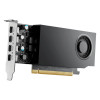
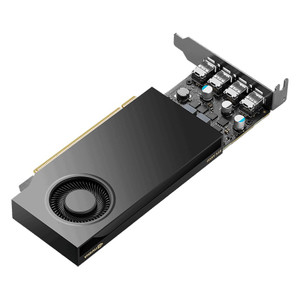
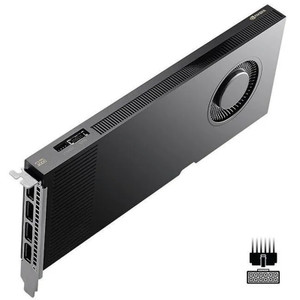
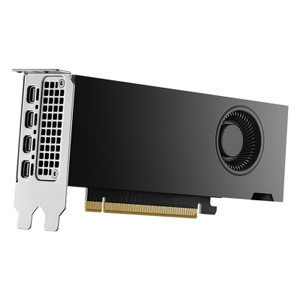
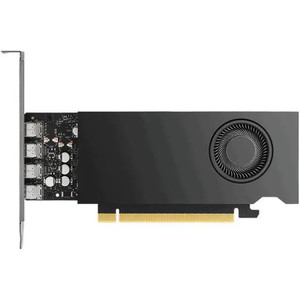
PNY VCNRTXA1000ATX-B NVIDIA RTX A1000 8GB GPU Accelerator
Overview
The PNY VCNRTXA1000ATX-B is a single-slot GPU accelerator built on NVIDIA's Ampere architecture. It delivers 2,304 CUDA cores and 8GB of GDDR6 memory across a 128-bit interface with 192GB/s bandwidth — purpose-built for video encoding, AI inference, and real-time analytics in surveillance and edge compute environments. At just 50W power draw and PCIe 4.0 x8 connectivity, it fits into standard rackmount servers without dedicated power connectors or extensive cooling infrastructure.
Key Features
- 2,304 CUDA cores with 72 Tensor cores: Delivers 6.7 TFLOPS single-precision and 53.8 TFLOPS FP16 tensor throughput — enough to handle real-time H.265 encoding across 16+ concurrent video streams or accelerate object detection inference on live camera feeds without bottlenecking your CPU.
- 8GB GDDR6 with 192GB/s bandwidth: Sufficient for storing intermediate inference results and encoding state without constant host memory round-trips. The 128-bit interface keeps latency predictable in surveillance pipelines where frame delivery timing matters.
- Dual video decode engines + single encode engine: Transcodes incoming H.264 or H.265 streams in hardware while simultaneously encoding outbound feeds — standard for NVR deployments where you ingest compressed camera streams and re-encode for archive or multi-bitrate distribution.
- 50W power envelope with PCIe 4.0 x8: Draws no external power connectors and fits in a single slot, so existing server infrastructure handles it without PSU upgrades or thermal redesign. PCIe 4.0 guarantees no bandwidth bottleneck even on older Gen3-capable motherboards.
- 4x Mini DisplayPort 1.4a outputs with 4K120 capability: Each display can run 4096×2160 @ 120Hz independently, useful for multi-monitor SOC dashboards or distributed analytics workstations where you need simultaneous live grid views.
- CUDA 11.6, OpenGL 4.66, Vulkan 1.36 support: Works with industry video codec libraries (FFmpeg with NVENC/NVDEC), TensorRT for inference, and DirectCompute workloads — eliminating proprietary SDK lock-in for surveillance software stacks.
Integration & Compatibility
The VCNRTXA1000ATX-B integrates via standard PCIe slots in x86 servers running Windows or Linux. NVIDIA driver 551.57 (and later) provides hardware video encode/decode support in FFmpeg, GStreamer, and transcoding frameworks. Real-time object detection pipelines using TensorRT or ONNX Runtime map directly to the Tensor cores — no recompilation needed. Surveillance VMS platforms using ONVIF or native RTSP can offload video processing to this GPU through standard acceleration APIs.
What's in the Box
No package contents data available in evidence. Contact the manufacturer directly for details on included adapters, mounting hardware, or documentation.
Frequently Asked Questions
Q: What's the maximum number of video streams the VCNRTXA1000ATX-B can encode simultaneously?
A: Hardware throughput depends on codec, resolution, and bitrate. At 1080p 30 fps H.265, expect 16–20 concurrent encodes. 4K streams reduce this to 4–6. Your CPU must feed frames faster than the GPU encodes them, so actual stream count also depends on host CPU and PCI-e lane saturation.
Q: Does the VCNRTXA1000ATX-B require external power connectors?
A: No. It draws a maximum of 50W, powered entirely through the PCIe slot. No 6-pin or 8-pin connectors needed — install it in any standard x86 PCIe x8 or x16 slot and it operates immediately.
Q: Is the VCNRTXA1000ATX-B NDAA Section 889 compliant?
A: No NDAA compliance data is available for this model in manufacturer documentation. If NDAA Section 889 certification is required for your procurement, verify directly with PNY or your organization's compliance team.
Q: Can this GPU accelerate both H.264 and H.265 decoding?
A: Yes. The dual decode engines support both H.264 and H.265 bitstreams simultaneously, allowing ingest of mixed-codec camera feeds without CPU overhead. H.264 decode offload alone typically frees 20–30% of CPU on a 16-core server.
Q: What operating systems are supported?
A: Windows 11 Enterprise x64 is verified with NVIDIA driver 551.57. Linux support (Ubuntu, CentOS, RHEL) is standard via the same driver series. Confirm driver availability for your specific OS distribution before purchase.
The VCNRTXA1000ATX-B is a quiet operator in surveillance architectures where you're running a GPU-accelerated encoding pipeline on a single or dual-socket x86 box. The 50W footprint and zero external power requirement mean you can retrofit this into existing server hardware without PSU headroom concerns — a real advantage in retrofit deployments where you can't redesign the power delivery. The dual decode engines handle something most integrators overlook: simultaneous decode of H.264 legacy camera streams while encoding to H.265 archive format, which is exactly what happens in warehouses running mixed-generation camera estates.
Technical Highlights:
- 2,304 CUDA cores + 72 Tensor cores: 6.7 TFLOPS single-precision and 53.8 TFLOPS FP16 tensor throughput means real-time inference on 2–4 concurrent object-detection models (person, vehicle, intrusion) without the CPU becoming the bottleneck — critical in SOC deployments where you're correlating events across 20+ camera feeds.
- Dual decode + single encode engines: Offloads H.264 ingest and H.265 re-encoding to hardware, freeing your CPU entirely for VMS indexing, alert logic, and database writes — a 20–30% CPU utilization improvement on a baseline 16-core server running constant transcoding.
- 192GB/s memory bandwidth on 128-bit interface: Keeps intermediate AI inference tensors and video frame buffers local to the GPU, avoiding host memory round-trips that create latency spikes in live detection pipelines. Matters less in archive encoding, matters greatly in real-time SOC analytics.
Deployment Considerations:
- Motherboard must have a PCIe x8 or x16 slot wired to the CPU (not the PCH/southbridge), otherwise you'll see PCIe protocol violations and dropped frames. Check BIOS before deployment — not all x16 slots on dual-socket systems hit CPU lanes.
- NVIDIA driver 551.57 is verified; older driver stacks don't have full NVENC/NVDEC support for modern H.265 profiles. Plan for driver management and test in your VMS environment before full rollout.
Right for: enterprise SOCs and large warehouse automation operations consolidating 20–50 camera streams on a single NVR appliance where you need sub-second inference latency and archival encoding headroom. Not for: edge encoder boxes or sub-1U appliances where form factor or power density is the constraint.