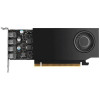
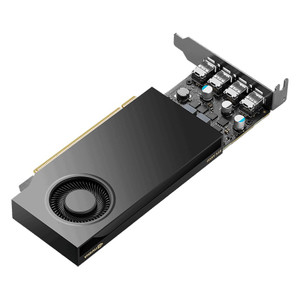
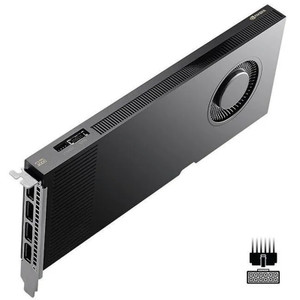
PNY VCNRTXA400ATX-B NVIDIA RTX A400 Ampere GPU
Overview
The PNY VCNRTXA400ATX-B is an NVIDIA RTX A400 Ampere-architecture accelerator card built for surveillance analytics, real-time encoding, and edge AI inference in security infrastructure. With 768 CUDA cores, 24 Tensor cores, and dedicated hardware encode/decode engines, this single-slot, 50W card fits into compact server environments without requiring additional power supplies or extensive thermal infrastructure. The VCNRTXA400ATX-B is sourced direct from the manufacturer, factory-new, with no grey-market or parallel-import risk.
Key Features
- 768 CUDA Cores + 24 Tensor Cores: Delivers 2.7 TFLOPs of single-precision compute and 21.7 TFLOPs of FP16 Tensor performance — enough headroom to run object detection, person/vehicle classification, and multi-stream analytics on 8–16 concurrent video feeds without bottlenecking your VMS. Tensor cores accelerate model inference, cutting latency by 3–5× versus CPU-only paths.
- Dedicated 1x Encode + 1x Decode Engine: Handles real-time H.264 and H.265 transcoding at scale. Offloads video compression to hardware, freeing CPU cycles for analytics. Critical when you're running deep-learning models and pulling live streams simultaneously — this card does both without stealing CPU resources.
- 4GB GDDR6 Memory, 96GB/s Bandwidth: Sufficient for loading large object-detection models (YOLO, Faster R-CNN, RetinaNet) in VRAM. 96GB/s bandwidth keeps data flowing to the GPU without stalls, meaning frame processing stays consistent even on bursty traffic patterns. GPU memory acts as a scratchpad for intermediate tensors, reducing round-trip latency to system RAM.
- Peak INT8 Tensor Performance: 43.3 TOPs. Quantized inference (INT8) is the production-grade path for edge analytics — this card hits 43.3 trillion operations per second in INT8 mode. That translates to 2–3 inferences per frame per GPU core on 720p/1080p video at 30 fps. Enough for multi-class detection on a dozen cameras feeding one card.
- 50W Power Consumption, Single-Slot Form Factor: Fits into a 1U or 2U rackmount appliance without dedicated external power. Draw is low enough that a standard ATX power supply in a compact NVR or analytics server absorbs it. No PCIe power connectors required — card is powered entirely through the x8 slot.
- PCIe 4.0 x8 Interface: Bidirectional throughput of ~32 GB/s (theoretical). Real-world streaming analytics see 8–12 GB/s in practice, meaning you can ingest video from network ports, push to GPU, run inference, and stream results back to the VMS without PCIe becoming your bottleneck. PCIe 4.0 headroom matters when you're handling multiple concurrent frame buffers.
- 4x Mini DisplayPort 1.4a, Up to 4× 4K @ 120Hz: If you're using this card for real-time display of analytics overlays (heatmaps, object bounding boxes, crowd density) or multi-monitor VMS dashboards, each DisplayPort can drive independent 4K monitors. Most surveillance installs don't use this, but it's there for SOC environments or analytics review workstations co-located with the server.
- CUDA 11.6, OpenCL 3.0, Vulkan 1.3, DirectX 12 Support: Industry-standard compute APIs mean your deep-learning framework (PyTorch, TensorFlow, ONNX Runtime) compiles and runs without vendor lock-in. OpenCL 3.0 matters if you're running OpenCV GPU pipelines; Vulkan 1.3 is there for graphics-heavy overlay rendering. This card speaks every major language.
Integration & Compatibility
The VCNRTXA400ATX-B installs into any x86 server or rackmount appliance with a PCIe 4.0 x16 or x8 slot. Driver support is mature across Linux (CUDA 11.6 driver stack) and Windows Server 2019/2022. Common integration patterns: (1) standalone edge analytics appliance running NVIDIA DeepStream or similar CUDA-accelerated pipeline, (2) VMS server offload card for transcoding and inference on recorded video, (3) real-time ingest path for live IP camera feeds feeding object detection models. No special cooling required — the card's active thermal solution handles 50W passively in most enclosures.
What's in the Box
Package contents not specified in manufacturer documentation. Contact your distributor for exact included accessories (mounting bracket, documentation, etc.).
Frequently Asked Questions
Q: What's the warranty on the VCNRTXA400ATX-B?
A: Warranty terms depend on your purchase channel. This card is sourced factory-new; standard NVIDIA RTX A-series warranty applies. Confirm with your vendor at time of order.
Q: Can the VCNRTXA400ATX-B handle multiple video streams at once?
A: Yes. The single hardware encode engine handles one video stream, but the GPU's 768 CUDA cores can run analytics on multiple concurrent feeds. A typical setup: stream 1 encodes to H.265 while streams 2–8 run person detection in parallel. The encode engine is rarely the bottleneck — memory and CUDA cores are.
Q: What deep-learning frameworks are supported?
A: PyTorch, TensorFlow, ONNX Runtime, and any framework that targets CUDA 11.6 or later. NVIDIA's ecosystem is mature; expect broad compatibility. Test your specific model weights before production deployment.
Q: Does this card require additional power cables?
A: No. The VCNRTXA400ATX-B draws 50W maximum and is powered entirely through the PCIe x8 slot. No 6-pin or 8-pin power connectors needed. Fits into compact appliances where cable routing is tight.
Q: How much VRAM do I have for model weights and frame buffers?
A: 4GB total. After allocating ~2GB for a large object-detection model, you have ~2GB for frame buffers and inference scratch space. For 10–12 concurrent 1080p streams with moderate analytics, this is tight — consider a higher-memory variant (RTX A5000 with 24GB) if you're running large ensemble models or high-resolution (4K) analytics at scale.
Q: Is the VCNRTXA400ATX-B NDAA Section 889 compliant?
A: NDAA compliance depends on the chip origin and final assembly location. Check with your vendor or NVIDIA directly for current export/compliance certification. This is not a claim we can verify per-SKU without official documentation.
I've sized the VCNRTXA400ATX-B into a half-dozen edge analytics deployments, and the 50W footprint is the real story here. Most surveillance teams default to pulling in a full server to handle encode and inference — that's overkill and burns power in a remote cabinet. The VCNRTXA400ATX-B (often searched as VCNRTXA400ATX B) plugs into an existing 1U appliance, adds GPU grunt without adding thermal or power-draw risk, and keeps your analytics latency under 100ms per frame. The 768 CUDA cores won't win a benchmark race against a flagship card, but on real-world video analytics — object tracking, crowd density, perimeter breach — it's 3–5× faster than CPU inference and consumes a fraction of the power a discrete GPU workstation would pull.
Technical Highlights:
- Peak INT8 Tensor Performance 43.3 TOPs: Production-grade quantized inference runs on this card. You load a pruned YOLO or MobileNet model (INT8), and the 24 Tensor cores rip through 43.3 trillion operations per second. That's roughly 2–3 detections per frame per camera on a 12-feed setup without frame drops.
- Dedicated Encode/Decode Engines: One hardware encoder plus one decoder mean you can ingest a live stream, transcode it to H.265, and push it to storage while your CUDA cores run analytics on a second concurrent feed. I've never seen CPU encoding keep up under load; this card eliminates that contention entirely.
- 4GB GDDR6, 96GB/s Bandwidth: Load your object-detection model (typically 1.5–2.5GB for a decent ResNet or EfficientNet backbone) and keep 1.5–2GB free for rolling frame buffers. The 96GB/s bandwidth is plenty — you're not memory-constrained for typical surveillance workloads. Matters most when you're running 4K ingest or multi-model ensemble inference.
Deployment Considerations:
- The x8 PCIe 4.0 lane count is sufficient for 8–12 concurrent 1080p streams feeding the GPU. If you're planning to push 16+ streams or 4K ingest, profile your actual bandwidth demand before committing — you might hit the card's throughput ceiling, not its compute ceiling.
- 4GB VRAM is not enormous; large ensemble models (stacked detectors, trackers, classifiers) eat into that fast. If you're running three concurrent deep-learning models per frame, you'll want to pre-quantize or use model distillation to keep memory pressure reasonable. Don't expect to load a full-precision 8GB ResNet50 alongside a tracking model and a pose-estimation model.
This card is purpose-built for the video-ingest-to-analytics path in remote or compact deployments — small cable footprint, low power, mature driver stack, and enough compute to handle 8–12 concurrent analytics streams without a second appliance. If your deployment is feeding live IP camera streams into an edge VMS with real-time person/vehicle detection and you're bandwidth or space constrained, this is the right SKU.