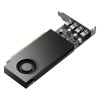
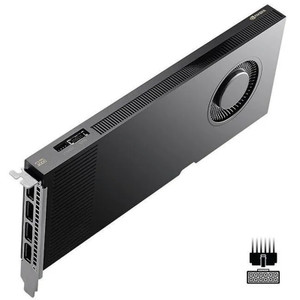
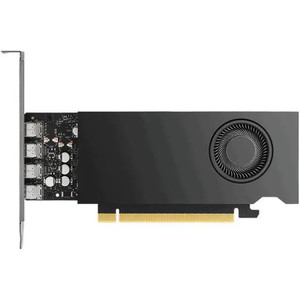
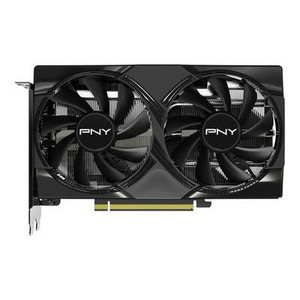
PNY VCNRTXA1000ATX-BLK NVIDIA RTX A1000 Professional GPU
Overview
The PNY VCNRTXA1000ATX-BLK is an NVIDIA RTX A1000 Ampere-architecture professional GPU designed for workstations requiring moderate compute density without the power budget or thermal footprint of larger accelerators. With 2,304 CUDA cores, 8GB of GDDR6 memory, and 50W power consumption, this single-slot card fits into tight spaces while delivering real acceleration for rendering, video encoding/decoding, and moderate machine learning inference tasks.
Key Features
- 2,304 CUDA Cores and 72 Tensor Cores: Sufficient parallelism for moderate 3D rendering workloads and video transcoding without requiring dual-GPU configurations. The ratio of compute units to power draw makes this card practical for office and mobile workstations where thermal headroom is limited.
- 8GB GDDR6 Memory on 128-bit Bus: 8GB is the practical floor for modern professional workflows — enough for single 4K frame buffers and most mid-range datasets. The 128-bit interface delivers 192 GB/s memory bandwidth, eliminating memory bottlenecks in typical encode/decode and inference tasks.
- Single-Slot, 2.7" Height Form Factor: Fits dense server chassis and compact workstation towers where full-height dual-slot cards are impractical. Eliminates secondary slot usage, allowing adjacent PCIe cards (SSDs, network adapters) to coexist without physical conflict.
- 50W Power Consumption: Draws power entirely from the PCIe slot (no 6-pin auxiliary connector required), simplifying installation in systems with modest PSU ratings. No additional cooling ductwork needed in most office environments.
- 1x Encode Engine + 2x Decode Engines: Hardware H.264/H.265 encoding at real-time frame rates; dual decode engines enable frame-rate-independent transcoding pipelines (simultaneous decode of two streams while encoding a third). Practical for video surveillance archives migrating from legacy codecs to H.265 or for live broadcast bitrate adaptation.
- 4x Mini DisplayPort 1.4a Outputs: Supports up to four 4K displays at 120Hz or eight 1080p displays. DirectX 12, OpenGL 4.66, and Vulkan 1.3 APIs enable professional CAD, 3D animation, and real-time visualization applications without vendor lock-in.
- PCIe 4.0 x8 Interface: Symmetric 8-lane PCIe Gen 4 connectivity ensures no upstream bottleneck when paired with modern server/workstation motherboards. Gen 4 PCIe bandwidth (approximately 8 GB/s) is more than adequate for video and most ML inference scenarios.
- Peak Single-Precision Performance: 6.7 TFLOPS; Tensor Performance: 53.8 TFLOPS (FP16): Measurable acceleration over CPU-only processing in floating-point heavy workloads. The gap between single-precision (FP32) and tensor (FP16) performance reflects Ampere's optimization for lower-precision training and inference — relevant if deploying pre-trained models rather than training from scratch.
Integration & Compatibility
The VCNRTXA1000ATX-BLK integrates via standard PCIe slot and requires NVIDIA driver 551.57 (or compatible) on Windows or Linux. Supports CUDA 11.6 and OpenCL 3.0 compute stacks, enabling integration with FFmpeg (video transcoding), TensorFlow (inference), and PyTorch workloads. DirectCompute support allows Windows-native C++ compute shaders without external libraries. Four Mini DisplayPort outputs require passive or active DP-to-HDMI/DVI adapters for legacy monitor connectivity; modern DisplayPort monitors connect directly. The card draws all power from the PCIe slot — no auxiliary power connectors, making it compatible with any system PSU rated for base platform plus 50W.
What's in the Box
Package contents not specified in available evidence.
Frequently Asked Questions
Q: Does the VCNRTXA1000ATX-BLK require external power connectors?
A: No. The card draws its entire 50W power budget from the PCIe x8 slot, eliminating the need for 6-pin or 8-pin auxiliary connectors. Any system with a standard PCIe slot and sufficient PSU headroom (motherboard + CPU + 50W) can support it.
Q: Can the VCNRTXA1000ATX-BLK handle simultaneous encoding and decoding?
A: Yes. The card includes 1 encode engine and 2 decode engines. You can decode two video streams while simultaneously encoding a third, making it suitable for real-time transcoding pipelines and archive migration workflows.
Q: What monitor configurations are supported?
A: The VCNRTXA1000ATX-BLK provides 4x Mini DisplayPort 1.4a outputs. You can drive up to four 4K displays at 120Hz, or eight 1080p displays. Legacy HDMI or DVI connections require passive or active DP adapters.
Q: Is the VCNRTXA1000ATX-BLK suitable for machine learning training?
A: This card is optimized for inference and rendering rather than large-scale training. With only 2,304 CUDA cores and 8GB memory, it is best suited to deploying pre-trained models. For training deep neural networks from scratch, consider larger GPUs in the RTX A6000 or higher tier.
Q: Does it fit in a single PCIe slot without blocking adjacent expansion cards?
A: Yes. The 2.7" height and single-slot design eliminate the need for a secondary slot, allowing adjacent PCIe cards (network adapters, SSDs, etc.) to install without physical conflict.
The VCNRTXA1000ATX-BLK sits at an interesting convergence point in the GPU lineup — enough compute density to meaningfully accelerate video transcoding and inference without the power overhead that makes larger cards unsuitable for compact workstations or dense server builds. The dual decode engines (plus single encode) make this particularly relevant if you are backfilling archive systems moving from H.264 to H.265, or if you need real-time transcode at multiple bitrates for adaptive streaming.
Technical Highlights:
- 50W PCIe-slot-only power: No auxiliary connectors required. This alone eliminates hours of PSU capacity planning and cooling ductwork design in office environments. Fits into legacy workstations and compact servers without case rewiring.
- Dual decode + single encode engines: 192 GB/s memory bandwidth and hardware video codec support mean real-time transcoding of 4K streams without CPU overload. Test this against your codec library (H.264, H.265, VP9) before committing — not all codecs accelerate equally.
- 8GB GDDR6 on 128-bit bus: Sufficient for single 4K buffers and inference on datasets up to ~6GB model size. Bandwidth ceiling is approximately 192 GB/s — adequate for video, but borderline for large-batch ML inference. Single-precision performance of 6.7 TFLOPS is real but modest; tensor operations (FP16) jump to 53.8 TFLOPS, favoring pre-trained model deployment over training from scratch.
Deployment Considerations:
- The single-slot form factor is a genuine constraint if your workstation or server has crowded PCIe topology. Verify adjacent cards (WiFi, SSD, network) do not share a thermal envelope — passive cooling on this card relies on ambient airflow.
- Four Mini DisplayPort outputs mean you need DP-native monitors or quality passive adapters for HDMI. Budget USD 30–80 per adapter if retrofitting legacy display infrastructure.
- This card is optimized for inference and rendering workloads, not for training. If your pipeline requires fine-tuning models, you will quickly hit memory and compute ceilings — jump to an A4000 or A5000 instead.
The VCNRTXA1000ATX-BLK is a strong fit for video archive migration (H.264 to H.265 transcoding) in compact data centers, and for deploying pre-trained inference models (object detection, segmentation) in distributed edge systems where power and thermal budgets are tight. It is not a workhorse for large-scale training or batch-processing ML pipelines — know the difference before ordering.