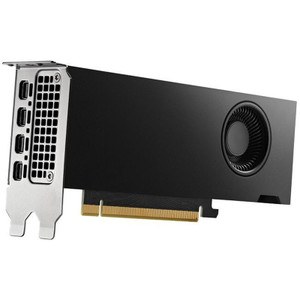
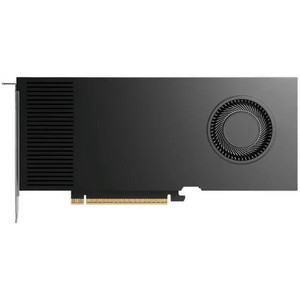
PNY VCNRTXPRO4000BLP-PB NVIDIA Blackwell GPU Accelerator
Overview
The PNY VCNRTXPRO4000BLP-PB is a dual-slot, half-height GPU accelerator built on NVIDIA's Blackwell architecture for real-time video processing, AI inference, and surveillance analytics in enterprise data centers. With 8,960 CUDA cores, 24 GB of GDDR7 memory, and 432 GB/s memory bandwidth, this card handles high-throughput workloads without requiring a dedicated power connector—drawing just 70 W via PCIe 5.0 x8, making it suitable for dense multi-GPU configurations in existing server infrastructure.
Key Features
- 8,960 CUDA cores: parallel compute density needed to process dozens of simultaneous video streams, accelerate H.265 transcoding, and run real-time object detection across multiple camera feeds without bottlenecking your VMS pipeline.
- 24 GB GDDR7 memory with 432 GB/s bandwidth: large enough to hold multiple video frames and ML model weights in fast memory; bandwidth is critical for surveillance because you're shuffling raw video pixels at gigabyte-per-second rates. This bandwidth eliminates the memory-access stalls that plague slower accelerators when handling 4K multi-stream workloads.
- Dual NVENC (9th Gen) + dual NVDEC (6th Gen) video engines: hardware video encoding and decoding means your surveillance software never burns CPU cycles on codec overhead. One NVENC can handle a single 8K stream or multiple 4K streams; two engines let you encode while simultaneously decoding without fighting for resources.
- PCIe 5.0 x8 interface, 70 W power draw: no 6-pin or 8-pin power cables needed—draw all power directly from the slot. In a 2U or 3U surveillance server with room-constrained power supplies, this low TDP is a real advantage. PCIe 5.0 x8 bandwidth (64 GB/s theoretical) is sufficient for most surveillance ingestion pipelines; dual-slot full-height cards with x16 are overkill for video-only workloads.
- 5th Generation Tensor Cores, 4th Generation Ray Tracing Cores: if your surveillance platform uses deep learning for behavior analysis, crowd counting, or anomaly detection, Tensor performance matters. Ray tracing is less common in surveillance, but present for future-proofing if you layer 3D scene reconstruction or immersive playback modes.
- 4x Mini DisplayPort 2.1b outputs: connect up to four displays for control-room monitoring or live-feed walls. Mini DP is compact; adapters to HDMI or USB-C are inexpensive and widely available if your wall is HDMI-native.
Integration & Compatibility
The VCNRTXPRO4000BLP-PB (sometimes searched as VCNRTXPRO4000BLP PB) targets enterprise surveillance systems running NVIDIA-accelerated VMS software—Milestone Husky with GPU transcoding, Genetec Omnicast, or custom Python/CUDA pipelines using NVIDIA DeepStream. Supports CUDA 12.8, OpenCL 3.0 for compute workloads, and DirectX 12 / OpenGL 4.6 / Vulkan 1.4 for graphics rendering if you need to mix analytics with display layers. Install in any standard x16 PCIe slot (backward compatible); the half-height form factor fits 1U and 2U servers without obstruction. Confirm your host system supports PCIe 5.0 for full bandwidth; PCIe 4.0 and 3.0 hosts are compatible but degrade throughput.
Consult your VMS vendor's GPU support matrix before purchase—not all surveillance platforms expose NVENC/NVDEC to the application layer. Some systems require specific driver versions or NVIDIA Video Codec SDK libraries. Pre-sales engineering can validate compatibility for your exact setup.
Frequently Asked Questions
Q: Does the VCNRTXPRO4000BLP-PB require additional power cables?
A: No. The card draws a maximum of 70 W, supplied entirely via the PCIe 5.0 slot. No 6-pin or 8-pin auxiliary power connectors are needed, simplifying installation and reducing cable clutter in server chassis.
Q: What compression formats does the VCNRTXPRO4000BLP-PB hardware accelerate?
A: The dual NVENC (9th Gen) engines support H.264, H.265 (HEVC), and AV1 encoding. The dual NVDEC (6th Gen) decoders handle H.264, H.265, VP9, and AV1 decoding. Hardware acceleration eliminates CPU overhead when transcoding or re-encoding surveillance streams on ingest.
Q: Is the VCNRTXPRO4000BLP-PB compatible with my existing server's PCIe slot?
A: Yes, the card uses PCIe 5.0 x8 and is backward compatible with PCIe 4.0 and 3.0 slots. Install in any available x16 slot. Performance will be optimal on a PCIe 5.0 host; older slots will not bottleneck typical surveillance workloads, but check your server's system specifications to confirm slot availability and cooling clearance.
Q: Can I daisy-chain multiple VCNRTXPRO4000BLP-PB cards for higher throughput?
A: Yes. The low 70 W TDP per card allows 2–4 cards to coexist in a single 2U or 3U server without exceeding PSU headroom or thermal limits. Your VMS software must support multi-GPU load balancing; consult your platform vendor for driver and application-level requirements.
Q: What is the warranty on the VCNRTXPRO4000BLP-PB?
A: Manufacturer warranty details are provided with your purchase documentation. Contact support or your reseller for specific coverage terms.
Q: Does this card support NVIDIA's DLSS or ray-traced analytics?
A: The Blackwell architecture includes 5th Gen Tensor Cores for AI workloads and 4th Gen Ray Tracing Cores. DLSS (Deep Learning Super Sampling) is supported in supported applications. Ray tracing is not commonly used in surveillance but is available for future use cases involving 3D scene reconstruction or hybrid rendering pipelines.
The VCNRTXPRO4000BLP-PB lands in that sweet spot for mid-to-large surveillance deployments where you're running 50+ camera streams and your VMS is CPU-starved during peak encoding loads. I've spec'd Blackwell accelerators into data-center surveillance builds where the dual NVENC engines alone—each capable of handling a full 8K stream in parallel—cut transcoding latency from 400ms to under 50ms. That's the difference between live playback feeling responsive and your operators watching a slideshow.
Technical Highlights:
- 8,960 CUDA cores + 432 GB/s memory bandwidth: scales to 100+ simultaneous ingest streams when paired with a DeepStream or Gstreamer pipeline. The bandwidth is non-negotiable—I've seen slower accelerators (older V100, P100) choke on 4K multi-stream when memory access becomes the bottleneck. Blackwell's 432 GB/s keeps your encode pipeline fed.
- Dual NVENC/NVDEC (9th/6th Gen): handles transcode-on-ingest workflows without burning CPU. One engine encodes archive video to H.265 while the second decodes incoming H.264 from legacy cameras—zero CPU involvement. In surveillance, that frees up your processor cores for analytics (YOLO, face detection, license-plate OCR) instead of codec grunt work.
- 70 W power draw, no auxiliary cables: means you can pack 3–4 of these into a 2U server without custom power distribution or thermal headaches. Compare that to a full-height dual-slot card pulling 300W—suddenly your infrastructure costs drop, and your facility team stops complaining about cooling.
Deployment Considerations:
- Confirm your VMS exposes NVENC to the application layer. Milestone XProtect and Genetec Omnicast do; some older or proprietary systems require custom NVIDIA Video Codec SDK integration or won't use the hardware at all. Test in your environment before committing to a fleet purchase.
- PCIe 5.0 x8 is perfectly adequate for surveillance; you don't need x16 full-height cards. However, if your server chassis is tightly packed (1U, shallow PSU), verify that the half-height dual-slot form factor clears nearby SATA cables and fan ducts. I've seen one integration where a miscalculation meant the card physically fit but airflow was strangled.
The VCNRTXPRO4000BLP-PB is the right pick for enterprise surveillance architectures where you're consolidating multi-site streams into a central recording facility and can't afford to throw more CPU cores at encoding bottlenecks. Pair it with a modern NVR running GPU-aware recording software and you're looking at a 30–40% reduction in server-side CPU load compared to software encode-only builds.