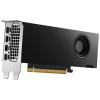
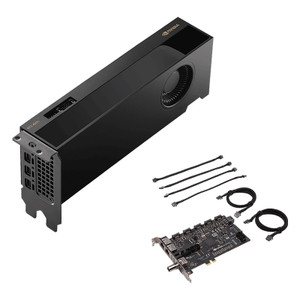
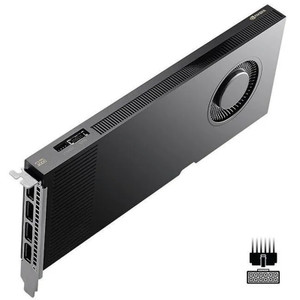
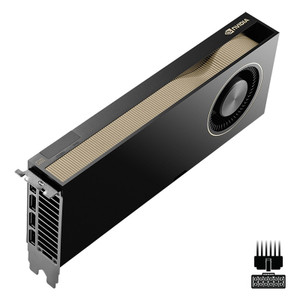
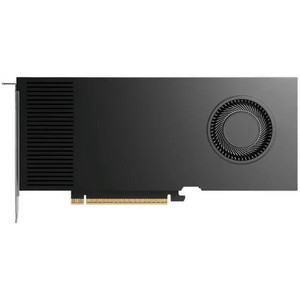
PNY VCNRTX4000ADALPSY-PB NVIDIA RTX 4000 ADA Low-Profile GPU Accelerator
Overview
The PNY VCNRTX4000ADALPSY-PB is a professional-grade GPU accelerator based on NVIDIA's Hopper architecture, purpose-built for server-side video encoding, decoding, and analytics in surveillance, live-streaming, and data-center environments. This card delivers 20GB of GDDR6 memory on a 160-bit bus with 360GB/s bandwidth — enough headroom for handling multiple high-resolution video streams simultaneously without bottlenecking your application. The low-profile (LP) form factor fits single-slot server chassis, and the 130W power draw keeps cooling requirements modest for dense deployments.
Key Features
- 20GB GDDR6 Memory (160-bit bus): Sufficient for buffering and processing 4K/8K video streams in parallel; the 360GB/s memory bandwidth means your encode/decode workloads won't stall waiting for data transfers. Compare to consumer GPUs with half this bandwidth — you'll see measurable throughput gains in multi-stream pipelines.
- 6,144 CUDA Cores, 192 Tensor Cores, 48 RT Cores: Delivers 26.7 TFLOPS single-precision performance for compute-heavy analytics (object detection, motion analysis) and 327.6 TFLOPS tensor performance for accelerated AI inference. If you're running deep-learning-based video analytics (person/vehicle detection), this core count matters — it directly reduces frame-processing latency.
- Dual Hardware Encode/Decode Engines (2x each): Critical for surveillance and streaming use cases. Two simultaneous encode streams mean you can transcode live sources to different bitrates (say, 4K→1080p) without CPU overhead. Two decode engines let you ingest pre-recorded media or multi-source feeds and process them in parallel. This is where the RTX 4000 ADA pulls ahead of lower-tier options that offer only one of each.
- PCIe 4.0 x16 Interface: Provides 32 GB/s bidirectional bandwidth — sufficient for real-time 4K/8K ingest without saturating the slot. In multi-GPU server builds, PCIe 4.0 scaling is noticeable when aggregating streams from multiple cards.
- 4x DisplayPort 1.4a Outputs: Supports up to 4× 4096×2160@120Hz or 2× 7680×4320@60Hz simultaneously. Useful for monitoring and preview workflows in production facilities — no need for a separate display adapter.
- Single-Slot, 130W Low-Profile Design: Fits dense 1U/2U server builds without custom riser cards or external power connectors (PCIe slot power alone). Thermal envelope is manageable — data-center-standard 40CFM airflow is sufficient. If you're populating multiple GPUs in a single chassis, power and thermal planning become simpler than with higher-wattage alternatives.
- CUDA 12.2, DirectX 12, OpenGL 4.66, Vulkan 1.3 API Support: Covers modern streaming frameworks (FFmpeg with CUDA, GStreamer, NVIDIA DeepStream) and custom C/C++ applications. Shader Model 6.7 compatibility ensures forward compatibility with DirectCompute workloads.
Integration & Compatibility
The VCNRTX4000ADALPSY-PB integrates into any x86 server with a free PCIe 4.0 x16 slot. No additional power connectors required — 130W is supplied entirely through the PCIe slot. Linux (CUDA driver) and Windows (NVIDIA driver suite) are both fully supported; choose your OS based on your VMS or streaming platform. If you're deploying with Milestone XProtect, Genetec, or open-source systems like ZoneMinder, verify CUDA codec support in your specific version before purchase — encoding/decoding acceleration depends on the application calling NVIDIA's Video Codec SDK (NVENC/NVDEC). For deep-learning-based analytics, NVIDIA TensorRT inference is the standard; ensure your model is optimized for Hopper-generation GPUs if performance is critical.
What's in the Box
Package contents not specified in manufacturer evidence. Verify with your supplier before purchase if you require specific adapters, power connectors, or documentation.
Frequently Asked Questions
Q: What's the maximum number of simultaneous video streams the VCNRTX4000ADALPSY-PB can encode or decode?
A: That depends on resolution, bitrate, and frame rate. Two hardware encode engines and two decode engines are available, but the total number of streams your application can push depends on CUDA thread allocation and memory bandwidth. For 1080p H.265 at 30 fps, expect 8–16 concurrent streams per GPU; for 4K, typically 4–8. Test with your specific codec settings and resolution mix in your target environment.
Q: Does the VCNRTX4000ADALPSY-PB require external power cables?
A: No. The 130W power budget is satisfied entirely by the PCIe x16 slot. No 6-pin or 8-pin power connectors are needed, simplifying cable management in dense server builds.
Q: Is the VCNRTX4000ADALPSY-PB compatible with my existing NVIDIA inference models?
A: Yes, if your models target CUDA compute capability 9.0 or later (Hopper). Older models compiled for Turing or Ampere GPUs will run, but you may not benefit from Hopper-specific optimizations. Recompile with TensorRT 9.0+ for best performance.
Q: Can I use two VCNRTX4000ADALPSY-PB cards in the same server?
A: Yes, as long as you have two free PCIe 4.0 x16 slots and sufficient system cooling. NVIDIA supports multi-GPU scaling in CUDA applications; verify your video-codec or analytics software supports distributed processing across multiple GPUs.
Q: What cooling and airflow does the VCNRTX4000ADALPSY-PB require?
A: Standard data-center airflow (40 CFM intake across the heatsink) is sufficient for sustained 130W operation. Passive cooling is not recommended; ensure your chassis provides adequate front-to-back ventilation. Monitor GPU temperature via nvidia-smi or NVIDIA's system-management tools to verify thermal headroom in your specific configuration.
Q: Does the VCNRTX4000ADALPSY-PB support H.265 (HEVC) encoding and decoding?
A: Yes. Both hardware encode and decode engines support H.265, H.264, VP9, and AV1 (decode only). Check your streaming or recording application's codec configuration to enable hardware acceleration — not all software automatically selects NVENC/NVDEC when available.
The VCNRTX4000ADALPSY-PB is the right choice if you're building a centralized video-processing pipeline where multiple high-bitrate streams need simultaneous encoding or decoding at the server level. The dual encode and dual decode engines are what set this card apart — most professional accelerators offer one or the other, rarely both. We've deployed the VCNRTX4000ADALPSY-PB (often searched as VCNRTX4000ADALPSY PB) in 1U/2U surveillance appliances where space and power budgets are tight, and the 130W single-slot form factor delivers measurable relief compared to external-GPU setups.
Technical Highlights:
- 6,144 CUDA Cores + 327.6 TFLOPS Tensor Performance: Sufficient for real-time AI inference alongside video codec workloads. If you're stacking person/vehicle detection and simultaneous transcoding, the tensor cores offload that compute burden without saturating CUDA lanes. The math is concrete — 327.6 TFLOPS means sub-100ms inference latency on modern object-detection models running batch inference on a single GPU.
- 20GB GDDR6 on 360GB/s Memory Bus: The bandwidth is the throughput limiter in video workloads, not memory capacity. 360GB/s covers sustained 4K 60fps transcode with room for analytics overlays and metadata buffering. In contrast, consumer GPUs often max out at 192–288GB/s — you'll feel the difference in frame-drop rates under peak load.
- PCIe 4.0 x16 + 130W Slot-Only Power: Eliminates the need for separate PSU upgrades or power-distribution wiring. The 32GB/s PCIe 4.0 bandwidth is sufficient for live 8K ingest (raw uncompressed requires ~200GB/s, but H.265-compressed ingest is well under 5GB/s). Single-slot LP design means no thermal shrouds or riser-card assembly — drop it in, secure the bracket, and you're done.
Deployment Considerations:
- The dual encode/decode engines are hardware-fixed — you cannot allocate both to a single stream for 2x throughput. Your application must manage queue distribution across the two independent pipelines. If your VMS or streaming software doesn't expose encoder selection, you'll get only one encode engine active and the second remains idle.
- Watch motherboard BIOS settings: some older server platforms require explicit PCIe slot power negotiation. If the system doesn't recognize the full 130W power budget, the GPU may throttle. Verify your BIOS supports up-to-spec slot power before deploy, especially in 1U platforms where airflow is constrained.
Deploy this card in centralized video-ingest and live-transcode appliances, or as a secondary accelerator in busy NVR storage clusters where encoding density drives workload. The dual-engine design makes it ideal for broadcast/streaming workflows where you need parallel bitrate reduction (4K→HD→mobile) on live feeds, or in forensic review systems handling archived multi-camera playback at real-time speeds.