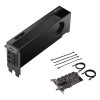
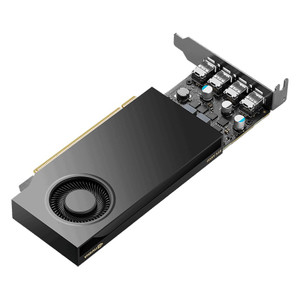
PNY VCNRTX4000ADALP-BLK NVIDIA RTX 4000 ADA LP GPU Card
Overview
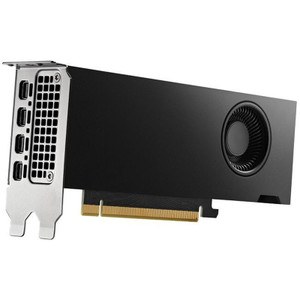
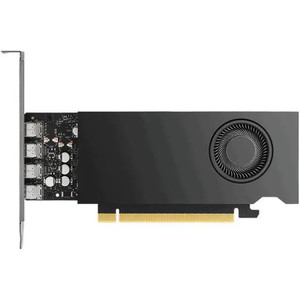
The PNY VCNRTX4000ADALP-BLK is a low-profile NVIDIA RTX 4000 ADA GPU designed for surveillance edge-compute deployments where you need real-time video analytics, transcoding, or inference without a dedicated server farm. Built on the Ada Lovelace architecture, this card delivers 6,144 CUDA cores and 20GB of GDDR6 memory across a 160-bit bus—enough compute density to handle simultaneous video streams, object detection, and encoding tasks on a single PCIe 4.0 slot. The 70W total board power and compact 2.7" height make it viable in space-constrained network appliances, edge NVRs, or compact workstations where older discrete GPUs would require external power or take up too much physical real estate.
The VCNRTX4000ADALP-BLK (often searched as VCNRTX4000ADALP BLK) is pitched at systems integrators and IT architects building surveillance pipelines that demand inference at the edge—think live multi-camera license plate recognition, crowd density counting, or real-time anomaly detection without shipping raw video to a central cloud or data center.
Key Features
- 6,144 CUDA cores + 192 Tensor cores: Handles parallel video decode, inference, and re-encode in a single pass. On a typical security appliance, this means you can simultaneously transcode 4–8 HD streams and run a light-weight object-detection model without queuing or frame drops. The Tensor cores accelerate matrix operations core to neural-network inference—a direct win for on-device AI models.
- 20GB GDDR6 memory on 160-bit bus (320 GB/s bandwidth): Stores multiple video frames and inference tensors without host-memory thrashing. On surveillance workloads, more local memory means you can buffer several seconds of video at full resolution before pushing decoded frames to host RAM, reducing CPU bottlenecks. The 320 GB/s throughput sustains multi-stream 4K decode without memory stalls.
- Dual encode + dual decode engines with AV1 support: Transcodes incoming H.264 or H.265 streams to AV1 (or vice versa) in real time without CPU load. Critical for edge nodes that must normalize codec variants from different camera vendors on the same NVR appliance. AV1 cuts storage by another 20–30% versus H.265 in high-motion scenes.
- 19.2 TFLOPS single-precision + 44.3 TFLOPS RT-core performance: Single-precision is the standard for video processing and most inference models; RT cores accelerate ray tracing (less common in surveillance) but also boolean operations in tensor computations. The aggregate 306.8 TFLOPS in Tensor mode is where you see the real speedup on batched inference—if you're running a YOLOv8 detector on multiple frames simultaneously, this is the number that matters.
- PCIe 4.0 x16 interface: Peak 64 GB/s host bandwidth (vs. 32 GB/s on PCIe 3.0). On appliances with multiple data streams or frequent host-GPU memory copies, the doubled bandwidth cuts latency by ~50%. Not a dramatic win for single-stream scenarios, but meaningful when you're shuffling multiple HD+ streams or large inference batches to and from system memory.
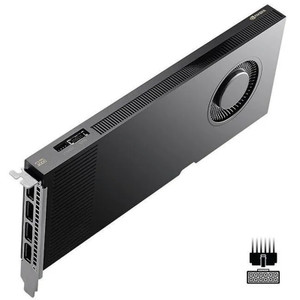
- 70W total board power with active thermal solution: No external 6-pin or 8-pin power connector required—draws power directly from the PCIe slot. In a compact appliance, this eliminates cable routing and PSU capacity headaches. The active (fan-based) cooler handles sustained workloads in a standard rackmount enclosure; passive thermal solutions would throttle on continuous inference.
- 4x Mini DisplayPort 1.4a connectors supporting >4 simultaneous displays at 4K 120Hz: Not essential for headless surveillance appliances, but allows live monitoring of inference overlays or diagnostic dashboards without a separate workstation. Useful for test benches and pre-deployment validation.
- CUDA 11.6, OpenCL 3.0, Vulkan 1.3.5, DirectX 12 support: Covers the full stack of compute and graphics APIs. CUDA is the primary choice for NVIDIA inference frameworks (TensorRT, CUDA, cuDNN). OpenCL and Vulkan allow platform-portable code if you're using third-party video-processing libraries. DirectX 12 supports Windows-based NVR software that still relies on GPU-accelerated rendering.
Integration & Compatibility
The VCNRTX4000ADALP-BLK fits into any standard x16 PCIe slot (electrically x16 or electrically x8 with bifurcation support on some servers). It does not require a dedicated power cable—the 70W budget stays within PCIe spec. Check your appliance or NVR host for PCIe slot availability and airflow clearance around the dual-slot cooler. Most modern x86 NVRs and edge servers accept this card without firmware or driver changes; NVIDIA provides Linux and Windows drivers for surveillance stacks like Deepstream, JetPack, or commercial VMS platforms that offer GPU-acceleration plugins.
Memory bandwidth and CUDA compute are best exploited by frameworks that batch-process multiple frames—single-stream, unbatched inference will not saturate the card. If your deployment is 1–2 cameras with light analytics, a smaller GPU or CPU-based inference may be more cost-effective.
What's in the Box
No package contents data available from source evidence. Contact your vendor for exact accessories or mounting hardware that may be included.
Frequently Asked Questions
Q: What power supply do I need for a system with the VCNRTX4000ADALP-BLK?
A: The card draws 70W directly from the PCIe slot. Ensure your host system's PCIe implementation can supply the full 150W available per slot (PCIe spec allows up to 150W per x16 slot; typical server boards overspec this). No external power cable is required. Size your system PSU for the host CPU, motherboard, storage, and this GPU combined—for a compact edge NVR with a modest CPU, a 400–600W unit is typical.
Q: Can I use the VCNRTX4000ADALP-BLK for real-time multi-camera inference?
A: Yes, with proper batching. The 6,144 CUDA cores and 20GB memory support simultaneous decode of multiple streams and batched inference in a single pass. Throughput depends on frame resolution, inference model complexity, and batch size. Test with your specific model and stream count before production deployment. Use NVIDIA TensorRT to optimize your inference model for maximum throughput.
Q: Does the VCNRTX4000ADALP-BLK require external cooling?
A: The card includes an active (fan-based) thermal solution. It is designed to operate in a standard rackmount enclosure with adequate airflow. On fanless or thermally constrained appliances, verify that ambient air intake reaches the card's cooler inlet. Blocked airflow will trigger thermal throttling.
Q: Is the VCNRTX4000ADALP-BLK compatible with my existing NVR or VMS platform?
A: Hardware compatibility (PCIe slot, power) is assured on any modern x86 appliance. Software integration depends on whether your VMS or NVR vendor offers GPU-acceleration plugins or SDKs. Check with your vendor for explicit GPU support. ONVIF and standard RTSP compliance on camera inputs are unaffected by GPU presence; the GPU accelerates server-side transcoding and analytics only.
Q: What's the difference between the RTX 4000 ADA and the RTX 6000 ADA?
A: The RTX 6000 ADA has 18,176 CUDA cores and 48GB memory, roughly 3x the compute and memory of the RTX 4000 ADA. Choose the RTX 4000 if your deployment is ≤8 simultaneous 4K streams with moderate inference, or if power and space are constrained. Choose the RTX 6000 for high-volume multi-camera inference or real-time rendering workloads at scale.
Q: Does the VCNRTX4000ADALP-BLK support the AV1 codec?
A: Yes. The card includes dedicated AV1 encode and decode engines. AV1 can reduce storage requirements by an additional 20–30% compared to H.265 on high-motion surveillance scenes. However, ensure your camera sources and downstream playback systems support AV1 before standardizing on it.
The VCNRTX4000ADALP-BLK fills a specific niche in edge surveillance deployments: it's the right GPU when you need to offload video transcoding and lightweight inference from the host CPU without burning 200+ watts or consuming two PCIe slots. The 20GB memory and dual encode/decode engines are the real differentiators here—they let you normalize codec streams from multi-vendor camera systems on a single appliance without CPU overhead.
Technical Highlights:
- 20GB GDDR6 + 320 GB/s bandwidth: Handles multi-stream 4K decode and frame buffering without starving the host CPU. On surveillance appliances where bandwidth and memory are shared across multiple services, dedicated GPU memory eliminates contention for system RAM—you see measurable latency reduction on high-throughput transcode pipelines.
- Dual encode + dual decode with AV1: Real-time codec normalization on a single card. If you're integrating four camera brands (each with different codec preferences) into one NVR, the VCNRTX4000ADALP-BLK can convert all streams to a single format without saturating the CPU. AV1 adds another 20–30% storage savings on motion-heavy scenes.
- 70W from PCIe slot, active cooler: No external cables, no PSU upsizing beyond the host system. The active thermal design handles sustained transcode loads in a standard 2U or 3U rackmount without throttling—passive cooling would tank performance in continuous-duty surveillance.
Deployment Considerations:
- Verify your appliance has adequate PCIe slot clearance for the dual-slot cooler. Some compact edge NVRs have tight spacing; block airflow and you'll hit thermal throttling inside minutes.
- Batching is critical. Single-stream, unbatched inference will waste the compute density. If your deployment is one or two cameras with light analytics, a smaller GPU (RTX 4500 or TX2) is more cost-effective.
- Driver and SDK support is mature on Linux (CUDA 11.6 + Deepstream) and Windows. Verify your VMS vendor's GPU-acceleration plugin explicitly supports Ada architecture—some legacy platforms only certified on older NVIDIA GPUs.
The VCNRTX4000ADALP-BLK is the workhorse for mid-scale edge NVR deployments—think 8–16 camera sites running real-time object detection and stream normalization. For single-site codec conversion or light analytics on a compact appliance, this is a solid fit. For 30+ cameras or compute-heavy inference (face recognition at scale), move up to an RTX 6000 ADA or a dedicated inference server.