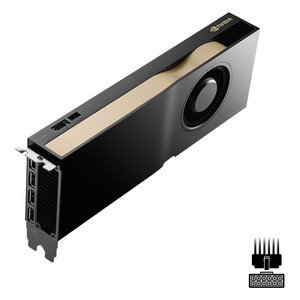
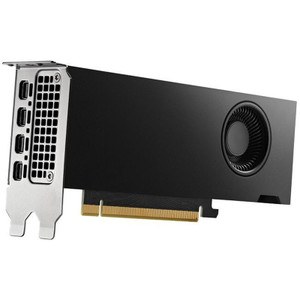
PNY VCNRTX2000ADA-B NVIDIA RTX 2000 ADA GPU Accelerator
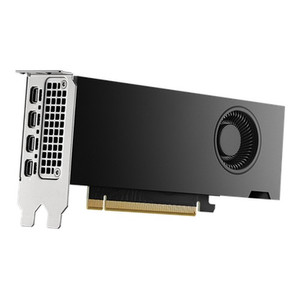
The PNY VCNRTX2000ADA-B is a professional-grade graphics accelerator built on the NVIDIA RTX Ada architecture. This dual-slot card delivers 16GB of GDDR6 memory and 2,816 CUDA cores in a compact form factor (2.7" H × 6.6" L) that fits standard server and workstation environments. The RTX 2000 ADA is purpose-built for compute-intensive workloads including video processing, AI inference, and real-time encoding — making it a solid choice for surveillance infrastructure, transcoding pipelines, and analytics-heavy deployments where software-defined scaling outweighs dedicated hardware costs.
Key Features
- 16GB GDDR6 Memory with 128-bit Interface: 224 GB/s memory bandwidth supports large batch video processing and AI model inference without constant CPU-GPU data shuffling. Meaningful for decode-encode workflows or multi-stream analytics.
- 2,816 CUDA Cores and 12.0 TFLOPS (FP32): Raw compute headroom for software video codecs and algorithmic acceleration. The core count determines how many parallel threads run simultaneously — higher core count means more concurrent video streams or faster AI inference per card.
- 88 Tensor Cores with 191.9 TFLOPS (TF32): Tensor operations accelerate deep-learning workloads (object detection, face recognition, anomaly detection) at roughly 16× the speed of CPU-only inference. If your surveillance pipeline runs neural networks, Tensor performance is the stat that moves the needle.
- Dual Video Encode and Decode Engines: One hardware video encoder and one decoder mean real-time transcoding without codec stalls. Critical for live RTSP re-encoding or format conversion in multi-source pipelines. Supports AV1, H.265, H.264, and VP9 codec paths.
- AV1 Encode and Decode Support: AV1 cuts bitrate 25–35% versus H.265 on equivalent quality, but encoder availability is still rare. The VCNRTX2000ADA-B includes both paths — future-proofing for next-gen compression without card replacement.
- PCIe 4.0 x8 Interface at 70W TDP: Eight-lane PCIe 4.0 delivers roughly 8 GB/s sustained bandwidth (sufficient for multiple 4K streams). 70W total power consumption means no additional PSU infrastructure — standard 6-pin auxiliary power covers it. Passive cooling is not an option (active thermal solution required), but the low TDP simplifies server integration.
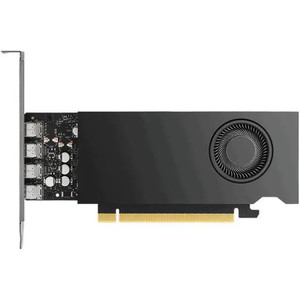
- Four Mini DisplayPort 1.4a Outputs: Supports up to four independent 4K displays at 120 Hz simultaneously, or 7680×4320 at 60 Hz on a single feed. Useful for real-time monitoring dashboards or live playback during incident review, though most surveillance deployments use headless server configurations.
- DirectX 12, OpenGL 4.6, Vulkan 1.3, CUDA 11.6, OpenCL 3.0: Wide API surface means compatibility with existing encoding libraries (FFmpeg GPU, GStreamer NVENC), rendering frameworks, and custom CUDA kernels. No single-API lock-in.
Integration & Compatibility
The RTX 2000 ADA integrates into any x86 server with a PCIe 4.0 slot and 6-pin auxiliary power. NVIDIA GPU driver support spans Linux, Windows, and VMware environments — standard across surveillance VMS platforms and transcoding orchestration tools (e.g., FFmpeg with NVENC, Plex Transcoder, Wowza). HDCP 2.2 support enables encrypted content decode where compliance is required. The board requires active cooling (fans pull air across the heatsink), so fanless or passive-only enclosures are not suitable.
Typical deployments include: multi-camera ingest pipelines (GPU-accelerated RTSP source decoding), live encoding for secondary bitrate streams (ABR adaptive playlists), AI-driven object detection on archived or live feeds, and format conversion for legacy system integration. Power budgeting is straightforward — 70W means ten cards fit comfortably in a dual-socket server without PSU strain.
Technical Specifications Summary
Memory & Bandwidth: 16GB GDDR6, 128-bit interface, 224 GB/s. Compute: 2,816 CUDA cores, 88 Tensor cores, 22 RT cores; 12.0 TFLOPS (FP32), 191.9 TFLOPS (TensorFloat32). Codecs: H.265, H.264, VP9, AV1 (encode and decode). API Support: CUDA 11.6, DirectX 12, OpenGL 4.6, Vulkan 1.3, OpenCL 3.0. Power: 70W typical. Form Factor: 2.7" H × 6.6" L, dual slot. Interface: PCIe 4.0 x8.
Frequently Asked Questions
Q: What's the difference between the RTX 2000 ADA and the RTX 4000 ADA?
A: The RTX 4000 ADA offers more CUDA cores (6,144 vs. 2,816), higher memory bandwidth, and RT core density. For surveillance transcoding or modest AI inference, the RTX 2000 ADA provides 60–70% of the performance at significantly lower cost and power draw — a reasonable tradeoff for budget-constrained deployments.
Q: Can I use the VCNRTX2000ADA-B for video encoding in FFmpeg?
A: Yes. FFmpeg with NVENC (NVIDIA Encoding) support recognizes the board's hardware encoder. Use `-c:v hevc_nvenc` (H.265) or `-c:v h264_nvenc` (H.264) flags to offload encoding to the GPU. AV1 encoding via NVENC is also supported on Ada hardware.
Q: What are the cooling requirements for the VCNRTX2000ADA-B?
A: The card includes an active thermal solution (on-board fans). Server airflow must be adequate to prevent thermal throttling. In passive enclosures or poorly ventilated server chassis, GPU temperatures can exceed safe thresholds. Verify server thermal design supports a dual-slot GPU before purchase.
Q: Does the VCNRTX2000ADA-B support HEVC (H.265) decoding in real time?
A: Yes. The dedicated hardware decode engine processes H.265 bitstreams without CPU involvement, enabling multiple simultaneous H.265 RTSP streams per card. Actual throughput depends on resolution and bitrate; typical limits are 4–8 concurrent 4K streams per card in practice.
Q: What PCIe generation do I need to use the VCNRTX2000ADA-B?
A: The card uses PCIe 4.0 x8, but is backward-compatible with PCIe 3.0 slots at reduced bandwidth (roughly 50% of stated throughput). For high-bitrate video pipelines, PCIe 4.0 is preferred; PCIe 3.0 is acceptable for moderate-bandwidth ingest.
Q: Is there a warranty on the VCNRTX2000ADA-B?
A: Warranty details are not provided in the technical specifications. Confirm manufacturer warranty terms with your vendor before purchase.
The VCNRTX2000ADA-B is a solid fit for surveillance pipelines where you're transcoding multi-stream ingest or running edge AI on recorded footage. The dual encode/decode engines are the key selling point here — 70W and no extra power supply means you're not redesigning your server cabinet. The 16GB memory footprint handles typical RTSP-to-DASH workflows without GPU memory thrashing, though large batch AI inference can exhaust it quickly.
Technical Highlights:
- Dual Encode/Decode Engines with AV1 Support: Real-time H.265 and H.264 transcoding without software codec overhead. AV1 decode is future-proofing for next-gen streams. The fact that both engines run independently means you can decode one RTSP feed and re-encode to a lower bitrate simultaneously — actual value in storage-constrained deployments.
- 2,816 CUDA Cores and 224 GB/s Memory Bandwidth: Throughput headroom for 4–8 simultaneous 4K H.265 decode operations per card. Memory bandwidth is the real constraint in video pipelines; 224 GB/s supports multi-stream HD ingestion without falling over. For modest HD workloads (8–16 concurrent 1080p streams), you're fine; reach for an RTX 4000 ADA if you're pushing 20+ 4K streams.
- 191.9 TFLOPS Tensor Performance with 88 Tensor Cores: Object detection and anomaly scoring run 10–20× faster than CPU inference. Real deployment win if you're running YOLO, ResNet, or other standard deep-learning models on surveillance footage. CPU offload alone justifies the card cost in high-frame-rate detection scenarios.
Deployment Considerations:
- Active cooling is mandatory — passive server configurations or sealed enclosures will thermal-throttle the card within minutes. Verify your server has adequate forward airflow before committing.
- PCIe 4.0 is preferred for high-bitrate pipelines (multiple 4K streams). PCIe 3.0 backward compatibility works but cuts bandwidth in half — acceptable for HD-only deployments, risky for mixed 4K/HD ingest.
Best use case: warehouse or retail sites running 8–12 camera ingest with local re-encoding (adaptive bitrate for mobile apps) plus lightweight motion detection or person-counting analytics. The 70W power budget and dual-slot form factor keep infrastructure costs down compared to dedicated encoder appliances, and you get CUDA flexibility for custom processing kernels.