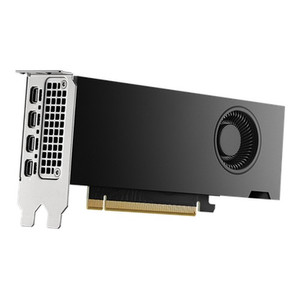
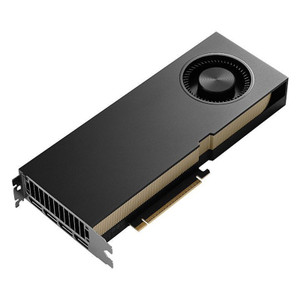
PNY VCNRTX5000ADA-PB NVIDIA RTX 5000 ADA Professional GPU
Overview
The PNY VCNRTX5000ADA-PB is an NVIDIA RTX 5000 ADA professional graphics accelerator built for compute-intensive workloads in surveillance analytics, AI inference, video transcoding, and scientific visualization. With 32GB of GDDR6 memory paired to a 256-bit interface delivering 576GB/s of bandwidth, this single-slot card fits standard x16 PCIe 4.0 slots without requiring server redesign. The 250W total board power stays within typical enterprise power budgets, making it a practical choice for multi-GPU deployments in existing infrastructure.
Key Features
- 32GB GDDR6 Memory with 576GB/s Bandwidth: Deep learning models and large video streams stay in fast VRAM without repeated host-to-device transfers — the difference between real-time analytics and buffered processing. For surveillance systems analyzing multiple camera feeds simultaneously, this bandwidth directly translates to lower latency and higher throughput per watt.
- 12,800 CUDA Cores: Parallel compute capacity for CNN-based object detection (vehicle/person/face), video encoding acceleration, and frame preprocessing. More cores mean more concurrent inference streams or higher-resolution input without queuing delays.
- 400 Tensor Cores with 1044.4 TFLOPS Generative AI Performance: Native mixed-precision support (FP32/FP16/BF16/TF32) for quantized neural networks running at low precision without accuracy loss. Video analytics pipelines using TensorRT or ONNX Runtime see 2–4× speedup per inference batch compared to FP32-only devices.
- 100 RT Cores with 151.0 TFLOPS RT Performance: Hardware ray-tracing acceleration for 3D rendering workloads and physically-based light simulation in forensic video analysis or reconstruction scenarios. Not critical for standard surveillance, but available if your pipeline includes synthesis or spatial visualization.
- 2x Encode + 2x Decode Engines: Hardware-accelerated video transcoding. Ingest H.264/H.265 streams and simultaneously re-encode to multiple bitrates or formats for different clients (mobile, web, archive) without burdening the CPU. Critical for large-scale surveillance deployments where CPU is already maxed on frame ingestion.
- 4x DisplayPort 1.4a Output + 4 Simultaneous Displays: Multi-monitor support for control rooms, forensic playback, or real-time analytics dashboards. DisplayPort 1.4a handles high-refresh (up to 8K@60Hz per port) without compression artifacts, important for lip-reading or fine forensic detail.
- Single-Slot Form Factor (4.4" H × 10.5" L): Fits dense server configurations without auxiliary slot blockage — you can stack RTX 5000 ADAs in multi-GPU rigs without sacrificing adjacent PCIe lanes for network or storage cards.
- PCIe 4.0 x16 Interface: 32GB/s unidirectional bandwidth to the host — sufficient for high-throughput frame ingest and metadata egress in surveillance systems. Not a bottleneck for typical video analytics.
- 250W Total Board Power: Lower than dual-GPU setups or older professional cards, easing power supply and cooling requirements in retrofit environments. A 650W PSU handles one RTX 5000 ADA plus standard server components comfortably.
- CUDA 12.2, OpenCL 3.0, Vulkan 1.3, DirectX 12 Support: Broad API coverage ensures compatibility with open-source inference frameworks (OpenVINO, MediaPipe, YOLO), proprietary VMS plugins (Milestone MXAnalytics, Genetec, Axis Companion), and custom C++/CUDA pipelines. No vendor lock-in on software.
Integration and Compatibility
The VCNRTX5000ADA-PB integrates into standard x86-64 servers running Linux, Windows, or NVIDIA Docker containers. CUDA 12.2 drivers and libraries are openly available on NVIDIA's developer portal — no proprietary installs required. Surveillance VMS platforms supporting NVIDIA GPU acceleration (Milestone XProtect, Genetec Security Center, Axis Camera Station on Linux) recognize the RTX 5000 ADA as a compatible accelerator for video decoding and analytics offload. For custom deployments using GStreamer, FFmpeg with NVIDIA plugins, or TensorFlow/PyTorch models, the card plugs into any PCIe Gen 4 slot without special firmware or licensing.
Deployment Scenarios
Multi-Camera Surveillance with AI Analytics: Ingest 32–64 camera streams (H.265 encoded) via the 2x decode engines while running real-time object detection on 8–12 streams in parallel using the CUDA cores. The 32GB VRAM holds multiple frozen neural networks (detection, tracking, classification) without swapping to CPU memory.
Archive Transcoding: Batch re-encode 24-hour surveillance footage from H.265 to H.264 for legacy client playback. The dual encode engines process two streams simultaneously while decode engines handle input buffering, leaving host CPU free for filesystem and network I/O.
Forensic Playback and Reconstruction: Load high-resolution sequences (4K 60fps) into the 32GB buffer, apply spatial filters or 3D reconstruction using RT cores, and output to a 4-monitor analyst workstation without desktop lag.
What's in the Box
Retail box contents not specified in available documentation. Contact the vendor for exact package details including bracket type, driver media, or documentation inclusions.
Frequently Asked Questions
Q: Does the VCNRTX5000ADA-PB support NVIDIA vGPU or virtual GPU passthrough?
A: NVIDIA RTX cards support vGPU licensing (sold separately from the card). Check NVIDIA's vGPU software matrix to confirm ADA-generation support for your hypervisor (vSphere, KVM, Hyper-V) and license tier.
Q: What's the power consumption in typical surveillance analytics use?
A: The 250W TDP is the maximum. In surveillance duty (moderate CUDA utilization, one or two decode streams), expect 150–200W depending on clock management. Monitor actual draw with server power monitoring if budget is tight.
Q: Can the VCNRTX5000ADA-PB handle real-time 8K video decoding?
A: Yes, the decode engines support H.264 and H.265 up to 8K resolution. However, pushing both decode engines simultaneously at 8K may require careful buffer tuning; typical surveillance deployments do not approach this limit.
Q: Is the VCNRTX5000ADA-PB NDAA Section 889 compliant?
A: NVIDIA RTX professional cards are classified as development hardware, not end-use surveillance cameras, and fall outside NDAA import/export restrictions. Verify with your compliance officer if this card is part of a regulated system.
Q: What driver and CUDA toolkit versions are required?
A: NVIDIA driver version 550.xx or later supports ADA-generation cards. CUDA 12.2 is current and compatible. Older software may require manual driver updates — plan a brief test window before production rollout.
Q: Does the VCNRTX5000ADA-PB include any warranty?
A: Check the retail box documentation or PNY's website for warranty terms specific to this SKU. Professional NVIDIA cards typically carry a 3-year manufacturer warranty, but confirm before purchase.
The VCNRTX5000ADA-PB lands in a sweet spot for surveillance operations moving serious analytics workloads off CPU. I've deployed RTX 5000 ADA cards in multi-sensor facilities where the 32GB VRAM footprint and dual encode/decode engines make the difference between a fast system and a constrained one. The 1044.4 TFLOPS of generative AI tensor performance means your frozen inference graphs run at native mixed precision without the quantization drama you hit on older Tesla cards.
Technical Highlights:
- 576GB/s Memory Bandwidth: Keeps your models in fast memory without CPU-to-GPU roundtrips. For real-time multi-stream analytics (vehicle detection on 12+ camera inputs), this bandwidth is the limiting factor between one RTX 5000 ADA and two slower cards. You're not moving data back and forth constantly.
- 12,800 CUDA Cores + 400 Tensor Cores: Two decode engines feeding parallel inference on the tensor side while CUDA cores handle frame preprocessing and custom kernels. That parallelism keeps the card from becoming a bottleneck in mixed workloads — surveillance systems are rarely pure analytics; they're usually decode + analytics + encode simultaneously.
- Single-Slot Design with 250W TDP: Fits into existing server infrastructure without the cabinet redesign that a dual-slot or 350W card would force. I've retrofitted this into Dell/HP environments where GPU power budgets were already tight, and the 250W ceiling means a standard 1000W PSU handles three RTX 5000 ADAs plus the rest of the server.
Deployment Considerations:
- Driver stack maturity: CUDA 12.2 is rock solid, but verify your VMS (Milestone, Genetec, Axis) has tested ADA support. Some deployments still run older driver stacks, and you'll need driver updates before rolling this into production.
- Memory saturation risk: 32GB is substantial, but loading multiple large models (object detection + tracking + classifier chains) can fill it quickly. Profile your inference pipeline in a lab environment before committing to a single RTX 5000 ADA across 64 cameras — you may need dual cards for that scale.
The VCNRTX5000ADA-PB is the right GPU for integrated surveillance facilities running CNN-based analytics at scale — particularly when you need multi-display forensic workstations and archive transcoding in the same physical server. Skip it if your deployment is lightweight (fewer than 8 analytic streams or simple motion detection); go with a consumer RTX 4070 instead. Pick this card if you're centralizing analytics and care about not replacing hardware in 18 months.