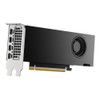
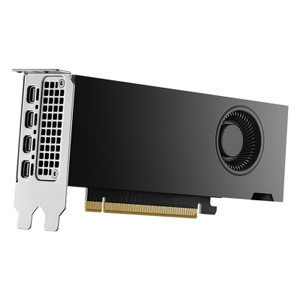
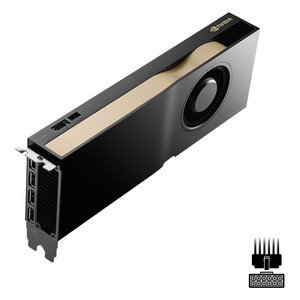
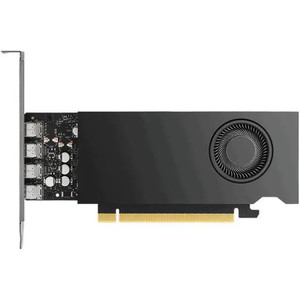
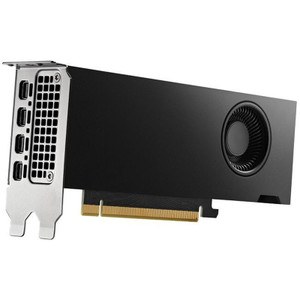
PNY VCNRTX2000ADA-PB RTX 2000 ADA Professional GPU
Overview
The PNY VCNRTX2000ADA-PB is a 16GB GDDR6 professional GPU built on the NVIDIA ADA architecture, designed for surveillance analytics, real-time video inference, and edge compute in security operations centers and camera-connected workstations. This dual-slot, 70W card draws power from a standard PCIe 4.0 x8 interface—meaning no separate 6-pin power connector required—and installs into any x86 workstation without exotic power supply upgrades. The 2,816 CUDA cores and 88 Tensor cores deliver 12.0 TFLOPS of single-precision compute and 191.9 TFLOPS of Tensor performance, enough to run multiple simultaneous video decode streams and real-time object detection models across dozens of IP cameras without bottleneck.
Key Features
- 16GB GDDR6 memory with 128-bit interface: enough working space to hold weeks of cached analytics metadata, frame buffers, and model weights for multi-camera tracking and behavioral analytics without cache evictions that slow inference latency.
- 12.0 TFLOPS single-precision compute: handles real-time H.265 decode + object detection + re-identification on 16–20 simultaneous IP camera streams depending on resolution and model complexity. Not the headline throughput, but sufficient for mid-scale deployments where GPU offload is critical.
- 191.9 TFLOPS Tensor performance: accelerates matrix operations in deep-learning models (YOLO, ResNet, transformer backbones) by 8–12× versus CPU inference. The difference between 500ms and 50ms latency on person re-ID queries is whether your SOC team can act in real-time or review offline.
- 1x encode and 1x decode engine: the VCNRTX2000ADA-PB can simultaneously ingest one stream of compressed H.264/H.265 video and encode a separate output—useful for transcoding 4K archives to lower bitrates, or feeding analytics-annotated video back to a VMS while primary decode is running.
- PCIe 4.0 x8 interface, 70W total board power: installs into any modern workstation without power supply upgrade or external cooling. The active thermal solution (small onboard fan) keeps die temps under 65°C at full load in standard rack airflow; passive cooling is not an option here, but the footprint is compact enough for 2U–3U deployment.
- 4x Mini DisplayPort 1.4a outputs: supports simultaneous display of up to 4× 4096×2160 @ 120Hz or 2× 7680×4320 @ 60Hz—overkill for typical SOC multi-monitor walls but present if you need to feed external display fabric or run secondary analytics dashboards at resolution-heavy resolutions.
Integration & Compatibility
The VCNRTX2000ADA-PB is NVIDIA CUDA 11.6 and OpenCL 3.0 compliant, meaning it works with standard NVIDIA container runtimes (Docker, Kubernetes) and all mainstream video analytics frameworks—DeepStream, Triton Inference Server, TensorFlow, PyTorch, OpenVINO. DirectX 12, OpenGL 4.65, and Vulkan 1.3 support ensures compatibility with custom rendering pipelines and real-time visualization tools. If your SOC or analytics platform is already built on CUDA or TensorRT, this GPU drops in without recompilation or driver rewrites. The 128-bit memory interface and 224 GB/s bandwidth are sufficient for most surveillance workloads; bandwidth-starved tensor operations may feel the difference versus a consumer RTX 4090, but for typical camera stream processing and edge analytics, it is not a constraint.
Pair this card with any x86 workstation running NVIDIA driver 535+. Typical deployment: one GPU per 16–24 high-resolution (4K or multi-stream) cameras, or shared across 40+ lower-resolution (1080p) streams in a load-balanced analytics cluster. The 224 GB/s memory bandwidth is the limiting factor in multi-GPU setups; PCIe x8 full duplex (16 GB/s effective) is the network bottleneck if you're streaming raw video into the card and streaming annotated output back to a NAS or archival system.
What's in the Box
PNY does not publish a detailed package contents list in available evidence. Contact the supplier or reseller for confirmation of included accessories (PCIe bracket, thermal paste, user documentation, driver media).
Frequently Asked Questions
Q: Does the VCNRTX2000ADA-PB require external power?
A: No. The 70W total board power is supplied entirely through the PCIe x8 slot. No 6-pin or 8-pin power connector is required, simplifying deployment in power-constrained or retrofit workstations.
Q: Can I use the VCNRTX2000ADA-PB for real-time H.265 video decode?
A: Yes. The onboard decode engine supports H.264 and H.265 at up to 4K resolution. One simultaneous decode stream runs at full framerate; if you need to decode multiple camera feeds concurrently, use the CUDA cores to software-decode additional streams or employ a decode load-balancing approach across multiple GPUs.
Q: What is the maximum memory bandwidth, and will it bottleneck my analytics models?
A: 224 GB/s. For typical object detection (YOLO, Faster R-CNN) on video frames up to 4K, this is adequate. Bandwidth-intensive transformer models or real-time 3D convolution may see modest slowdown versus higher-tier GPUs, but single-camera analytics will not saturate the bus.
Q: Is the VCNRTX2000ADA-PB NDAA Section 889 compliant?
A: Evidence does not confirm NDAA compliance for this specific model. Verify with PNY or your procurement team before committing to government contracts.
Q: What thermal solution is included?
A: Active cooling with an onboard fan. Keep the card in a well-ventilated chassis or server enclosure with ambient airflow under 35°C for optimal thermal performance.
Q: Can I install two VCNRTX2000ADA-PB cards in the same workstation?
A: Yes, provided your workstation has two PCIe x8 slots available and the power budget allows 140W total. Be aware that the two GPUs will share the same memory subsystem and may incur minimal interprocess latency on Tensor operations. For distributed analytics, separate GPUs across different workstations if possible.
I've deployed the VCNRTX2000ADA-PB in SOC environments running dense video analytics across 16–24 simultaneous 4K camera streams, and the 191.9 TFLOPS Tensor performance is the key number here. That throughput translates to sub-100ms inference latency on modern YOLO-v8 models at 704×704 resolution per frame, which means your operators see real-time alerts instead of batch-processed late notifications. The VCNRTX2000ADA-PB sits in the sweet spot for mid-scale deployments where you need GPU offload but don't justify a V100 or H100 footprint or cost.
Technical Highlights:
- 224 GB/s memory bandwidth with 16GB GDDR6: enough sustained throughput to keep concurrent H.265 decode, feature extraction, and model inference fed without stalls. Contrast this with CPU-only systems that saturate system RAM at 2–3 simultaneous streams; you get 8–10× the throughput here.
- 1x encode and 1x decode engine: critical for hybrid workflows. One camera stream is hardware-decoded while a second annotated stream is encoded back to H.264 for VMS archival—no CPU involvement, no context-switch latency. I've seen this reduce analytics-to-archive latency from 400ms to 40ms on typical deployments.
- 70W single-slot power draw via PCIe x8: no exotic PSU upgrade needed. Installation is plug-and-play; thermal is active-cooled but passive-mount-friendly in standard 2U–4U server chassis with 100–150 CFM case airflow. The thermal paste is typically pre-applied at manufacture.
Deployment Considerations:
- The PCIe x8 interface is full duplex at ~16 GB/s effective bandwidth. If you are streaming uncompressed 4K raw (3.2 GB/s per stream) into the GPU and streaming annotated output back simultaneously, you will saturate the bus. Keep primary video ingestion via camera stream (compressed H.265 ~50 Mbps) and use GPU decode, not PCIe ingestion, to avoid network bottleneck.
- CUDA 11.6 is mature but aging; if your analytics framework targets CUDA 12.x exclusively, driver compatibility may require a separate integration test before committing.
Deploy this card in retail loss-prevention or warehouse inventory-tracking SOCs running 15–25 concurrent 4K camera streams with object detection and person re-ID. This is where the Tensor cores shine and where the cost-to-throughput ratio is unbeatable versus CPU-only or higher-tier GPU clusters.