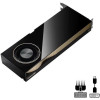
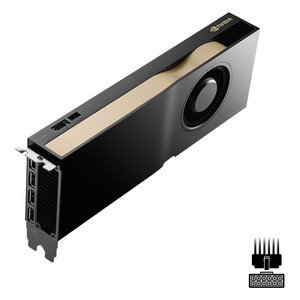
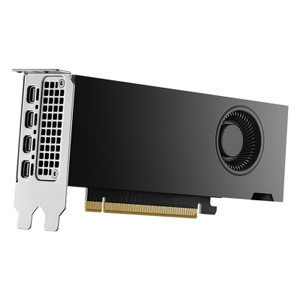
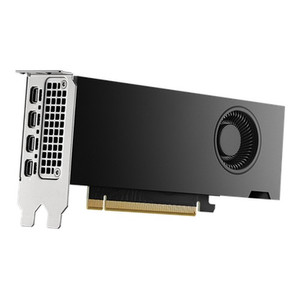
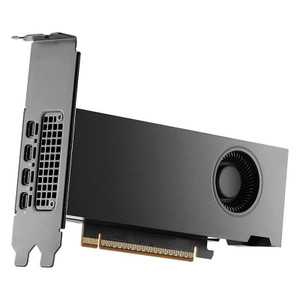
PNY VCNRTX6000ADA-TAA Trade Compliant NVIDIA ADA Lovelace GPU
Overview
The PNY VCNRTX6000ADA-TAA is a dual-slot, full-height professional compute accelerator built on NVIDIA's ADA Lovelace architecture. With 48 GB of GDDR6 memory, 568 Tensor cores, and 142 RT cores, this card is engineered for compute-intensive workloads in surveillance analytics, AI model inference, and real-time video processing in regulated environments. The TAA designation indicates compliance with U.S. trade requirements, making it suitable for government and federally funded projects. The VCNRTX6000ADA-TAA delivers 91.1 TFLOPS of single-precision performance and 210.6 TFLOPS of RT core performance—enough throughput to process multiple 4K video streams with deep learning inference simultaneously without bottlenecking your storage or network infrastructure.
Key Features
- 48 GB GDDR6 Memory with 384-bit Interface: Supports large batch processing of video frames and persistent model loading. The 960 GB/s memory bandwidth means you can feed analytics pipelines with continuous 4K streams without memory access becoming the constraint.
- 568 Tensor Cores, 142 RT Cores: Tensor cores accelerate matrix operations in deep learning inference (detecting objects, counting people, analyzing behavior). RT cores handle real-time ray tracing and sparse tensor operations. Combined, they deliver 1457.0 TFLOPS of tensor performance—sufficient for multi-model inference on surveillance footage without CPU assistance.
- 91.1 TFLOPS Single Precision (FP32) Performance: Handles traditional compute tasks and mixed-precision workloads. In surveillance deployments, this translates to processing roughly 8–12 simultaneous 4K streams with inference per GPU, depending on model complexity.
- PCIe 4.0 x16 Interface: 32 GB/s bidirectional bandwidth. No PCI Gen 3 bottleneck—data moves between system RAM and GPU VRAM without throttling your inference latency. Pairs with modern server chipsets (Xeon Scalable 3rd-gen or newer, EPYC 7002/7003 series).
- 3x Encode and 3x Decode Engines (Including AV1): Offload video re-encoding at the edge. If you're ingesting H.264 streams and need to transcode to H.265 or AV1 for archival, dedicated hardware engines handle that without taxing Tensor cores. Critical in multi-source surveillance where storage cost is a factor.
- 4x DisplayPort 1.4a Connectors, Support for >4x 4096x2160 @ 120 Hz: Allows direct monitoring of inference output or live dashboards without a separate video card. Useful in SOCs where you're visualizing analytics results in real time.
- 300 W Total Board Power, 1x PCIe CEM5 16-pin Connector: Single power rail simplifies PSU provisioning. A 550–650 W PSU is sufficient in a dual-GPU surveillance appliance. Idle acoustics peak at 20 dBA (whisper-quiet); under full load, fans ramp to 47 dBA maximum—acceptable in a server room but not silent.
- vGPU and RTx Virtual Workstation Support: Virtualize this GPU across multiple VMs if you're running analytics in a Hyper-V or VMware environment. One physical card can serve 8–16 simultaneous inference pipelines at lower density per VM.
- CUDA 11.6, OpenCL 3.0, DirectCompute APIs: Broad software ecosystem. NVIDIA's CUDA Toolkit and cuDNN support TensorFlow, PyTorch, and OnnxRuntime inference frameworks used in most surveillance analytics platforms.
- Operating Range: 0°C to 45°C (Inlet); GPU Target 85°C: Designed for server racks. The 45°C max inlet temperature is standard for data centers; GPU throttling begins at 100°C and shutdown occurs at 105°C, providing thermal margin in normal HVAC conditions.
Integration & Compatibility
The VCNRTX6000ADA-TAA is PCIe 4.0 native, compatible with x16 slots on modern server platforms (Intel Xeon Scalable 3rd-gen, 4th-gen; AMD EPYC 7002, 7003, 7004 series). It integrates with popular surveillance analytics stacks via NVIDIA's DeepStream SDK, Triton Inference Server, and container-based architectures (Docker, Kubernetes). DirectX 12, OpenGL 4.6, and Vulkan 1.3 support ensures compatibility with Windows Server and Linux workloads. RDMA (Remote Direct Memory Access) support enables GPU-to-GPU communication in cluster configurations, reducing latency when distributing video analysis across multiple appliances. The TAA compliance status confirms this specific SKU is eligible for U.S. government contracts and federally funded procurements without additional sourcing restrictions.
Frequently Asked Questions
Q: Is the VCNRTX6000ADA-TAA compliant with U.S. trade restrictions (TAA/NDAA Section 889)?
A: Yes. The TAA designation on the VCNRTX6000ADA-TAA confirms it meets U.S. trade compliance requirements for government and federally funded surveillance projects. Verify final system-level compliance with your procurement officer, as integration into a larger appliance may introduce additional sourcing considerations.
Q: What real-time inference throughput can I expect from the VCNRTX6000ADA-TAA?
A: Throughput depends on model architecture and frame resolution. In typical surveillance scenarios (e.g., person detection on 4K @ 30 fps), expect 8–12 simultaneous streams per GPU using modern efficient models (YOLO v8, MobileNet). Heavier models (e.g., ResNet-50 with metadata extraction) may reduce this to 4–6 streams per GPU.
Q: Does the VCNRTX6000ADA-TAA require external cooling?
A: No external cooling required. The card includes dual axial fans rated to 47 dBA maximum under full load. In a standard server rack with front-to-back airflow and inlet temperature ≤ 45°C, passive operation is not practical—keep the GPU in active cooling mode. Monitor inlet air temperature in your rack layout.
Q: Can I use the VCNRTX6000ADA-TAA in a virtualized surveillance environment?
A: Yes. NVIDIA vPC and RTx Virtual Workstation support allows this GPU to be partitioned across multiple virtual machines. One physical card can serve 8–16 VMs at lower utilization per VM, useful in shared analytics infrastructure.
Q: What's the power supply requirement for a system with two VCNRTX6000ADA-TAA cards?
A: Two cards draw 600 W combined (300 W each). Size your PSU to 850–1000 W to account for CPU, memory, storage, and thermal headroom. A quality 80+ Gold or Platinum rated unit is recommended for surveillance appliances running 24/7.
Q: Is manufacturer warranty included with the VCNRTX6000ADA-TAA?
A: Warranty terms depend on your vendor and purchase context. Confirm warranty coverage directly with your supplier—this information is not standardized across channels.
The VCNRTX6000ADA-TAA is a solid choice for building a scalable video analytics appliance in regulated environments. The 48 GB GDDR6 memory and 1457.0 TFLOPS tensor performance make it capable of handling multi-model inference pipelines—object detection, behavior analysis, anomaly flagging—all running in parallel on 4K streams. The TAA compliance simplifies procurement in government and federally funded projects, eliminating supply-chain friction that would otherwise delay deployment. One detail that matters: the 960 GB/s memory bandwidth ensures you're not waiting on memory access while your Tensor cores are idle. That's a real advantage when processing high-frame-rate video feeds.
Technical Highlights:
- 568 Tensor cores with 1457.0 TFLOPS: Enough headroom to run two heavy inference models per stream (detector + classifier) or one model across 8–12 streams simultaneously. In surveillance, that means you can deploy complex, accurate models without needing a farm of GPUs.
- 3x encode/decode engines with AV1 support: If you're managing video archival at scale, these engines offload re-encoding work. You ingest H.264, transcode to H.265 or AV1 for storage, all without stealing cycles from analytics pipelines. That's where cost savings happen.
- PCIe 4.0 x16 with RDMA: 32 GB/s effective bandwidth and RDMA support mean you can cluster multiple VCNRTX6000ADA-TAA cards across appliances with sub-millisecond GPU-to-GPU communication. Useful if you're building a distributed edge analytics system across multiple sites.
- 300 W single power rail: Keeps PSU sizing simple and reduces cabling complexity in appliance design. Two cards draw 600 W—manageable in a compact 2U or 1U form factor with a decent 850–1000 W PSU.
Deployment Considerations:
- The 45°C max inlet air temperature is a real constraint in some environments. If your data center ambient exceeds 35–37°C regularly, verify cooling strategy with your facilities team before committing to a dense configuration (e.g., 4 GPUs in 2U).
- TAA compliance covers the GPU itself, but verify your entire system (motherboard, CPU, NIC, SSD) meets trade requirements if this is for a U.S. government contract. The GPU is compliant; the appliance is only compliant if every component is sourced accordingly.
- NVIDIA vGPU licensing is separate and required if you virtualize this card. Budget for vPC or RTx licensing on top of hardware cost.
Build the VCNRTX6000ADA-TAA into a containerized analytics platform (DeepStream + Triton Inference Server) running on Linux, and you have a high-throughput, TAA-compliant edge analytics engine suitable for federal law enforcement operations centers, border security facilities, or DoD-affiliated surveillance networks.