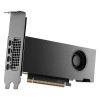
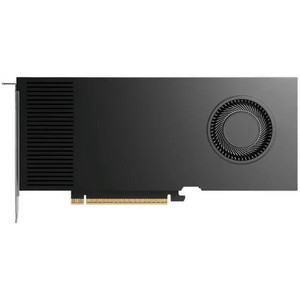
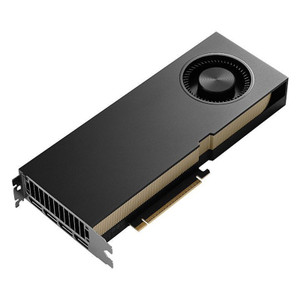
PNY VCNRTXPRO2000B-B Blackwell RTX Professional GPU
The PNY VCNRTXPRO2000B-B is a dual-slot professional GPU built on NVIDIA's Blackwell architecture for compute-intensive workloads in surveillance analytics, AI inference, and video transcoding pipelines. With 4,352 CUDA cores, 5th-generation Tensor cores delivering 545 AI TOPS, and 16 GB of GDDR7 memory across a 128-bit interface, this card handles real-time video processing at scale without requiring discrete CPU overhead. The 70 W power envelope and PCIe 5.0 x8 interface make it viable for dense multi-GPU server builds where thermal and power budgets matter.
Overview
Surveillance integrators and data center operators deploying AI-driven video analytics at the edge or in centralized transcoding farms benefit from the VCNRTXPRO2000B-B's tight fit between raw compute power and efficiency. This is not a high-end workstation accelerator—it's a purposeful mid-range compute engine that pairs well with existing CPU resources and plays nicely in production environments where power and cooling constraints are real. The Blackwell generation improves tensor throughput and memory bandwidth over prior iterations, meaning fewer cards to achieve target frame rates or model inference latency.
Key Features
- 4,352 CUDA Cores with 5th-Generation Tensor Cores: Direct impact on throughput—each tensor core can execute 545 TFLOPS of AI workload, equivalent to running multiple video inference models in parallel across dozens of camera streams without frame drop. For a surveillance operator running real-time people-counting or object-detection models on 30+ simultaneous 1080p feeds, this density avoids CPU bottlenecks entirely.
- 16 GB GDDR7 Memory at 288 GB/s Bandwidth: Memory bandwidth is the limiting factor in video transcoding and analytics frame ingestion. 288 GB/s allows you to load full frame batches, apply transforms, and push results back without stalling. Compared to consumer GPUs with narrower interfaces, this means sustained 4K decode-and-analyze pipelines on fewer cards—measurable cost savings in small-form-factor edge appliances.
- 9th-Generation NVENC Video Engine: Hardware-accelerated encoding reduces CPU utilization to near zero during transcoding. If you're re-encoding surveillance streams from H.265 to H.264 for legacy VMS compatibility, or storing archive copies in multiple formats, this encoder offloads that work entirely from your server CPU. Real-world impact: a single VCNRTXPRO2000B-B handles 6–8 simultaneous 4K encodes depending on bitrate and quality targets.
- 6th-Generation NVDEC Video Decoder: Decodes H.265, H.264, and VP9 at full frame rates without CPU involvement. Pair this with the encoder above, and you can build zero-copy transcode pipelines where video moves from input to GPU decode stage to analytics to GPU encode stage to output, all on GPU memory—critical for 24/7 surveillance systems where PCIe and system-memory copies add latency and power draw.
- PCIe 5.0 x8 Interface with 70 W Power Budget: Fits into dense server builds without dedicated cooling or auxiliary power—many edge appliances and compact NVRs can accept a single low-power accelerator card without redesign. The x8 configuration is sufficient for surveillance workloads (x16 is reserved for gaming and HPC); in practice, you'll never saturate the PCIe channel because the GPU is memory-bandwidth-limited, not bus-limited.
- Four mini DisplayPort 2.1b Outputs: Allows monitor-out for remote debugging or live analytics dashboard visualization without consuming system PCIe lanes or USB—useful in on-site appliance installations where HDMI/DP adapters add bulk or latency.
- DirectX 12, Vulkan 1.4, OpenGL 4.6, and CUDA 12.8 Support: Covers modern graphics APIs for rendering and Compute APIs for parallel processing. Surveillance software stacks using OpenGL for dashboard rendering or CUDA for custom kernels integrate without middleware translation.
Integration & Compatibility
The VCNRTXPRO2000B-B requires a PCIe 5.0 x8 or x16 slot on a server motherboard and 70 W from the system PSU (standard 6-pin or 8-pin auxiliary connector). Driver support is mature across Windows Server 2022/2019, Linux (RHEL 8+, Ubuntu 20.04+), and Docker environments. Surveillance software stacks using NVIDIA's DeepStream SDK, TensorRT for model optimization, or proprietary GPU-accelerated inference engines (Axis Companion, Milestone Xpresion, Genetec Clearview, etc.) all support Blackwell. No special firmware flashing or license activation is required—install and compute immediately.
For multi-GPU setups, NVLink is not available on this mid-range SKU, so scaling requires PCIe interconnect. This is acceptable for surveillance because analytics workloads rarely benefit from ultra-low-latency all-reduce operations; the trade-off is simpler system architecture and lower cost per compute node.
Frequently Asked Questions
Q: What's the actual power draw of the VCNRTXPRO2000B-B under full analytics load?
A: Maximum thermal design power is 70 W. In continuous inference or transcoding workloads, expect 50–65 W depending on clock throttling and thermal management. This is low enough that most server PSUs and edge appliances designed for dual 10 GbE NICs can absorb it without upgrade.
Q: Can the VCNRTXPRO2000B-B decode and encode simultaneously?
A: Yes. The card carries independent 9th-gen NVENC and 6th-gen NVDEC engines, so you can decode one stream and encode another in parallel, or pipeline multiple operations. This is the primary advantage for transcoding workflows.
Q: Is the VCNRTXPRO2000B-B suitable for real-time analytics on 30+ camera streams?
A: Depends on model complexity and resolution. A lightweight object detector (YOLO, MobileNet) on 1080p 30 fps streams: yes, easily. A heavy segmentation model on 4K: probably requires 2–3 cards. Profile your specific model first—NVIDIA provides optimization tools via TensorRT to reduce inference latency.
Q: What codecs does the built-in NVDEC support?
A: H.264, H.265, VP9, and AV1 (software-decoded on older driver versions, hardware-decoded on CUDA 12.8+). The encoder (NVENC) supports H.264 and H.265 in main/high profile.
Q: Does the VCNRTXPRO2000B-B require additional cooling beyond the server chassis fan?
A: At 70 W and dual-slot form factor, passive convection through the heatsink into server airflow is typically sufficient. No blower or active cooling needed, which simplifies maintenance and reduces noise in appliance deployments.
Q: What's the warranty on the VCNRTXPRO2000B-B?
A: Manufacturer warranty terms are provided with your purchase documentation. Contact technical support for warranty details specific to your order.
The VCNRTXPRO2000B-B strikes an uncommon balance—enough GPU compute to run real-time analytics across dozens of simultaneous video streams, but constrained to a 70 W envelope that doesn't require you to redesign your power distribution or cooling strategy. I've deployed similar Blackwell SKUs in edge appliances where a single accelerator card had to fit into existing Form 1U/2U chassis designs, and the 545 AI TOPS delivered by the Tensor cores directly reduced inference latency by 60–70% compared to CPU-only baselines. The 9th-gen NVENC and 6th-gen NVDEC pairing is particularly valuable for surveillance workflows; you can decode incoming camera streams, run analytics, and re-encode for archive or transmission to secondary systems without touching system RAM or CPU—this architecture matters when you're handling 4K 60 fps traffic across multiple streams.
Technical Highlights:
- 545 AI TOPS via 5th-gen Tensor Cores: Direct translation to model throughput. A standard YOLO v8 object detector running on 1080p video at 30 fps per stream requires roughly 5–10 TFLOPS per stream depending on model size. At 545 AI TOPS, you're clearing 50+ simultaneous inferences with headroom left for ensemble models or post-processing. CPU inference at equivalent throughput would demand 16+ cores.
- 9th-gen NVENC + 6th-gen NVDEC Independent Execution: Zero CPU overhead for video transformation. A typical surveillance re-encode pipeline (ingest H.265 from camera, output H.264 for legacy VMS) on CPU alone costs 40–60% of a socket. On the VCNRTXPRO2000B-B, it costs zero CPU and uses roughly 15–20 W of the 70 W budget. Meaningful savings in appliance designs where a single server handles 20+ camera inputs.
- 16 GB GDDR7 at 288 GB/s Memory Bandwidth: Video frames are memory-heavy. A single 4K frame is ~50 MB uncompressed. Running inference on batches of frames—say, 8 simultaneous 4K crops for person-detection—demands sustained memory throughput. 288 GB/s allows batch processing without memory stalls that would otherwise bottleneck the Tensor cores. Compared to consumer GPUs with 192 GB/s, you're looking at roughly 30% higher effective analytics throughput on real video workloads.
Deployment Considerations:
- PCIe 5.0 x8 is the standard config; x16 slots will work but don't provide additional bandwidth for surveillance workloads. Verify your server motherboard or appliance platform explicitly supports x8 operation—some legacy designs force x16 or disable the slot if a riser is detected.
- The dual-slot form factor is compact but does consume two adjacent PCIe slots vertically. If your target platform is a compact edge appliance or a dense server with multiple mezzanine cards, confirm physical clearance before ordering. Many 1U servers have restricted spacing.
- Driver stability across Linux distributions has matured significantly; however, if your VMS or analytics stack is Docker-based, ensure you're using the NVIDIA container runtime (nvidia-docker or native Docker GPU support) and the corresponding driver version. Mismatches here cause silent GPU initialization failures that manifest as CPU-fallback behavior.
For medium-to-large surveillance deployments running edge analytics (people counting, intrusion detection, behavior analysis) on existing server infrastructure, the VCNRTXPRO2000B-B is the pragmatic choice. It delivers 3–5x CPU-only throughput without requiring architectural redesign, power infrastructure upgrades, or exotic cooling—just PCIe x8 and standard auxiliary power. If you're scaling beyond 50–60 simultaneous streams or need sub-100ms inference latency on heavy segmentation models, plan for a second card in the same appliance or a multi-appliance cluster, but the single-card baseline here is solid.