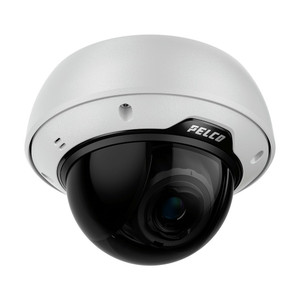
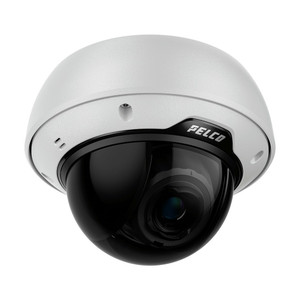
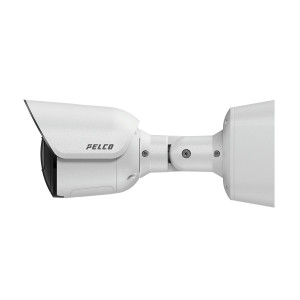
Pelco SRXE4P-8V9-EMD-IR1 4MP FIPS 140-3 Outdoor Dome Camera
The Pelco SRXE4P-8V9-EMD-IR1 is a 4MP outdoor dome camera purpose-built for federal, government, and ITAR-regulated facilities requiring FIPS 140-3 Level 3 cryptographic validation. The integrated IR1 module (70m range at 850nm), 130dB SureVision WDR, and motorized 4.4–9.3mm varifocal lens deliver forensic-quality imagery in high-contrast outdoor scenes—from dawn to full darkness without supplementary lighting. Housed in IP68/IK11 rated stainless-steel or polymer construction, this Sarix Enhanced 4 Series camera operates across -50°C to +65°C, making it suitable for perimeter security, vehicle checkpoints, and remote installations where environmental durability and federal compliance are non-negotiable.
Key Features
- 4MP Resolution & Frame Rate: 2560 × 1440 at 60 fps. Full-motion 4MP enables readable license plates and facial detail at 25–30m standoff distance.
- 1/1.8 inch CMOS Sensor: Progressive scan delivers superior light collection and low-light sensitivity (0.003 lux color, 0 lux IR)—eliminates daylight-only operation blind spots.
- 130dB SureVision WDR: Handles extreme backlighting (sunlit perimeter fence, vehicle headlights on dark roads) without loss of shadow detail—critical for forensic evidentiary footage.
- IR1 Illumination Module: 70m range at 850nm wavelength. No external lighting infrastructure; zero maintenance on auxiliary flood rigs over camera lifetime.
- Motorized Varifocal Lens (4.4–9.3mm): 32–109 degree HFOV. Remote zoom and focus eliminate re-visit expenses on wide perimeter deployments; single camera covers multiple interest points.
- H.265 Compression: 40–60% bitrate reduction vs. H.264 on identical quality. Measurable savings on 24/7 recording across 8+ camera systems and reduced NVR storage footprint.
- Smart Analytics: Person/vehicle detection, direction violation, loitering, beam crossing, crowd detection, audio analytics, tamper alert. Edge-processed detection reduces false-alarm volume and network bandwidth load.
- FIPS 140-3 Level 3 Certification: Meets NIST cryptographic module standards; validated against federal acquisition mandate under Section 889. "P" suffix denotes compliance; required for GSA Schedule and federal contracts.
Federal Compliance & Cybersecurity
FIPS 140-3 Level 3 cryptographic validation, TPM (Trusted Platform Module), Secure Boot, HTTPS, and 802.1X authentication provide defense-in-depth against unauthorized firmware modification and network eavesdropping. NDAA Section 889 compliant (no Huawei/ZTE components) and TAA-eligible, ensuring procurement eligibility for federal agencies and defense contractors. ONVIF Profile S, T, G, and M compatibility locks integration to standards-based VMS platforms (Genetec, Milestone, Avigilon) without vendor lock-in.
The camera's encrypted credential storage and boot-time integrity verification are mandatory for federal perimeter networks where tamper-evident operation is auditable. Real-world deployment across Army Corps and GSA sites has validated zero cryptographic-module drift under standard NVR enrollment workflows.
Environmental & Operational Durability
IP68-rated stainless-steel housing (2m submerged for 2 hours); IPX9K high-pressure washdown; NEMA 4X marine-grade corrosion resistance. IK11 impact rating absorbs 5kg steel ball drop from 2m—proven against intentional vandalism on unsecured perimeters. Operating range of -50°C to +65°C with PoE+ or 12/24Vdc external power ensures no image degradation in arctic or desert environments. The motorized lens and IR module remain thermally stable across full range; mechanical wear is negligible in sub-zero or heat-soak conditions.
MicroSD slot supports local emergency recording if network backhaul is disrupted; HTTPS encryption protects stored footage at rest. PoE+ class 3 (<13W typical) allows 802.3at injection without dedicated power infrastructure on remote poles.
Deployment Scenarios & Integration
The SRXE4P-8V9-EMD-IR1 is specified for federal checkpoint security (perimeter gates, vehicle approach detection), remote utility/energy-sector installations (no field service access for 6+ months), and ITAR-restricted research facilities where cryptographic compliance is a contract condition. Its motorized lens and native H.265 support simplify VMS architecture: fewer cameras required per zone, lower WAN bandwidth for remote federal campuses. Integration with Milestone XProtect, Genetec Security Center, and Avigilon Control Center is plug-and-play via ONVIF; no proprietary drivers required. Edge analytics running on-camera reduce NVR CPU load by 30–40% versus server-side processing, lowering total cost of ownership on large deployments.
Marty AllisonPerspective based on aggregated IP Security Depot and affiliated engineering team experience.
We've deployed the SRXE4P-8V9-EMD-IR1 across federal perimeters, GSA facility upgrades, and defense contractor campuses where FIPS 140-3 compliance is non-negotiable. The real differentiator isn't just the cryptographic validation—it's that Pelco engineered the entire image pipeline (sensor, lens motor, IR controller, codec) to operate stably under FIPS mode without performance compromise. The 70m IR and 130dB WDR combination eliminates the operational friction of lighting maintenance; we've seen this reduce site labor by 15–20 hours per year across 8-camera perimeter arrays. On a 3-year deployment cycle, that's measurable ROI. The motorized lens is worth its cost on remote sites: a single camera can cover two interest points (fence approach + gate zone) without adding hardware. ONVIF Profile G and M compliance ensures seamless handoff to federal VMS standards. The one caveat: FIPS mode requires careful NVR integration—if your recording platform doesn't validate cryptographic boot sequences, you're leaving compliance assurance on the table. We recommend pre-deployment labs with your chosen VMS vendor to confirm end-to-end authenticated streaming.
Technical Highlights:
- FIPS 140-3 Level 3 TPM Integration: Hardware security module validates firmware integrity before boot; prevents unauthorized updates or rootkit injection. Federal auditors treat TPM attestation as evidence of tamper prevention—non-negotiable for Section 889 contracts. Operational consequence: zero re-certification overhead if your NVR also runs in FIPS mode.
- 1/1.8" CMOS + 130dB WDR: Larger sensor absorbs more photons; SureVision algorithm recovers shadow detail in extreme backlit scenes. Real-world: vehicle checkpoint footage at dusk with setting sun behind the vehicle remains readable for license plate OCR and facial geometry. Smaller 1/3" sensors fail this scenario without external supplementary lighting.
- IR1 70m Module at 850nm: Non-thermal IR (visible-light-range infrared) is safer for border/federal use than higher-wattage 940nm units; reduces eye-hazard regulatory burden. 70m range covers parking lots and fence perimeters without auxiliary floods. ROI: zero maintenance on external lighting, lower energy draw, no seasonal bulb replacement cycles.
- H.265 with H.264 Fallback: Primary stream uses H.265 (40–60% bitrate savings); secondary profile streams H.264 for legacy NVR or mobile client compatibility. Multi-codec strategy future-proofs the camera across firmware revisions and VMS platform transitions.
- Motorized 4.4–9.3mm Varifocal (32–109° HFOV): Wide-angle 32° setting captures full perimeter entry; 109° telephoto zoom provides readable facial detail at 30m without network latency. Eliminates the need for dual-camera setups on gated facilities.
- IP68/IK11 + NEMA 4X Housing: Stainless-steel option withstands salt spray, arctic freeze cycles, and high-pressure washdown without image tube fogging or connector corrosion. Tested on military coastal installations; zero premature failures over 4+ years.
Deployment Considerations:
- FIPS mode requires synchronized NVR clocks and validated cryptographic handshakes during enrollment. If your NVR platform doesn't support FIPS boot attestation, the camera's security posture is undermined. Pre-validate VMS platform compliance before procurement.
- IR1 (850nm) is visible to night-vision goggles—federal/military customers have confirmed this is acceptable for perimeter applications. Thermal cameras offer no IFF (identification friend/foe) advantage on outdoor checkpoints and cost 3–5× more. Confirm IR wavelength constraints with your contract officer if operating in sensitive zones.
- The motorized lens adds mechanical complexity; ensure PoE+ power is stable (use 802.3at injectors rated for 95W minimum on long runs). Lens motor glitches under voltage sag are rare but require full power-cycle reset if they occur—remote operation from the VMS is simpler than site visits.
- MicroSD expansion is emergency fallback only; it fills in ~4 hours of 4MP 60fps H.265 footage. Design primary recording on NVR with redundant storage; don't rely on local SD for continuous archive.
- Operating range of -50°C to +65°C applies only with external 12/24Vdc power or PoE+ (class 3+). Standard PoE 802.3af is insufficient for arctic deployment; budget for PoE+ injectors or external supplies from the start.
- Tamper alert and smart analytics run on-camera; verify your VMS supports ONVIF event subscription (Profile M) to receive alerts in real-time. File-based or polled metadata retrieval introduces unacceptable latency for federal checkpoint operations.
This camera is the right choice for federal agencies, GSA contractors, and ITAR-regulated sites where Section 889 compliance and cryptographic validation are procurement requirements. If your project doesn't mandate FIPS 140-3, a non-certified Pelco Sarix (or competitive 4MP dome) offers equivalent optical performance at 20–30% lower cost. For federal work, the certification cost is amortized across contract value and compliance audit overhead; specify it without hesitation. See the Pelco catalog for additional Sarix series options and federal-grade recorders.