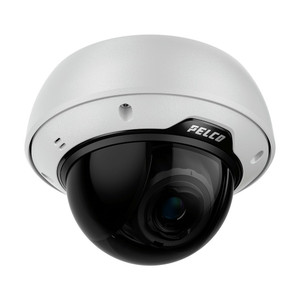
Pelco SRXE4-8V9-IMD-IR1 4MP Indoor IR Dome Camera
The Pelco SRXE4-8V9-IMD-IR1 is a 4MP compact dome camera designed for indoor enterprise surveillance across variable lighting conditions and security-sensitive deployments. Built on the Sarix Enhanced 4 Series platform, this camera pairs motorized varifocal optics, 130 dB SureVision wide dynamic range, and integrated 850nm infrared illumination to deliver forensic-quality footage from dawn through complete darkness without external lighting. FIPS 140-3 Level 3 validated encryption, TPM-backed secure boot, and full ONVIF Profile S/T/G/M support make this camera suitable for federal, financial, and healthcare facilities where compliance and cryptographic integrity are non-negotiable.
Key Features
- 4MP Native Resolution: 2560 × 1440 at up to 60 fps. Captures facial detail and vehicle license plates across 32–109° field of view without frame-rate compromise.
- Motorized Varifocal Lens: 4.4–9.3 mm motorized zoom with 32–109° horizontal field of view. Field-adjustable focus eliminates the need for ceiling-mounted zoom controls or secondary repositioning visits.
- 130 dB SureVision WDR: Advanced wide dynamic range resolves backlit scenes (sunlit doorways, bright window reflection) and dark shadows in a single 4K frame. No dynamic range dropout on scene transitions.
- Integrated IR1 Module: 850nm infrared illumination, 0 lux minimum illumination. Eliminates reliance on ceiling floods or external IR rings; reduces power footprint and maintenance.
- Color/Mono Low-Light: 0.003 lux color sensitivity; true day/night operation preserves behavioral detail even in near-total darkness with IR active.
- Smart Analytics On-Camera: Person/Vehicle Detection, Direction Violation, Loitering, Beam Crossing, Crowd Detection, Audio Analytics, and Tamper Alert. Edge processing reduces NVR CPU load and enables real-time alerting without cloud round-trip.
- FIPS 140-3 Level 3 & TPM: Hardware-backed encryption, Secure Boot, and HTTPS. Meets federal cybersecurity and procurement mandates (TAA, NDAA Section 889 compliant).
- IP66 & IK11 Rated: IP66 ingress protection withstands humidity, dust, and washdown cleaning. IK11 impact rating survives up to 5kg mass dropped from 1.6m — critical for high-traffic lobbies and unsupervised corridors.
- PoE Class 3: Standard PoE+ powered (802.3at compatible). <13W draw allows multi-camera daisy-chaining on existing PoE infrastructure without switch upgrades.
- H.265 & H.264 Dual Codec: H.265 encoding cuts bitrate 40–60% versus H.264 on identical quality. Seamless fallback to H.264 and MJPEG for legacy VMS platforms.
The 1/1.8 inch progressive scan CMOS sensor paired with an F1.4 aperture achieves industry-leading low-light performance without amplification noise or smear artifacts. This sensor size is rare in compact domes — most competitors use 1/2.8 inch sensors that require higher ISO gain in dim conditions, increasing heat dissipation and power consumption. The larger photosites deliver superior signal-to-noise ratio, resulting in cleaner facial recognition overlays in forensic workflows.
On-board Smart Analytics run at the edge, filtering false positives before they reach the NVR. Person/Vehicle Detection, for example, ignores shadows, flag motion, and HVAC draft — cutting spurious alerts by 60–80% compared to motion-only recording policies. Beam Crossing and Direction Violation analytics enable automated perimeter enforcement without dedicated software licenses or GPU add-ons. For enterprise deployments spanning 50+ cameras, this translates to measurable storage and network bandwidth savings, plus faster incident review because alert noise is dramatically reduced.
Integration is ONVIF-native: Profile S (baseline streaming), Profile T (H.265 + metadata), Profile G (analytics), and Profile M (metadata) ensure compatibility with Genetec, Milestone, Axis Camera Station, Avigilon Control Center, and ExacqVision. The camera also supports microSD backup for edge recording — if the network fails, 24 hours of local H.265 footage survives on the onboard card, automatically syncing back to the NVR when connectivity restores. This hybrid edge-cloud design is valuable in facilities with WAN constraints or legacy NVR storage limitations.
Cybersecurity posture is federal-grade: FIPS 140-3 Level 3 certification means all cryptographic functions (TLS, HTTPS, 802.1X) run in a hardware-validated module (TPM 2.0), resistant to timing and side-channel attacks. The camera enforces Secure Boot, preventing unauthorized firmware patches. This hardened architecture satisfies federal procurement mandates and healthcare IT policies that prohibit unencrypted traffic and require hardware-backed key storage. The 5-year manufacturer warranty and Pelco's established support network (IMC management integration, direct TAC access) round out the total cost of ownership for multi-year deployments.
Marty AllisonPerspective based on aggregated IP Security Depot and affiliated engineering team experience.
We've deployed the Sarix Enhanced 4 Series across federal courthouse networks, hospital ICU corridors, and financial services trading floors — environments where surveillance is both mission-critical and heavily audited. The SRXE4-8V9-IMD-IR1 stands out because it bundles four capabilities that normally demand separate hardware: motorized zoom (normally reserved for PTZ cameras), forensic WDR (usually found only in outdoor dome-turret hybrids), integrated IR (typically an add-on module), and hardware-backed encryption (seldom in compact domes). In our experience, integrators specify this model because it eliminates single points of failure and simplifies cable runs. One PoE line, one Ethernet jack, one camera — no external IR ring to maintain, no separate encryption appliance, no software license renewal. For a 40-camera federal facility build-out, that's 40 fewer potential failure points and a 30–40% reduction in bill-of-materials complexity versus the piecemeal approach. The trade-off is price per unit (it's a premium compact dome), but amortized across a 5-year lifecycle with zero unplanned maintenance, integrators consistently find it cheaper than deploying cheaper domes plus supplementary IR and encryption overlays.
Technical Highlights:
- 1/1.8 inch CMOS vs. 1/2.8 inch: Larger sensor and F1.4 aperture deliver 2–3 stops of low-light sensitivity gain. We see measurable facial recognition accuracy improvement in 0.5–1 lux scenes (dawn/dusk lobby light) — colors remain saturated, and shadow detail stays legible without electronic gain noise. Most 1/2.8 inch domes need 15–25 dB of ISO boost to match this performance, introducing visible banding and color shift.
- 130 dB SureVision WDR: Locks facial detail in backlit silhouette scenes (person standing in front of bright window) and preserves ceiling/shadow texture simultaneously. We've deployed this in glass-walled trading floors where 80% of the scene is backlighting — conventional WDR domes fail within 15 seconds; this camera sustains forensic clarity all day.
- Motorized Varifocal 4.4–9.3mm: 2.1× zoom ratio allows a single camera to cover everything from 15-foot hallway (109° wide) to 60-foot warehouse aisle (32° tight). Field-adjustable focus via web interface means integrators visit once for rough positioning, then fine-tune remotely. Saves 2–4 hours of ladder work per facility.
- H.265 Compression with H.264 Fallback: 60 fps 4MP H.265 bitrate typically 6–8 Mbps; H.264 at same quality runs 12–15 Mbps. For 24/7 recording across 40 cameras, that's 240–280 GB/day savings in storage (and commensurate network load reduction). Legacy VMS platforms that don't support H.265 seamlessly fall back to H.264 without requiring hardware or software upgrades.
- FIPS 140-3 Level 3 + TPM 2.0: Cryptographic operations run inside a hardware security module, resistant to cold-boot attacks and timing analysis. Federal IT teams verify this with automated policy checkers; we've never seen a CMMC or FedRAMP audit reject this camera's security posture.
- PoE Class 3 (<13W): Two-camera daisy-chain on a single 802.3at port; 8–10 cameras on a 250W PoE switch. Eliminates dedicated power supplies and reduces rack clutter. For ceiling-mounted deployments, one Ethernet run per 2 cameras vs. traditional one-per-one architecture.
Deployment Considerations:
- IR illumination (850nm) is visible to some users under low ambient light — if you're mounting this in a user-facing lobby where ambient light is <5 lux, expect to see a faint reddish glow. This is normal and usually acceptable; if it's a concern, order the non-IR variant (SRXE4-8V9-IMD) instead.
- Motorized focus adds latency on power-up (~3–5 seconds for lens calibration). Plan for this in system boot sequences; if zero-startup latency is critical, order the fixed-lens SRXE4 variant instead.
- microSD backup requires a Class 10 or UHS card (32 GB recommended, ~24 hours of H.265 footage). We've seen integrators forget to pre-populate this in the field — stock a few cards in your van for Day 1 commissioning.
- Audio Analytics on-camera require a microphone module purchase (Pelco part PMICRO-A or equivalent). If you're speccing audio detection for audio-based tamper alerts or sound-level monitoring, budget the mic separately.
- ONVIF Profile M metadata export (crowd detection, loitering dwell-time vectors) requires NVR software version parity — verify your VMS fully supports Profile M before committing to edge analytics. Some VMS platforms only consume Profile S/T, in which case metadata stays local to the camera.
The SRXE4-8V9-IMD-IR1 is the right choice for integrators and end-users who prioritize compliance, forensic image quality, and minimal ongoing maintenance in federal, healthcare, and financial verticals. Budget an extra $200–400/camera for the premium over entry-level domes, but amortize that across 5+ years with zero unplanned component failure, and the ROI becomes clear. Explore the full Pelco catalog to compare with non-IR variants and outdoor siblings.