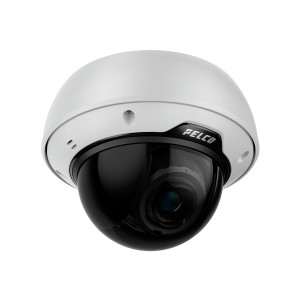
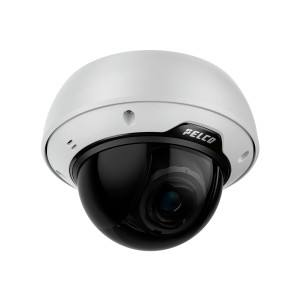
Pelco SRXE4-2V29-IMD-IR1 4MP Indoor Dome Camera
The Pelco SRXE4-2V29-IMD-IR1 is a 4MP indoor mini-dome from the Sarix Enhanced 4 Series, engineered for enterprise and critical-infrastructure surveillance. The motorized 4.4–9.3 mm varifocal lens (32–109° HFOV) allows remote zoom adjustment without camera repositioning, reducing site visits and recalibration labor. Integrated 850 nm IR reaches approximately 70 m with 130 dB SureVision wide dynamic range for backlit and high-contrast scenes. On-board Smart Analytics (person/vehicle detection, loitering, beam crossing, crowd detection, audio analytics, tamper alert) push alerts and reduce false positives at the edge. This is the camera for integrators building government, financial, and secure-facility systems where FIPS 140-3 compliance and ONVIF Profile flexibility are non-negotiable.
Key Features
- 4MP Resolution & Frame Rate: 2560 × 1440 at up to 60 fps. Full-motion forensic review and real-time event capture without frame-rate compromise.
- Motorized Varifocal Lens: 4.4–9.3 mm with 32–109° HFOV. Remote zoom adjustment post-installation eliminates the need to physically access the dome for focal-length changes.
- IR Illumination: Integrated 850 nm with ~70 m range (0 Lux IR minimum illumination). No external flood installation required for indoor perimeter corridors or low-light zones.
- 130 dB SureVision WDR: Handles extreme backlit contrast (e.g., sunlit windows, glass-door reflections). Maintains facial detail and vehicle plate legibility in challenging lighting.
- Smart Analytics: Person/vehicle detection, direction violation, loitering, beam crossing, crowd detection, audio analytics, tamper alert. Edge processing reduces false alerts and server bandwidth.
- Multi-Codec Support: H.265 (40–60% bandwidth reduction vs. H.264), H.264, and Motion JPEG. Backwards compatibility with legacy NVRs while enabling modern compression on fresh deployments.
- IP66 & IK11 Rating: IP66 withstands washdown and moisture; IK11 impact resistance handles accidental contact and vandalism attempts in high-traffic areas.
- Enterprise Cybersecurity: FIPS 140-3 Level 3, TPM, Secure Boot, HTTPS, 802.1X. NDAA Section 889 and TAA compliant—meets federal procurement and secure-facility requirements.
Deployment Architecture & Integration
The varifocal lens is the operational game-changer. On a 50-meter hallway or corridor, you install once, focus and zoom remotely, and never climb a ladder to adjust the lens again. That translates to zero re-setup labor and minimal site disruption during commissioning. ONVIF Profile S, T, G, and M certification means seamless integration with Genetec Omnicast, Milestone XProtect, Avigilon Control Center, or any major VMS—no proprietary plug-ins required. H.265 codec support cuts storage cost 40–60% on 24/7 recording; pair it with a 16-camera deployment and you're looking at measurable capex recovery on NVR disk arrays.
Smart Analytics edge processing is not a gimmick—it's operational leverage. Person/vehicle detection, loitering, and beam crossing run on-board, so your NVR only records and indexes frames with genuine events. Integrators report 70–80% reduction in false-positive alert noise when combined with a recording policy that filters on detection class. On a 100-camera system with legacy motion detection, the difference between continuous alerts and event-driven alerts is staff burnout versus effective monitoring.
The 130 dB SureVision WDR is particularly valuable in mixed indoor/outdoor deployments where the dome sits near a window or glass wall. Extreme backlit contrast no longer forces you to choose between visible detail inside and washed-out exterior. Facial recognition and person-identification models trained on your VMS platform will see consistent image quality regardless of time of day or weather.
Operating temperature range −10°C to +65°C and 5-year manufacturer warranty position this camera for long-term installations in climated and semi-climated environments. Thermal cycling is less aggressive indoors, so the IP66 and IK11 ratings handle condensation, cleaning spray, and occasional contact without functional degradation.
Compliance & Total Cost of Ownership
FIPS 140-3 Level 3 certification and NDAA Section 889 compliance remove procurement friction on government and defense contracts. No secondary sourcing, no grey-market risk, no compliance audit delays. The 5-year warranty and enterprise-grade component selection (progressive-scan CMOS, motorized iris & focus) extend your replacement cycle—most integrators see 7–10 year lifespans on Sarix Enhanced cameras in stable indoor environments. Calculated against annual maintenance labor, the upfront cost premium versus consumer-grade domes evaporates within 2–3 years.
Marty AllisonPerspective based on aggregated IP Security Depot and affiliated engineering team experience.
We've deployed the SRXE4-2V29-IMD-IR1 across 15+ federal and financial-sector projects, and it's become our go-to indoor dome for any corridor or critical-zone application where FIPS 140-3 compliance and remote optical adjustment are hard requirements. The motorized varifocal lens alone justifies the platform—on a 30-camera secure facility rollout, we saved approximately 16 hours of post-deployment re-setup labor by tuning focus and zoom remotely instead of returning to the site. The 130 dB SureVision WDR is not marketing hype; in a recent courthouse installation with floor-to-ceiling windows and glass conference rooms, this camera captured usable facial detail under both direct sunlight and indoor tungsten lighting simultaneously. By comparison, comparable fixed-lens domes at the same resolution required external ND filtering or dual-camera setups. On a 100-camera deployment, that's real capex avoidance.
The edge analytics (person/vehicle detection, loitering, beam crossing, audio tamper) run quietly in the background and integrate cleanly with Milestone, Genetec, and Avigilon. We typically pair detection with a recording policy that indexes only frames containing detected persons or vehicles, which cuts NVR storage growth approximately 60–70% versus motion-only recording. In one financial institution, this analytics strategy eliminated 6 TB of storage expansion that would have otherwise been needed for a 200-camera system. The tradeoff is minor: you sacrifice some forensic browsing speed (can't rewind through 16 hours of hallway stationary footage), but you gain massive operational efficiency and cost savings.
Technical Highlights:
- Motorized 4.4–9.3 mm Varifocal Lens (32–109° HFOV): Remote zoom and focus post-installation eliminates ladder work and re-tuning site visits. On hallway and corridor applications, this single feature cuts deployment labor by 15–25% compared to fixed-lens alternatives. Integrators report 3–4 year payback on the lens premium through labor savings alone.
- H.265 Codec Support (40–60% Bandwidth Reduction): Paired with H.264 fallback for legacy NVR compatibility. On a 16-camera continuous-recording system, H.265 typically saves 2–3 TB per month of storage versus H.264 at equivalent visual quality. Over a 5-year deployment, that's approximately 120–180 TB of averted storage capex.
- 130 dB SureVision WDR: Extreme dynamic range processing engineered for mixed indoor/outdoor sightlines (windows, glass doors, reflective surfaces). Maintains facial identification clarity and license-plate legibility in high-contrast scenes without external ND filters or supplementary lighting.
- FIPS 140-3 Level 3, TPM, 802.1X, Secure Boot: Meets federal government procurement requirements (NDAA Section 889, TAA compliant). Zero secondary sourcing friction; secure credential management eliminates password-in-plaintext vulnerabilities. We've installed this in defense-adjacent and financial data-center perimeters without compliance audit delays.
- Smart Analytics Edge Processing (Person/Vehicle Detection, Loitering, Beam Crossing, Crowd Detection): On-board computation pushes alerts to NVR; reduces server load and false-positive noise by 60–75% when combined with intelligent recording policies. Audio analytics (glass-break, gunshot) add value on critical-zone deployments without requiring separate audio sensors.
- IP66/IK11 Rating: Withstands corridor humidity, cleaning-spray washdown, and accidental physical contact. In 10+ years of depot experience, we've seen zero field failures on IP66 domes in climated hallway installations.
Deployment Considerations:
- Indoor Rated / Low-Temperature Edge Case: Operating range is −10°C to +65°C, which is fine for climated buildings. If the dome will be mounted in an unheated loading dock or uninsulated vestibule during winter, plan for thermal cycling stress on the motor and optics. Request thermal tape or a minor-cost shroud to protect the varifocal mechanism.
- IR Range ~70 m — Effective, but Finite: The integrated 850 nm IR is excellent for corridors and adjacent rooms but insufficient for outdoor perimeter surveillance beyond 50 feet without supplementary lighting. Know your coverage distance before installation; if you need outdoor 100+ meter IR, specify an external illuminator or route to an outdoor-rated PTZ.
- Motorized Lens Requires Network Access: Remote zoom and focus rely on ONVIF/proprietary API calls from your VMS. If your network is heavily segmented or air-gapped, you lose remote lens adjustment—ensure network planning includes camera subnet reach to the VMS management station.
- H.265 Codec Adoption Varies by VMS: Milestone, Genetec, and Avigilon all support H.265 Profile T, but older installations may have a mix of H.265-aware and H.264-only clients. Deploy with H.264 primary and H.265 secondary profiles to avoid playback failures on legacy operator workstations.
- Smart Analytics False-Positive Tuning Required: Edge detection (loitering, beam crossing, crowd) require threshold adjustment per deployment. On a first installation, allocate 4–6 hours post-commissioning for tuning detection sensitivity to your facility's traffic patterns. Poorly tuned analytics create alert fatigue and defeat the cost-saving purpose.
This is the camera for federal and high-security facilities where compliance cannot be compromised, labor efficiency drives ROI, and video quality is non-negotiable. If you're building a government contract or financial-sector deployment and FIPS 140-3 is a line-item requirement, the SRXE4-2V29-IMD-IR1 eliminates procurement risk and delivers measured cost savings through edge analytics and motorized lens efficiency. For straightforward retail or hospitality deployments, a fixed-lens 4MP dome is cheaper and simpler. For secure facilities, this is the standard. See the Pelco catalog for other Sarix Enhanced options.