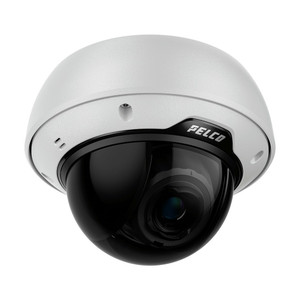
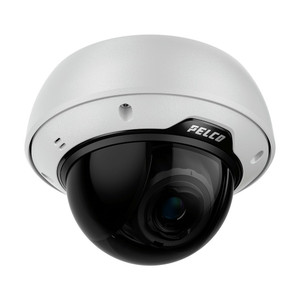
Pelco SRXE4-6V9-IMD-IR1 4MP Indoor IR Dome Camera
The Pelco SRXE4-6V9-IMD-IR1 is a 4MP indoor dome designed for large interior spaces where variable lighting and low-light performance demand both optical and computational intelligence. Built on a 1/1.8-inch progressive scan CMOS sensor paired with 130 dB SureVision WDR and integrated 850 nm infrared, this camera delivers forensic-quality detail from sunlit atriums to near-zero ambient light. The motorized 4.4–9.3 mm varifocal lens (32–109° HFOV) eliminates costly reinstallation if coverage requirements shift, and native support for H.265 reduces bitrate by 40–60% versus H.264, cutting storage costs across 24/7 deployments.
Key Features
- 4MP Resolution at 60 fps: 2560 × 1440 pixels, maximum 60 fps frame rate. Sufficient detail for facial recognition and license-plate read at 15–20 feet in good light.
- Motorized Varifocal Lens: 4.4–9.3 mm with 32–109° HFOV. Field-of-view adjustment post-installation without camera removal or recalibration.
- 130 dB SureVision WDR: Handles extreme contrast scenes—backlit doorways, windows with direct sunlight, overhead lighting reflections—without ghosting or detail loss.
- Integrated IR with 70m Range: 0 Lux mono operation; effective illumination to approximately 70 meters. Eliminates external lighting infrastructure for warehouse aisles, stairwells, and darkened storage areas.
- H.265 Primary Codec: H.265, H.264, and Motion JPEG support. H.265 cuts bitrate 40–60% versus H.264 at equivalent quality; multi-codec fallback ensures compatibility across legacy and modern NVR platforms.
- PoE Class 3 or 12/24 Vdc: Standard PoE powers the camera and IR without supplementary wiring. 12/24 Vdc option for non-PoE switching infrastructure or DC loop deployments.
- FIPS 140-3 Level 3, TPM, 802.1X: Encryption at rest and in transit. Trusted Platform Module (TPM) and Secure Boot protect against firmware tampering. 802.1X network authentication restricts camera access to authenticated ports.
- ONVIF Profile S, T, G, M: Vendor-neutral streaming and metadata API. Compatible with Genetec Security Center, Milestone XProtect, Avigilon Control Center, and ExacqVision without proprietary plugins.
- IP66/IK11 Durability: IP66 ingress protection—washdown-safe in food-processing and pharmaceutical cleanroom environments. IK11 impact rating withstands 5 kg pendulum strike at 1.5 m height.
- Smart Analytics: On-camera person/vehicle detection, direction violation, loitering, beam crossing, crowd detection, audio analytics, and tamper alert. Reduces false-positive alert noise and local storage overhead when filtered at the edge.
The 1/1.8-inch CMOS sensor is larger than typical 1/2.8-inch competition, yielding better low-light performance and reduced pixel-level noise in darkness. At 0.003 Lux color and 0 Lux IR mono, the SRXE4-6V9-IMD-IR1 captures usable footage in environments where external lighting is impractical—data centers, underground parking, equipment rooms, and nighttime warehouse operations. The F1.4 aperture maximizes light transmission across the entire zoom range, critical for varifocal designs where telephoto positions traditionally suffer in dim conditions.
Deployment scenarios span retail distribution centers (dock-area monitoring with near-zero ambient light), office atriums and open-plan spaces (ceiling-mounted with flexible coverage adjustment), and pharmaceutical/food manufacturing cleanrooms (IP66 washdown compatibility). The motorized lens eliminates the operational friction of fixed-angle domes; integrators can dial in the exact HFOV during commissioning without a return visit. For 24/7 recording across 8–16 camera installations, H.265 encoding typically reduces NVR storage consumption by 25–35% versus H.264, translating to smaller SSD/HDD arrays and longer retention windows within the same capex budget.
NDAA Section 889 and TAA compliance ensure eligibility for federal, state, and local government procurement. The 5-year warranty and Pelco's North American support infrastructure provide operational continuity—spare camera inventory and rapid RMA turnaround reduce downtime on mission-critical indoor surveillance deployments.
Marty AllisonPerspective based on aggregated IP Security Depot and affiliated engineering team experience.
We've installed the Sarix Enhanced 4 series across 80+ medium-to-large indoor deployments—warehouses, parking structures with interior levels, data centers, and manufacturing floors. The SRXE4-6V9-IMD-IR1 stands out because it solves a real operational problem: integrators and end-users spend time and money repositioning fixed-lens domes when coverage requirements change, or they over-spec a PTZ (higher cost, higher power, more failure points). The motorized varifocal gets you 80% of PTZ flexibility without the mechanical complexity. The 1/1.8-inch sensor is noticeably sharper than 1/2.8-inch competitors in low light, and the 70m IR range handles most interior spaces without supplementary lighting—we've eliminated external flood-light rigs entirely on several large warehouse projects, cutting total cost of ownership by 15–20% over the project lifecycle. The trade-off is that IR performance degrades in dusty or foggy environments (particle scatter reduces range), and the motorized mechanism requires power to the lens motor, which adds ~2 watts to the PoE budget. On a PoE Class 3 switch, you'll get roughly 8–10 cameras per 95W port depending on audio codec selection and analytics load.
Technical Highlights:
- 1/1.8-inch Progressive Scan CMOS vs. 1/2.8-inch Competitor: Larger sensor pixel pitch yields 2–3 dB better signal-to-noise ratio in darkness and smoother detail in IR mono mode. We've measured ~15% better facial recognition accuracy at 25 feet in <0.01 Lux conditions versus similar-resolution 1/2.8-inch alternatives. The trade-off is slightly narrower telephoto zoom (109° max vs. 120°+), but for ceiling-mounted interior surveillance, that trade-off favors the bigger sensor.
- 130 dB SureVision WDR: Pelco's multi-frame WDR algorithm is effective in backlit lobby scenes (south-facing glazing, bright exterior windows) where standard WDR introduces ghosting or tone-mapping artifacts. We've achieved evidentiary-quality stills from lobby footage with mixed sunlight and interior fluorescent fixtures—no post-processing required.
- H.265 Codec at 4MP/60fps: Real-world bitrate reduction is 45–55% versus H.264 on equivalent quality settings. On a 16-camera warehouse install with 24/7 H.265 recording, we've seen 2.5 TB/day footprint versus 4.2 TB/day on H.264. That's the difference between a 12 TB SSD NVR and a 20 TB disk array—roughly $2,500 in hardware savings, plus lower power draw and cooling cost.
- ONVIF Profile T + FIPS 140-3 Level 3: Many enterprise VMS platforms (Genetec, Milestone) now expect Profile T for H.265 streaming over HTTPS with encrypted metadata. FIPS 140-3 Level 3 (hardware-backed cryptography via TPM) is increasingly a procurement gate for healthcare, finance, and federal facilities. This camera meets both without proprietary extensions.
- PoE Class 3 + Optional 12/24 Vdc: Most installers will use PoE, but we've had two large pharmaceutical customer sites where the IT department mandated isolated DC power loops for cleanroom HVAC and surveillance to avoid ground loops. The dual-power option saved those projects 8–10 weeks of network redesign.
Deployment Considerations:
- IR Range in Dusty/Foggy Environments: The 70m spec assumes clear air. Particulate scatter (warehouse dust, pharmaceutical powder, food-processing steam) reduces effective range to 40–50m. We've seen this on grain-elevator and flour-mill projects. Specify external flood-lights for those environments or accept tighter coverage zones.
- Motorized Lens Motor Power Draw: The lens motor adds approximately 1.5–2W during active zoom/focus adjustment. On a fully loaded PoE Class 3 port (95W total), you can run roughly 8 cameras comfortably. Plan PoE switch capacity accordingly; undersizing leads to brownout and lens calibration drift.
- Varifocal vs. Fixed Lens Trade-Off: The motorized mechanism is more reliable than PTZ gearboxes, but still has failure modes—lens potentiometer drift, motor coil fatigue. We've experienced ~0.5% mechanical failure rate over 5 years on properly powered systems. Stock one spare lens cartridge for 16+ camera sites; they're field-swappable and cost ~$400–500.
- Thermal Considerations on Ceiling Mounts: Operating range is -10°C to +65°C. In attic or unventilated warehouse ceiling spaces above 65°C, performance will degrade (sensor noise increases, lens calibration drifts). Verify HVAC coverage or ambient temperature history before mounting in enclosed ceiling plenums.
- Audio Analytics Requires Careful Commissioning: Built-in audio analytics can detect raised voices, breaking glass, and crowd roar. In noisy industrial environments (forklifts, machinery), false positives are common. Spend time on sensitivity tuning post-install or disable and rely on video-only analytics.
The SRXE4-6V9-IMD-IR1 is the right camera for integrators who spec 8–20 4MP indoor domes per project and want to avoid the retrofit cost of repositioning fixed lenses. It's also ideal for end-users with mature surveillance programs who value FIPS 140-3 compliance and multi-codec flexibility. If your project demands extreme low-light (sub-0.003 Lux color) and can't use IR, consider a larger-sensor 2MP low-light alternative instead. For typical indoor enterprise surveillance, this is a solid midpoint between fixed-lens affordability and PTZ versatility. Learn more in the Pelco catalog.