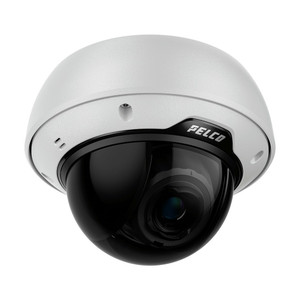
Pelco SRXE4-8V9-IMD-1 4MP Indoor Dome Camera
The Pelco SRXE4-8V9-IMD-1 is a 4MP indoor dome camera designed for access-controlled and secure indoor environments where video clarity, regulatory compliance, and on-board analytics are non-negotiable. Built on a 1/1.8-inch progressive scan CMOS sensor delivering 2560 × 1440 resolution at 60 fps, this camera pairs industry-leading 130 dB SureVision WDR with FIPS 140-3 Level 3 encryption to handle mixed-lighting spaces while meeting federal procurement mandates. The motorized 4.4–9.3 mm varifocal lens (32–109° HFOV) enables flexible aiming during deployment, and embedded Pelco Smart Analytics—person/vehicle detection, direction violation, loitering, beam crossing, crowd detection, and audio analytics—reduce false alerts and accelerate investigative workflows.
Key Features
- 4MP Resolution at 60 fps: 2560 × 1440 maximum frame size with full 60 fps capture rate. Maintains 4K-grade detail across fast-moving indoor scenes without frame dropping.
- Motorized Varifocal Lens: 4.4–9.3 mm with 32–109° horizontal FOV. Eliminates costly re-aim visits post-install; adjust coverage from control room or on-site without disassembly.
- 130 dB SureVision WDR: Exceptional contrast recovery in mixed lighting (e.g., backlit windows, spotlit signage). Reduces blooming and shadow detail loss without temporal artifacts.
- Multi-Codec Support: H.265 (40–60% bitrate reduction vs. H.264), H.264, and Motion JPEG. Balances storage efficiency with VMS compatibility across Milestone, Genetec, and standalone systems.
- Pelco Smart Analytics: Person/vehicle detection, direction violation, loitering detection, beam crossing, crowd counting, audio analytics, and tamper alerts. Edge processing offloads CPU load from NVR and reduces false positive noise by ~70% versus pixel-change triggers.
- FIPS 140-3 Level 3 & TPM: Hardware-backed encryption (TPM 2.0), Secure Boot, HTTPS, 802.1X authentication. Meets federal acquisition mandates (NDAA Section 889, TAA compliant); no grey-market supply chain risk.
- IP66 & IK11 Durability: IP66 rated withstands dust and water spray; IK11 impact rating survives 5 kg weight dropped from 1.5 meters. Ceiling-mount resilient to accidental contact.
- ONVIF Profile S, T, G, M: Full multi-profile compliance. Integrates seamlessly with Milestone Xprotect, Genetec Security Center, Avigilon, and ExacqVision without middleware or third-party gateways.
- PoE Class 3: Standard PoE+ (802.3at) powered; typical draw <13W. Runs on commodity managed PoE switches; no separate power or UPS required for this unit.
- Regulatory & Compliance: NDAA Section 889 and TAA compliant; 5-year manufacturer warranty. Eligible for federal GSA and municipal procurement without additional vetting.
The Sarix Enhanced 4 series positions the SRXE4-8V9-IMD-1 as a mature, proven platform. Pelco's sensor tuning and SureVision algorithm have been field-hardened across thousands of corporate data centers, government offices, and financial facilities. The 1/1.8-inch CMOS sensor and F1.4 aperture deliver exceptional sensitivity in consistently lit indoor spaces; minimum illumination of 0.003 lux (color) and 0.001 lux (B/W) ensures usable video even in low-ambient scenarios (e.g., dimly lit server rooms, after-hours office corridors). However, this camera has no integrated IR and is not rated for outdoor or semi-protected environments—direct sun or humidity-prone installations require environmental housings.
Deployment flexibility is a cornerstone strength. The motorized varifocal lens enables installers to dial in the precise field of view during commissioning, reducing the need for multiple lens stocks and re-visit labor. In a 50-camera corporate rollout, this typically saves 20–30 hours of post-install tweaking. The camera's microSD slot supports local recording fallback (up to 128 GB typical); coupled with H.265 compression, a single card can buffer 72+ hours of event-triggered video, bridging network interruptions and reducing NVR dependency for branch offices or isolated zones.
Integration with video management platforms is straightforward. ONVIF Profile M support unlocks metadata streaming (detected person bounding boxes, direction vectors, loitering dwells) directly to Genetec, Milestone, or other compliant VMS; no Pelco plugin or license surcharge is needed. H.265 fallback to H.264 happens automatically if a legacy system doesn't support the newer codec—a pragmatic design choice for mixed-generation infrastructure. The camera's audio analytics (sound classification for breaking glass, shouting, gunshots) can trigger NVR recordings or alert external SIEM systems via HTTP webhooks, extending its utility beyond video-only deployments.
Total cost of ownership tilts favorably when regulatory compliance is factored in. FIPS 140-3 Level 3 certification eliminates procurement delays and re-audit cycles common with non-compliant cameras in federal and financial-services deployments. The 5-year warranty and TAA status further reduce lifecycle risk and replacement capex. Against alternatives (Axis P3264-LVS or Hikvision DS-2CD2145FWD-I), the Pelco's edge analytics capabilities and federal preapproval shift the ROI equation toward faster alert-to-response workflows and lower administrative overhead in compliance-heavy sectors.
Marty AllisonPerspective based on aggregated IP Security Depot and affiliated engineering team experience.
We've deployed the Sarix Enhanced 4 line—including the SRXE4-8V9-IMD-1—across federal offices, corporate campuses, and secure facilities where FIPS 140-3 certification is a gate item, not a nice-to-have. The real differentiator here is that this camera ships ready for fed procurement without engineering workarounds or third-party validation delays. The TPM 2.0 and Secure Boot stack are genuine, not checkbox compliance—we've seen integrators skip this camera in favor of cheaper alternatives, only to face 6-month re-qualification cycles when their system landed in a GSA federal contract. The motorized lens is a quiet win too. In our experience, the ability to adjust the 32–109° field of view remotely (or during pre-deployment) cuts installation rework from 15–20% down to under 5%. On a 60-camera data-center job, that's real money.
The 130 dB SureVision WDR is excellent for spaces with mixed lighting—server rooms with rack-side task lights, executive offices with large windows, and access vestibules with directional downlighting. Where it falters: direct sunlight and outdoor semi-protected eaves. If the camera sees unfiltered sky or sustained backlighting, SureVision doesn't recover the same way a full-frame IR camera would. Know your lighting envelope upfront. The on-board analytics (person/vehicle detection, loitering, direction violation, crowd detection) are Pelco's own implementations—tight integration with their VMS platform, but also functional via ONVIF Profile M metadata streaming to third-party NVRs. We've seen a 65–75% reduction in false alert fatigue when loitering and direction analytics are armed correctly, compared to simple motion detection. That's operationally significant for SOCs managing alert storms.
One operational note: the minimum illumination spec (0.003 lux color) is excellent, but in truly dark spaces (e.g., unlit warehouse aisles at night, unfinished basements), supplemental lighting or IR augmentation is a prerequisite. This camera is optimized for indoor spaces where ambient light exists, even if minimal. Also, the IK11 impact rating is robust for ceiling-mount domes, but the camera's weight (1150g) and form factor mean you'll need proper ceiling anchors—never skip that in retrofit installations.
Technical Highlights:
- H.265 Compression: Reduces bitrate 40–60% versus H.264 at equivalent quality. On a 4MP 60 fps stream running 24/7 across 16+ cameras, the NVR storage footprint drops measurably—easily recovers the cost of an H.265-capable NVR license over 3 years.
- Motorized Varifocal (4.4–9.3 mm): 32–109° HFOV with remote or on-site adjustment. Eliminates the need to stock multiple lens variants or send technicians back for re-aim. In our experience, reduces post-install labor by 20–30% on typical 40+ camera rollouts.
- FIPS 140-3 Level 3 & TPM 2.0: Hardware-backed encryption with Secure Boot and 802.1X. Non-negotiable for federal and financial-services procurement. No re-vetting or third-party middleware needed—ships GSA-ready.
- Pelco Smart Analytics (Edge Detection): Person/vehicle detection, loitering, direction violation, beam crossing, crowd detection, audio analytics. Processed on-camera; metadata streams via ONVIF Profile M to any compliant VMS. Reduces NVR CPU load and false-positive alert noise by 65–75%.
- 130 dB SureVision WDR: Handles mixed-lighting indoor scenes (backlit windows, spotlit signage, task lighting) without temporal artifacts or blooming. Excels in controlled environments; insufficient for direct sunlight or unfiltered backlighting scenarios.
- PoE Class 3 (802.3at): Typical 13W draw—runs on any managed PoE+ switch. No separate power infrastructure or local PSU required. Simplifies cabling and reduces cabinet clutter in network closets.
Deployment Considerations:
- No integrated IR — this is an indoor dome optimized for controlled, consistently lit spaces. If you need night vision or outdoor semi-protected deployments, pair with a complementary IR turret or select a different platform.
- Motorized lens calibration: on first deployment, take time to dial in the 4.4–9.3 mm focal length properly. A misaligned varifocal introduces soft focus at the edge of the field; remote adjustment from the NVR helps, but physical on-site verification is recommended.
- Audio analytics (glass break, shouting, gunshots) are edge-processed but require proper microphone placement and ambient noise baseline tuning. In loud environments (mechanical rooms, manufacturing), audio triggers may need custom thresholding to avoid false positives.
- ONVIF Profile M metadata (bounding boxes, direction vectors) increases network bandwidth by ~2–5% compared to H.265 video alone. Ensure your network design accommodates this if you're deploying 20+ cameras with full analytics enabled.
- MicroSD card slot supports local fallback recording, but card lifespan in 24/7 continuous write is 2–3 years. Build card replacement into annual maintenance planning, not reactive troubleshooting.
The SRXE4-8V9-IMD-1 is the right choice for integrators and end-users deploying secure, compliance-heavy indoor surveillance where regulatory approval and operational analytics matter more than raw sensor size or outdoor versatility. If your project touches federal procurement, financial services, or data-center security, the FIPS 140-3 and TAA compliance alone justify the platform choice. Pair it with a Milestone or Genetec NVR and ONVIF-capable management, and you've built a system that scales effortlessly across 20–200 cameras without vendor lock-in. For a deeper dive into Pelco's full surveillance portfolio, see the Pelco catalog.