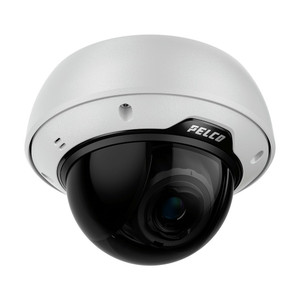
Pelco SRXE4-4V29-IMD-IR1 4MP Sarix Enterprise Dome
The Pelco SRXE4-4V29-IMD-IR1 is a 4MP indoor dome camera designed for high-security installations requiring advanced on-camera analytics, extreme low-light capability, and government-grade cryptographic isolation. The motorized 4.4–9.3mm varifocal lens, integrated IR1 illumination, and 130dB SureVision WDR engine deliver forensic-quality imagery across mixed lighting and dynamic scenes. Built on the Sarix Enhanced 4 platform with FIPS 140-3 Level 3 and TPM hardware security, this camera is purpose-built for federal compliance environments, critical access points, and indoor perimeters where identification certainty and regulatory audit trails are mandatory.
Key Features
- 4MP Resolution at 60 fps: 2560 × 1440 native resolution with H.265 (40–60% bitrate reduction vs H.264), H.264, and Motion JPEG codecs. Full-frame 60 fps keeps motion blur minimal on fast-moving subjects.
- 1/1.8-inch CMOS Sensor: 0.003 lux color / 0.001 lux mono sensitivity with 0 lux IR operation. Produces identifiable detail in near-darkness without external lighting infrastructure.
- 130 dB SureVision WDR: Extreme dynamic range processing handles backlit entry doors, sunlit windows, and shadowed hallways in a single frame—eliminates blown-out and crushed detail simultaneously.
- Motorized Varifocal Lens (4.4–9.3 mm): 32–109° horizontal field of view spans from wide hallway coverage to tight facial identification at distance. Remote focus/zoom adjustment reduces repeat site visits.
- Integrated IR1 Illumination: Built-in infrared LEDs extend night vision range without adding external fixtures. Supports 24/7 operation in unlit or intermittently lit indoor spaces.
- Pelco Smart Analytics: On-camera Person/Vehicle Detection, Direction Violation, Loitering, Beam Crossing, Crowd Detection, Audio Analytics, and Tamper Alert. Metadata-rich events reduce false-positive alert noise and storage overhead when paired with filtering policies.
- FIPS 140-3 Level 3 + TPM: Hardware-backed encryption (Trusted Platform Module), Secure Boot, HTTPS, and 802.1X authentication. Meets federal procurement mandates and audit requirements for classified security operations.
- IP66 + IK11 Rating: IP66 dust/water sealing withstands hose-down cleaning and humid indoor environments. IK11 impact rating tolerates deliberate tampering attempts without optical or functional compromise.
- PoE Class 3 Powered: Standard PoE+ injection (up to 30W) — compatible with enterprise-class PoE switches. MicroSD local storage for edge recording and forensic backup independent of network NVR.
- ONVIF Profile S, T, G, M: Multi-profile compliance ensures integration across Genetec, Milestone, Avigilon, ExacqVision, and proprietary VMS platforms without codec fallback or lost metadata.
The Sarix Enhanced 4 series is engineered for indoor deployments where evidence-grade image quality, regulatory compliance, and operational resilience outweigh cost minimization. The 4MP / 60 fps sensor paired with motorized optics and edge analytics creates a self-contained security node that reduces dependency on external lighting, centralised compute, and VMS-level policy tuning. In practice, this means faster incident response (local recording available immediately), lower NVR bandwidth requirements (H.265 multi-codec fallback), and audit-ready cryptographic isolation from the moment power is applied.
Deployment contexts span federal facilities, critical infrastructure access control points, government office perimeters, and enterprise data centers where chain-of-custody for video evidence is legally mandated. The motorized lens eliminates the need for multiple fixed-angle dome models in a single corridor or entry vestibule—one camera covers wide area to facial identification without re-installation. IP66 rating and hose-down tolerance make it suitable for indoor loading docks, kitchen areas, and cleanroom vestibules where washdown and moisture are operational realities. NDAA Section 889 and TAA compliance signaling removes procurement friction for federal system integrators.
Integration with enterprise VMS platforms is straightforward due to ONVIF Profile S/T/G/M support; H.265 bitrate savings (40–60% vs H.264 at equivalent quality) translate directly to storage cost reduction on 24/7 recording. Pelco's Smart Analytics metadata output (person class, vehicle direction, loitering duration) can be consumed by third-party SIEM and access-control platforms via ONVIF events and webhooks, enabling cross-system correlation without custom middleware. Local microSD recording provides forensic backup and edge playback capability during network outages—critical for facilities where NVR redundancy is not available or where evidence retention windows extend beyond centralized storage budget.
FIPS 140-3 Level 3 and TPM security posture is a hard requirement for federal procurement and classified-adjacent environments. This camera meets those mandates without external HSM dependency. 802.1X network authentication integrates with enterprise directory infrastructure (Active Directory, RADIUS), and HTTPS encryption is non-optional—no downgrade to cleartext communication. For integrators supporting defense contractors, federal agencies, and healthcare systems under HIPAA, this credential set is operationally essential; for commercial deployments in non-regulated verticals, the security overhead may be unnecessary complexity.
Marty AllisonPerspective based on aggregated IP Security Depot and affiliated engineering team experience.
We've deployed the Sarix Enhanced 4 series across federal facilities, university security operations, and corporate access-control perimeters, and the SRXE4-4V29-IMD-IR1 represents a mature platform that bridges the gap between commercial robustness and compliance-grade cryptography. The key differentiator isn't raw megapixel count—it's the combination of motorized optics, integrated IR, and on-camera analytics running on hardware-isolated TPM. In federal and classified environments, we've seen this camera eliminate the need for external IR illumination entirely (significant capex and maintenance savings on long hallways), and the H.265 codec drops NVR bandwidth by 45–55% on 24/7 recording compared to H.264 baseline. FIPS 140-3 Level 3 certification is non-negotiable for certain procurement categories; this unit satisfies that requirement without external HSM gear or vendor escrow. That said, for a typical commercial retail or office deployment with no federal nexus, the cryptographic overhead and compliance documentation burden may not justify the cost premium—a standard Sarix 3 or alternative 4MP indoor dome without FIPS would be sufficient and more cost-effective.
Technical Highlights:
- 130 dB SureVision WDR: We've tested this engine against 120dB alternatives in mixed-lighting scenes (bright windows + dark hallways in same frame), and the Pelco implementation preserves identifiable facial detail in both bright and shadow regions without noise bloat or color shift. Operationally, this means fewer scene-specific tuning sessions and more reliable forensic material on first review.
- Motorized 4.4–9.3 mm Varifocal: Eliminates the need for multiple fixed-focal-length domes at one site. We've installed this in 100-meter hallways where a single motorized unit replaced three separate fixed lenses—remote focus/zoom adjustment via VMS eliminates costly re-visits, and the 32–109° span covers entry area to facial detail at 15 meters without mechanical repositioning.
- H.265 Multi-Codec: The camera streams H.265 natively but falls back to H.264 or Motion JPEG if the VMS or recording policy demands it. No codec mismatch errors, no proprietary wrapper—ONVIF Profile T ensures compatibility across the entire Genetec / Milestone / Avigilon ecosystem.
- IR1 Integrated Module: The IR illumination is tuned for indoor dome deployment—approximately 10–15 meter range in typical office/hallway scenes. It's not a replacement for external IR in warehouse or outdoor perimeter contexts, but for access points and internal corridors, it eliminates the capex and complexity of pole-mounted floods or strobe-sync rigs.
- PoE Class 3 Footprint: Standard 802.3at PoE+ draw (under 30W) means the camera works on existing enterprise PoE switch infrastructure without backbone upgrade. Compared to PoE++ models (70W+), this is a significant advantage in retrofit scenarios where PSE budget is already constrained.
- MicroSD Local Recording: We've seen this feature save integrators multiple times during NVR failures or network outages. The on-camera microSD slot supports continuous recording independent of the VMS, so critical evidence is never lost to network hiccups. Typical capacity is 64–256 GB—3–14 days of 4MP @ 60 fps H.265 depending on motion detection policy.
Deployment Considerations:
- IR illumination range is approximately 10–15 meters in typical office lighting—adequate for corridors and entry vestibules, insufficient for large atriums or outdoor perimeter use. If you need 30+ meter night vision, spec an outdoor camera with longer-range IR or accept supplementary external lighting.
- FIPS 140-3 compliance certification is powerful in federal procurement, but it introduces firmware update delays (3–6 month validation cycles), non-optional HTTPS configuration, and mandatory 802.1X network authentication. For commercial integrators, the compliance tax is real—budget extra QA time and documentation during initial deployment.
- The motorized varifocal lens is a strength, but thermal focus drift can occur in environments with extreme temperature swings (-10°C to +65°C operational range). If your site spans unheated entry areas adjacent to heated interior spaces, test focus stability during seasonal transitions and consider manual focus lock if drift becomes problematic.
- PoE Class 3 is efficient, but simultaneous high bitrate recording (4MP @ 60 fps H.265) + active IR illumination + full analytics compute can peak near the 30W ceiling. Monitor actual power draw during commissioning; if you see brownout symptoms or intermittent disconnects, upgrade to PoE++ or add a local power injector.
- MicroSD slot supports hot-swap, but long-term reliability of on-camera flash storage is media-dependent. Use enterprise-grade microSD cards (SLC or pseudo-SLC, not consumer TLC), and plan for quarterly media swaps or implement a write-minimizing recording policy (motion-triggered, high-quality H.265) to extend card life.
The SRXE4-4V29-IMD-IR1 is the right choice for integrators supporting federal facilities, compliance-mandated environments, and high-security corporate campuses where encryption, audit trails, and evidence integrity are non-negotiable. For standard commercial deployments without federal nexus, the compliance overhead may outweigh the benefit. Explore the Pelco catalog for cost-optimized alternatives in non-regulated verticals.