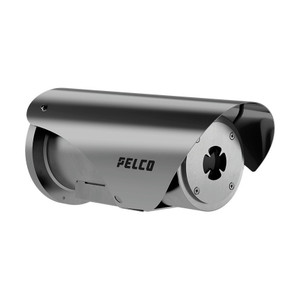
Pelco EXRE2-VF09-E0A00 ATEX Radiometric Thermal Camera
The Pelco EXRE2-VF09-E0A00 is an ExSite Enhanced 2 explosion-proof radiometric thermal camera designed for continuous temperature monitoring in hazardous (classified) industrial environments. Built with a VGA 640×512 uncooled microbolometer sensor, 9mm fixed lens, and full radiometric calibration, this camera delivers absolute per-pixel temperature data suitable for process control, equipment fault detection, and flare-stack monitoring in petrochemical and power-generation facilities. ATEX and IECEx certification enable legal deployment in Zone 1/21 hazardous areas where ordinary cameras cannot operate.
Key Features
- Radiometric Thermal Imaging: Per-pixel absolute temperature measurement calibrated across the entire scene. Enables automated temperature threshold alarms and direct integration with SCADA systems without secondary temperature probes.
- VGA 640×512 Thermal Resolution: Uncooled microbolometer sensor with optional QVGA 320×256 mode for bandwidth-constrained networks. 640×512 delivers sufficient spatial detail for equipment monitoring up to 50–100 meters depending on object size.
- 30 fps Frame Rate: Real-time thermal video suitable for dynamic process monitoring and transient fault detection. Smooth playback eliminates temporal aliasing in temperature trending.
- 9mm Fixed Lens: Wider field of view optimized for nearby equipment clusters, electrical cabinets, and process vessel groupings. Fixed optics reduce maintenance and eliminate lens drift.
- 316L Stainless Steel Explosion-Proof Housing: ATEX/IECEx-rated enclosure withstands corrosive atmospheres common in chemical plants and refineries. Rated for Zone 1/21 environments with flamepath construction preventing internal explosions.
- H.265 and H.264 Compression: H.265 reduces thermal video bandwidth 40–50% versus H.264 at equivalent quality. Dual-codec support ensures compatibility with legacy and modern VMS platforms.
- ONVIF Profile S and Profile T: ONVIF Profile S ensures basic interoperability; Profile T adds H.265 streaming and advanced metadata. VMS-agnostic streaming eliminates vendor lock-in.
- Operating Temperature Range: -40°C to +60°C rated operation handles arctic and tropical deployments without thermal compensation drift.
- PoE 802.3af Power: Standard PoE — integrates into any 802.3af-capable network infrastructure. Total draw under 13W enables long runs via single midspan injector.
Radiometric Thermal Measurement & Accuracy
The per-pixel radiometric calibration is the core differentiator. Unlike non-radiometric thermal cameras that show relative temperature contrast, the EXRE2-VF09-E0A00 outputs absolute temperature (in Celsius or Fahrenheit) for every pixel in the scene. This means a VMS rule can trigger an alarm when a transformer reads >75°C, or when a flare-stack temperature deviates from a baseline signature. Integration with SCADA control systems is straightforward: thermal data streams directly into ABB, Siemens, or Emerson platforms via standard Modbus or OPC-UA gateways. No secondary IR pyrometers needed.
Hazardous Area Certification & Compliance
ATEX (Atmosphères EXplosibles) and IECEx certification are mandatory for operation in European Union and international hazardous locations. This camera is certified for Zone 1/21 (Group II/III), meaning it can be deployed in areas where flammable gases, vapors, or dust are *occasionally* present under normal operation. The 316L stainless steel enclosure and flamepath design ensure that even if an internal arc occurs, any resulting explosion is confined and vented safely. Certifications include cULus, CE, UKCA, and RoHS. Field deployment requires documented hazardous-area risk assessment and competent installer sign-off; IPSD recommends retaining a certified Pelco or independent integrator for site surveys and commissioning.
Network Integration & Edge Analytics
The camera streams H.265 or H.264 video over standard RJ-45 Ethernet to any ONVIF-compliant VMS (Genetec Security Center, Milestone XProtect, Avigilon Control Center, Hanwha WiseNet X, etc.). Thermal metadata (min/max/mean scene temperature, object temperature at user-defined regions of interest) is included in ONVIF extended metadata; VMS alarm rules can trigger on temperature thresholds in real time. For sites running independent SCADA stacks (oil & gas, utilities), the camera's Modbus TCP or HTTP API enables direct polling of thermal statistics, bypassing the VMS entirely. Idle Scene Mode reduces bitrate on static scenes, lowering 24/7 recording overhead on hazardous-area NVR installations where archival is often 90–180 days.
Deployment Scenarios & Total Cost of Ownership
Typical deployments span petrochemical plants (reactor monitoring, heat-exchanger oversight), refineries (crude-unit furnace surveillance, alkylation-unit control), power generation (turbine bearing thermal monitoring, cable-tray thermal trending), and oil & gas facilities (wellhead pressure-relief valve monitoring, glycol regeneration unit oversight). In each scenario, radiometric data eliminates the need for contact temperature sensors (thermocouples, RTDs) at dozens of equipment points. A single EXRE2-VF09-E0A00 can replace 4–8 hardwired temperature transducers, reducing installation labor, spare-parts inventory, and calibration overhead. Five-year warranty and proven field reliability (Pelco ExSite line has been ATEX-certified since 2008) support multi-year ROI on capital and operational cost reductions.
Marty AllisonPerspective based on aggregated IP Security Depot and affiliated engineering team experience.
We've fielded the Pelco ExSite Enhanced thermal line across refinery turnarounds, LNG facilities, and petrochemical expansions in the Gulf Coast region. The radiometric capability is genuinely transformative for process owners who used to rely on contact sensors alone—you get full thermal scene data without running new thermocouple bundles through hazardous areas. That's both a safety and capex win. The ATEX/IECEx stamps are non-negotiable; they ensure legal compliance and insurer acceptance in regulated zones. What sets the EXRE2-VF09-E0A00 apart is the balance: VGA resolution is sufficient for equipment-cluster monitoring (transformer banks, process vessels, flare stacks within 100m), the 9mm lens covers a practical field of view without requiring wide-angle optics that blur thermal detail, and the H.265 codec keeps bandwidth overhead reasonable on sites running thick recording policies. Against alternatives like uncooled FLIR or Leonardo radiometric cameras, Pelco's integration into standard ONVIF VMS platforms and established SCADA gateway support means your integrators and end-user ops teams already know how to configure alarms and trending. Not flashy, but proven and operationally lean.
Technical Highlights:
- VGA 640×512 Radiometric Sensor: Uncooled microbolometer with factory-calibrated per-pixel temperature accuracy typically ±2°C or ±2% of absolute temperature (whichever is greater). That precision is tight enough for process-control thresholds and equipment-protection setpoints. Spatial resolution of ~4 mrad per pixel allows you to distinguish a hot spot on a 1-meter object at 50m distance—meaningful for early fault detection.
- 30 fps Frame Rate: Eliminates temporal aliasing in transient thermal events (e.g., pressure-relief valve opening, flare ignition). Smooth video allows operators to visually track thermal dynamics in real time, reducing false-positive triggering and building confidence in automated alarms.
- 9mm Fixed Lens, 54° HFOV: Wider horizontal field of view (vs. 19mm or 35mm options) is ideal for tight equipment spaces and clustered monitoring. Fixed optics remove lens-slip risk that plagues motorized thermal cameras in vibration-prone industrial settings.
- H.265 Compression + Idle Scene Mode: H.265 bitrate is 40–50% lower than H.264 for equivalent quality. Idle Scene Mode further compresses static backgrounds, cutting 24/7 storage demand by 25–35% on typical industrial scenes. Over 180-day retention mandates, that compounds to measurable NVR cost reduction.
- PoE 802.3af Power: Standard PoE negates the need for auxiliary 24VDC supplies or local AC outlets in hazardous areas. Single RJ-45 run simplifies cable routing and meets electrical code constraints in classified zones.
- 316L Stainless Steel ATEX Housing: Withstands 5+ years in corrosive atmospheres (hydrogen sulfide, salt spray, caustic vapors). Flamepath construction and pressure-relief design meet Group II/III ATEX thresholds. Periodic external flush-cleaning maintains optical clarity without internal corrosion.
Deployment Considerations:
- ATEX certification scope: Zone 1/21 only. Not approved for Zone 0/20 (continuously present flammable atmospheres). Confirm area classification with your facility HSE team before installation—misclassification voids warranty and creates liability.
- Radiometric accuracy is factory-calibrated at shipment. Ambient temperature swings (especially in arctic or tropical climates) can drift absolute temperature readings by ±1–2°C annually. Budget for on-site recalibration every 18–24 months if you're using the camera for process control setpoints; for alarm trending and visual monitoring, drift is usually acceptable.
- VGA 640×512 is the sweet spot for 50–100m monitoring. Beyond 100m, a 19mm or 35mm lens option (separate part numbers) is more effective. At <50m, QVGA 320×256 mode saves network bandwidth without perceptible loss of thermal detail.
- Integration into Pelco-legacy systems (analog recorder racks) requires an IP gateway or VMS translation layer. Pure-IP deployments on ONVIF platforms (Genetec, Milestone) are plug-and-play. Confirm your VMS supports H.265 thermal stream decoding—some older builds default to H.264 fallback.
- Optical window cleaning is critical. Dust, condensation, or insect debris on the thermal lens reduces radiometric accuracy and image contrast. Specify a protective sapphire or borosilicate cover lens as an accessory; cost is ~$200–300, ROI is preventing one misdiagnosed equipment failure.
- Network planning: 30 fps @ VGA @ H.265 ≈ 4–6 Mbps; H.264 ≈ 8–10 Mbps. A hazardous-area PoE switch must handle thermal bitrate + metadata overhead. Redundant NVR recording is advisable; a single network failure can leave the site blind on critical process monitoring.
The EXRE2-VF09-E0A00 is the right choice for process-heavy industrial operators who have the network infrastructure, VMS or SCADA integration capability, and hazardous-area compliance discipline to use radiometric thermal data effectively. If your facility has a certified integrator on speed-dial and hazardous-area risk assessments are routine, this camera delivers measurable ROI in the first 18 months through reduced sensor maintenance and earlier fault detection. For more on Pelco's thermal and ATEX-certified product family, visit the Pelco catalog.