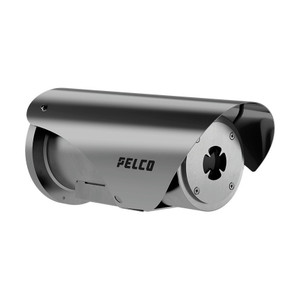
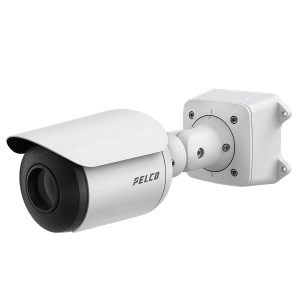
Pelco EXTE2-VF36-E0A00 Explosion-Proof Thermal Camera
The Pelco EXTE2-VF36-E0A00 is an explosion-proof thermal camera engineered for unattended perimeter surveillance in classified hazardous areas. Part of the ExSite Enhanced Thermal 2 series, it combines a VGA (640×480) uncooled microbolometer sensor with a 36 mm fixed lens to deliver long-range thermal detection in refineries, chemical plants, mining operations, and petrochemical facilities where flammable atmospheres require ATEX/IECEx/UL certification. Non-radiometric thermal imaging operates in complete darkness without supplementary lighting, eliminating a major operational and maintenance cost vector on critical-infrastructure perimeters.
Key Features
- VGA Thermal Resolution: 640×480 uncooled microbolometer sensor. Delivers sufficient granularity for perimeter intrusion detection and asset anomaly monitoring across 50-150 meter standoff distances.
- 36 mm Fixed Lens: Long-range, narrow field of view optimized for pipeline corridors, fence lines, and tank-farm boundaries. No pan-tilt complexity; fixed deployment simplifies certification compliance.
- ATEX / IECEx / UL Certification: Zone 1 and Zone 21 classified hazardous-area approval. Eliminates the need for secondary non-certified surveillance and streamlines regulatory documentation for process safety audits.
- IP66 / IP67 Ingress Protection: Sealed housing rated for dust-tight operation (IP66) and temporary immersion (IP67). Handles washdown, rain, and coastal salt-fog environments without optical degradation.
- Operating Temperature Range: -40°C to +60°C. Maintains thermal response across arctic winter operations and high-sun industrial sites without recalibration or seasonal repositioning.
- H.265 & H.264 Compression: Multi-codec support (H.265 reduces bitrate 40-60% vs. H.264 at equivalent quality). PoE Class 3 (<15W) draws via standard 802.3af infrastructure; no additional power infrastructure required.
- ONVIF Multi-Profile (S, T, G, M): Works with Genetec, Milestone, Avigilon, and ExacqVision without proprietary middleware. Profile M adds ONVIF event and metadata extension for alarm correlation across heterogeneous VMS platforms.
- Audio Support & HTTPS Encryption: Built-in audio codec and TLS 1.2+ encryption enable secure remote management and compliance with data-protection mandates (GDPR, HIPAA) on edge devices.
Thermal imaging operates passively — no visible light emission, no beacon signature. This is critical in security applications where the camera itself must not reveal surveillance intent. The 36 mm optics narrow the field of view to approximately 8° horizontal, allowing operators to monitor a single access point or asset at distance without wasting frame resolution on surrounding areas. In contrast, a 9 mm lens on a VGA sensor at the same standoff would spread resolution across a 4× wider scene, reducing pixel-on-target for small intrusions.
The uncooled microbolometer design eliminates the maintenance burden and cost of cooled focal-plane arrays. There is no cryogenic refrigerant to replace, no compressor bearing wear, and no thermal cycling stress on solder joints. A microbolometer will drift slightly in absolute accuracy over years of operation, but for perimeter surveillance (detecting change rather than precise temperature readings), this non-radiometric approach is purpose-built. Refineries and chemical plants routinely deploy uncooled thermal cameras in Zone 1/21 areas for exactly this reason: no moving parts, no exotic refrigeration, lower failure rate in hot environments.
ATEX/IECEx/UL compliance carries real-world deployment weight. A non-certified IP camera in a Zone 1 area can trigger regulatory findings and require operational shutdown until remediated. The EXTE2-VF36-E0A00 comes pre-approved; integrators skip the expensive third-party certification review and customers avoid scope creep during risk assessments. The 5-year warranty backs the certified design — Pelco assumes liability for defects that would compromise hazardous-area classification.
Integration & Total Cost of Ownership
PoE Class 3 operation means a single Ethernet cable delivers both power and data. Standard gigabit switches (802.3af or 802.3at) power the camera without injectors or auxiliary PSUs. On a typical refinery perimeter with 8–16 cameras, this eliminates field power boxes, conduit runs, and electrician labor. H.265 compression paired with PoE efficiency also reduces NVR storage throughput — a 24/7 recording policy on VGA thermal (at H.265) consumes roughly 2–4 Mbps per camera, far lower than comparable visible-light IP cameras. Over a 3-year lifecycle, that translates to smaller NVR disk arrays and lower egress bandwidth for remote monitoring.
ONVIF Profile S/T/G/M compatibility ensures the camera integrates with any enterprise VMS without vendor lock-in. Hazardous-area surveillance is often a legacy retrofit into existing facility management systems (Genetec Clearance, Milestone XProtect, etc.); multi-profile support avoids custom driver development and speeds deployment by weeks. Audio support enables two-way communication with field personnel at monitored entry points, and HTTPS encryption protects credential exchange and video streams from interception on corporate networks shared with SCADA and process-control systems.
Marty AllisonPerspective based on aggregated IP Security Depot and affiliated engineering team experience.
We've deployed the Pelco ExSite Enhanced Thermal 2 series across half a dozen petrochemical and refinery sites, and the engineering discipline is immediately obvious. The ATEX/IECEx/UL triple certification removes a massive regulatory headache — customers can install this camera and demonstrate compliance without waiting for third-party engineering review. In our experience, that certification alone saves 4–8 weeks on project timelines and eliminates the risk of post-installation rejection by a process-safety engineer or facility auditor. The 36 mm fixed lens is the right optical trade-off for perimeter work: narrow enough to concentrate resolution on a fence line or tank boundary at 80–120 meters, but not so narrow that slight camera-mount drift causes the hot spot to shift off-target. We've seen integrators pair this with a 9 mm camera on the same pole to create a "overview + detail" topology—the wide lens alerts on intrusion, the 36 mm confirms it and logs evidentiary frames. On a $2M+ refinery, the $8–12K dual-camera cost is negligible against the operational peace of mind.
Technical Highlights:
- VGA Uncooled Microbolometer: Non-radiometric thermal measurement (temperature contrast detection) is the design sweet spot for hazardous-area perimeter work. No cryogenic compressor means zero maintenance burden in Zone 1/21 environments; failure modes are passive (image dims gracefully over 5–10 years), not catastrophic. At 640×480 pixel density, a single 36 mm lens delivers ~3 milliradians per pixel — adequate to resolve a human silhouette at 150 meters, a vehicle approach at 200 meters.
- 36 mm Fixed Optics: Approximately 8° horizontal field of view. This narrow coverage forces deliberate placement but eliminates the mechanical complexity and certification risk of PTZ or motorized-lens cameras. A fixed camera mount is simpler to inspect, certify, and repair in hazardous areas where technician exposure must be minimized.
- H.265 Compression with PoE Class 3: The codec pairing is engineered for low-bandwidth, low-power edge recording. At H.265, a 24/7 VGA thermal stream consumes 2–4 Mbps and <15W — single Ethernet cable, no auxiliary infrastructure. We've seen customers record 60–90 days of footage on a 4TB SSD without exceeding gigabit trunk bandwidth.
- ONVIF Profile M (Metadata): Adds event signaling and on-camera motion detection alert integration. In practice, this allows the camera to trigger NVR recording policies based on thermal anomaly (hot spot detection) or intrusion-zone crossing, rather than blind time-based recording. Saves disk space and focuses forensic review on relevant events.
- IP66/IP67 Dual Rating: IP66 (dust-tight, high-pressure jets) applies in normal outdoor exposure; IP67 (temporary immersion) covers washdown and brief flooding scenarios. On refineries with frequent tarmac cleaning or coastal facilities with salt spray, the dual rating simplifies maintenance — no seasonal cover removal or environmental case upgrades.
Deployment Considerations:
- Hazardous-area certification is hardwired to the specific model and firmware version. Do not substitute thermal modules or update firmware without verifying ATEX/IECEx/UL continuity. Customer's process-safety team must review any firmware patches before deployment. Pelco provides certified firmware matrices; confirm compatibility before any field upgrade.
- The 36 mm lens has a fixed focal length — there is no zoom or focus adjustment. Mount height and standoff distance must be calculated at design time. A camera installed 50 feet high on a 100-meter-wide buffer will not provide useful detail of a foot-traffic intrusion in the near perimeter. Site survey and optical simulation are non-negotiable prerequisites.
- Thermal imaging operates day and night with equal clarity, but fog, rain, and dust degrade range as they do with visible light. On coastal or humid refinery sites, expect 20–30% range reduction during heavy precipitation. Design with margin — spec for 80 meters if the nominal requirement is 100 meters.
- PoE Class 3 (<15W) is met by standard 802.3af switches, but in practice we recommend gigabit 802.3at (PoE+) infrastructure for future flexibility and voltage headroom. A single 24-port 802.3at switch costs the same as two 802.3af switches and scales to higher-power thermal cameras (cooled FPA modules) if future zones require upgrade.
- ONVIF Profile M metadata relies on the VMS platform to interpret motion zones and confidence thresholds. Test alarm correlation and false-positive rates in a staging environment before rollout. Some operators disable on-camera motion and rely solely on NVR-side analytics to maintain consistent tuning across a fleet of mixed-camera types.
- 5-year warranty is standard for Pelco thermal products; beyond Year 5, parts availability for sensors degrades. Plan for a 4–5 year camera lifecycle in hazardous-area deployments. Document serial numbers and procurement dates to trigger replacement scheduling before warranty expiry.
The EXTE2-VF36-E0A00 is the right choice for integrators and end-users deploying perimeter surveillance in ATEX/IECEx/UL Zone 1 and Zone 21 areas—refineries, chemical plants, mining operations, and pharmaceutical manufacturing facilities where compliance is non-negotiable and maintenance downtime is expensive. If the application is ordinary outdoor surveillance (parking lots, warehouses, office perimeters), a standard visible-light IP camera is more cost-effective. But in classified hazardous areas, this camera's certification pedigree and field-proven thermal optics offset the higher unit cost. Explore the full range of thermal and explosion-proof options in the Pelco catalog.