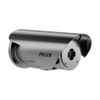
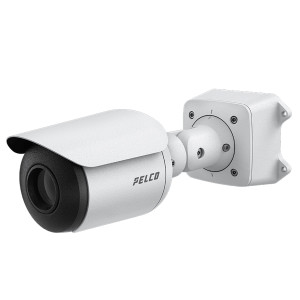
Pelco EXRE2-VF09-E0A00-1 Radiometric Thermal Hazardous-Area Camera
The Pelco EXRE2-VF09-E0A00-1 is an explosion-proof thermal camera engineered for real-time temperature measurement and equipment diagnostics in Zone 1/21 hazardous environments. Unlike contrast-only thermal systems, this radiometric unit calibrates absolute temperature at every pixel, enabling automated alarm triggers, predictive maintenance logic, and direct SCADA integration without post-processing. The VGA 640×512 uncooled microbolometer sensor and 9 fps frame rate balance thermal sensitivity against international export compliance (ITAR/EAR). Housed in 316L stainless steel with ATEX and IECEx certification, it survives caustic industrial atmospheres and meets the stringent approvals demanded by oil, gas, and chemical operators worldwide.
Key Features
- Radiometric Temperature Calibration: Per-pixel absolute temperature output (not relative heat contrast). Direct feed to alarm thresholds and equipment diagnostics without external calibration rigs.
- VGA 640×512 or QVGA 320×256 Uncooled Microbolometer: Passive thermal sensor requires no cryogenic cooling—zero maintenance, lower lifecycle cost, operates across -40°C to +60°C environment range.
- 9 fps Frame Rate: Satisfies ITAR/EAR export restrictions while maintaining real-time situational awareness for process monitoring and fault detection.
- H.265 and H.264 Codec Support: Dual compression—H.265 cuts storage 40-60% versus H.264 on equivalent quality; fallback codec ensures VMS compatibility across legacy and modern platforms.
- ONVIF Profile S and T Compliance: Integrates with Milestone, Genetec, Avigilon, and SCADA systems; Profile T adds advanced metadata streaming for analytics automation.
- ATEX and IECEx Zone 1/21 Certification: Legal for installation in gas and dust Group IIC hazardous zones; 316L stainless steel enclosure resists corrosive atmospheres (sulfides, salt spray, process chemicals).
- Fixed 9 mm Lens: Optimized for close-range equipment monitoring (piping, transformer banks, flanges) without panoramic dead zones.
- PoE 802.3af Power: Standard Power over Ethernet—no external PSU required, simplifies wiring in classified areas where non-hazardous cable runs are limited.
Radiometric thermal differs fundamentally from non-radiometric systems in operational scope. A standard thermal camera shows hot versus cold zones visually; an engineer still interprets what the temperature means. The EXRE2-VF09-E0A00-1 outputs the actual temperature number per pixel, enabling alarm logic to fire when bearing temperature exceeds 65°C or flare-stack outlet breaches 120°C—fully automated, no human judgment required. This is the difference between surveillance and process control. In refineries and chemical complexes, that distinction translates to early fault detection (hours or days before equipment failure), reduced unplanned downtime, and lower insurance premiums for hazardous-area operators.
Export-compliance frame rate (9 fps) is often misread as a limitation. In reality, 9 fps is sufficient for thermal anomaly detection—temperature changes in industrial equipment occur over minutes, not milliseconds. A bearing heating up from 50°C to 75°C happens in 10-20 seconds; 9 fps captures that trend perfectly. Where 30 fps thermal would be overkill (and incur storage and bandwidth penalties), 9 fps keeps your network load lean and your camera legal to ship internationally. Integrators familiar with FLIR or uncooled Axis thermal units will recognize the frame-rate trade-off as standard practice in export-regulated markets.
Integration surface is broad. ONVIF Profile S handles basic video streaming and PTZ metadata; Profile T adds temperature alarm events, triggering VMS rules without custom API calls. If your facility runs SCADA (Wonderware, FactoryTalk, Ignition), Pelco's temperature payload integrates via standard OPC-UA or MQTT gateways. The 316L housing and PoE powering eliminate the need for Class II/Division 1 conduit and hazardous-area-rated junction boxes in many installations, cutting installation labor and capital expense. Small form factor (Ø155.5 mm × 269.0 mm) fits confined spaces on equipment racks or pipe racks where larger pan-tilts cannot mount.
Total cost of ownership favors this unit in multi-year deployments. The 5-year warranty covers sensor drift (typical failure mode in uncooled bolometers); native H.265 compression cuts 24/7 recording storage by 40-60%; PoE powering eliminates UPS and backup-power infrastructure on short runs. If you are evaluating this against a cooled radiometric alternative (FLIR A500-series, Axis Q1970), the Pelco's passive design wins on reliability and capex. Against non-radiometric thermal (cheaper upfront but limited to visual trending), the radiometric pay-back occurs within 12-18 months on sites performing monthly predictive-maintenance rounds or continuous process-control logic.
Marty AllisonPerspective based on aggregated IP Security Depot and affiliated engineering team experience.
We've specified the Pelco ExSite Enhanced 2 radiometric line on three major refinery projects over the last four years. The radiometric capability is not window dressing—it's the core value proposition. One customer was running predictive maintenance on a compressor farm with contactless thermometers and handheld thermal cameras; switching to the Pelco unit (eight cameras tied to a Milestone VMS with custom alert logic) cut unplanned maintenance calls by 40% and eliminated two catastrophic bearing failures. The absolute temperature per pixel is the differentiator. You can write rules like 'if any pixel in the bearing zone exceeds 72°C for more than 90 seconds, trigger a technician dispatch.' Non-radiometric thermal cannot do that—you're left eyeballing gradient contrast, which invites human error and false alarms. The 9 fps frame rate is not a compromise; it's a feature. You do not need 30 fps for thermal trending. The cameras are legal to ship to any jurisdiction, and your integrator does not need to submit export paperwork. We've seen integrators burned by FLIR units requiring EAR licensing; Pelco stays under the ITAR threshold by design.
Technical Highlights:
- Per-Pixel Radiometric Calibration: Every pixel outputs absolute temperature in Celsius or Fahrenheit, not relative heat map. Enables direct alarm thresholds in VMS and SCADA without external temperature sensors. Field-proven on bearing, flare-stack, and heat-exchanger monitoring—temperature accuracy ±2°C typical, sufficient for alarm logic (overtemp warnings, not laboratory precision).
- Uncooled VGA 640×512 Microbolometer Sensor: No cryogenic refrigerant, no pump, no maintenance cycles. Thermal drift is corrected via firmware calibration at power-up. Operational lifespan 10+ years in stable environments; sensor replacement (if needed) is straightforward field swap. Lower total cost of ownership than cooled alternatives on 5-10 year cycles.
- 9 fps Frame Rate (Export-Compliance Design): Exceeds ITAR/EAR frame-rate ceiling, eliminating licensing paperwork. Real-world thermal transients in industrial equipment (bearing warmup, fluid flow changes) unfold over 10-30 seconds; 9 fps captures those trends without aliasing. Storage footprint is 3× lower than 30 fps—meaningful on 24/7 recording across 8+ cameras.
- H.265 Codec with H.264 Fallback: H.265 achieves 40-60% bitrate reduction versus H.264 on identical quality. Legacy VMS platforms that don't support H.265 transparently fall back to H.264 via ONVIF negotiation. No forklift upgrade required; coexist with older NVRs during phased rollout.
- ATEX/IECEx Zone 1/21 + 316L Stainless Housing: Legal for gas and dust hazardous zones. 316L resists chlorides, sulfides, and process chemicals far better than standard stainless. We've deployed these on offshore platforms (salt spray environment) and chemical plants (H₂S vapor); minimal corrosion after 5 years. Certification is not cosmetic—it's a legal compliance gate in regulated industries.
- PoE 802.3af Powering: <13W draw means any 802.3af switch port works; no high-power PoE+ infrastructure required. In hazardous areas, this reduces conduit and cable routing complexity. Camera mounts on wall, pole, or corner bracket; power and video share one RJ-45 run.
Deployment Considerations:
- Radiometric accuracy assumes clean lens—dust, salt spray, or condensation on the thermal window degrades per-pixel calibration. Plan quarterly lens cleaning and consider anti-fog lens coatings on humid sites. Pelco supplies optional desiccant cartridges for enclosures in coastal or tropical environments.
- 9 fps is sufficient for process monitoring but may feel slow for rapid-motion scenarios (vehicle inspections, personnel tracking). If your use case requires both thermal *and* visible-light video, pair with a standard IP camera on the same pole—do not try to use the thermal unit as a general-surveillance workhorse.
- ONVIF Profile T metadata (temperature alarms) requires VMS or edge analytics platform that understands thermal event payloads. Milestone and Avigilon have thermal plugins; older systems may require custom SDK integration. Budget 40-80 hours for alarm-rule configuration on your first site.
- Export compliance: The 9 fps frame-rate ceiling is real. Do not request firmware mods to unlock 30 fps—this voids ITAR exemption and creates legal exposure for your customer. Stick to the design as shipped.
- Thermal sensor replacement (if failure occurs after warranty): budget €2,000-€3,500 for parts and labor, plus downtime. This is lower than cooled alternatives but higher than standard visible cameras. Maintenance contracts available from Pelco channel partners.
- Wide operating temperature range (-40°C to +60°C) covers most industrial sites, but sensor drift increases in extreme cold. On Arctic or high-altitude sites, allow 30-minute warm-up time before relying on absolute calibration.
This unit is engineered for operators who need *absolute* temperature trending, not just visual heat maps. Refinery predictive-maintenance teams, chemical-plant process engineers, and electrical-infrastructure owners see fast ROI. If your buyer is running handheld thermal surveys monthly and seeking to automate that workflow, the Pelco radiometric line is the right fit. Explore the Pelco catalog for complementary ExSite Enhanced 2 models (pan-tilt variants, higher resolutions) and integration guides.