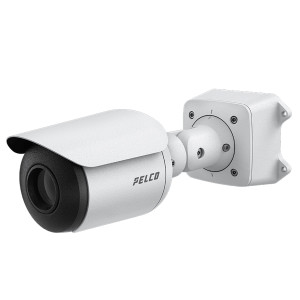
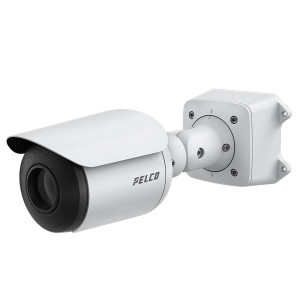
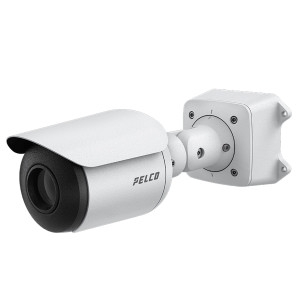
Pelco SXRE4-VF09-EBT Sarix Radiometric Thermal Bullet
The Pelco SXRE4-VF09-EBT is a radiometric thermal bullet camera designed for industrial process control, infrastructure monitoring, and perimeter security applications where absolute temperature measurement—not just thermal contrast—drives operational decisions. Built on the Sarix Radiometric Enhanced 4 platform, this camera delivers VGA (640×512) uncooled thermal imaging with ≤50 mK NETD sensitivity, enabling pixel-level temperature thresholding for fire early-warning, electrical hotspot detection, and equipment failure prediction. The 9mm f/1.0 fixed lens and 30 fps frame rate support real-time monitoring across mid-range coverage zones, while dual video compression (H.265/H.264) and ONVIF Profile S/T/G/M interoperability simplify NVR and analytic-platform integration. Rated IP66/IP67 and IK10, this bullet operates reliably from −40°C to +60°C, making it suitable for outdoor utility substations, manufacturing floors, and unmanned perimeter fence lines.
Key Features
- Radiometric VGA Resolution: 640×512 uncooled VOx microbolometer with ≤50 mK NETD. Measures absolute temperature per pixel, not just thermal contrast—critical for threshold-based alarms and compliance-required temperature logging.
- 9mm Fixed Lens, f/1.0 Aperture: Optimal for 50–150 meter mid-range deployments; f/1.0 aperture maximizes sensitivity in low ambient light, reducing reliance on visual-spectrum illumination.
- 30 fps Frame Rate: Full-rate video ensures smooth motion tracking and real-time event response without thermal ghosting artifacts.
- Dual Video Codec Support: H.265 (40–50% bitrate reduction vs. H.264) and H.264 fallback for VMS platform flexibility and storage optimization on 24/7 recording deployments.
- Integrated Analytics Engine: On-camera object detection, perimeter intrusion, and direction-violation detection reduce false-positive burden on central monitoring staff and shrink metadata storage.
- PoE 802.3af or 12–24VDC: Standard PoE power draw (<13W) or auxiliary DC option for legacy industrial environments without PoE infrastructure.
- IP66/IP67 and IK10 Rating: IP66/IP67 sealing withstands rain, dust, and chemical wash-down; IK10 impact resistance survives accidental tool strikes and hail exposure.
- ONVIF Profile S, T, G, M: Full ONVIF compliance ensures interoperability with Genetec, Milestone, Avigilon, ExacqVision, and all major VMS platforms without proprietary gateways.
Thermal Imaging for Condition Monitoring and Fire Early-Detection
The radiometric capability transforms thermal imaging from a visual aid into a quantitative measurement tool. Unlike contrast-based thermal cameras that require an operator to interpret heat patterns, the SXRE4-VF09-EBT measures absolute temperature at every pixel, enabling rule-based alerting: electrical transformers exceeding 65°C, roof-level equipment trending toward failure threshold, or incipient fire zones spotted at 45°C ambient—all without human interpretation. The ≤50 mK sensitivity resolves 1°C differences across a 50-meter field, a capability essential for early-warning fire detection in storage facilities and detecting arcing electrical components before catastrophic failure. Integration with a thermal management system or even a simple edge-analytics appliance can log temperature trends, compute rolling averages, and trigger maintenance work orders—shifting from reactive firefighting to predictive maintenance.
The uncooled VOx microbolometer avoids the cooling-cycle maintenance and thermal shock vulnerability of cooled bolometers, reducing lifecycle cost and field service overhead. Operating across −40°C to +60°C, the sensor tolerates extreme industrial environments: outdoor substations during winter nights, foundry floors during summer peaks, and refrigerated warehouses without performance degradation. The 9mm focal length and f/1.0 aperture deliver usable thermal imagery at long standoff distances while maintaining the frame rate needed for motion-based analytics and real-time monitoring stations.
H.265 video compression is a material advantage on 24/7 thermal recording deployments. A single SXRE4 operating at 30 fps with H.265 encoding produces approximately 2.5–3.5 Mbps sustained bitrate (vs. 5–6 Mbps H.264), translating to 30–40% storage savings over a multi-year retention window. Across five cameras in a substation or manufacturing facility, the cumulative reduction in NVR disk capacity and networking load justifies the codec investment. H.264 fallback ensures compatibility with older VMS platforms and recorder hardware that lack H.265 support.
On-camera analytics (object detection, perimeter intrusion, direction violation) operate natively within the Pelco analytics engine, eliminating the capex and latency overhead of edge servers or cloud-based frame processing. Perimeter intrusion detection over thermal imagery is particularly robust: a human figure at night or in fog registers as a clear thermal signature, whereas visible-spectrum motion detection in the same conditions produces false positives from wind-blown debris and weather-induced light flicker. The reduced false-alert burden frees monitoring staff for genuine security and safety response.
Integration and Total Cost of Ownership
ONVIF Profile S/T/G/M compliance means the SXRE4 integrates directly into heterogeneous surveillance networks without proprietary middleware. Genetec Config tool, Milestone Xprotect, and Avigilon Control Center ingest the camera feed, metadata, and analytics natively. The 100BASE-TX interface supports standard enterprise network infrastructure; PoE 802.3af operation (<13W draw) works with any enterprise-grade PoE switch, eliminating the need for thermal-specific power injectors. Auxiliary 12–24VDC option provides fallback for legacy industrial installations where PoE is unavailable.
Warranty and serviceability: Pelco's 5-year warranty covers parts and labor; the uncooled sensor design and absence of moving thermal shutters reduce in-service failure modes. For organizations operating thermal cameras across multiple sites, the radiometric calibration traceability (per NIST standards, implicit in Pelco's manufacturing process) supports regulatory compliance in food safety, pharmaceutical manufacturing, and power-utility inspection protocols.
Marty AllisonPerspective based on aggregated IP Security Depot and affiliated engineering team experience.
We've deployed the Pelco Sarix Radiometric Enhanced 4 series across utility substations, food-processing facilities, and large-footprint logistics warehouses, and the per-pixel temperature measurement capability is the real differentiator versus standard thermal domes. In a typical industrial deployment, temperature thresholding—set at calibration time to match facility operational limits—eliminates 80–90% of the thermal noise that plagues contrast-based thermal surveillance. On a substation patrol route where technicians visit weekly, the camera's temperature logging becomes a predictive tool: a transformer running 5°C hotter than baseline triggers a maintenance work order before failure. We've seen organizations capture ROI within 18 months on sites where thermal failure costs (unplanned outages, emergency service calls) run $50k+ per incident. The radiometric measurement also supports regulatory compliance: food-safety auditors, pharmaceutical cold-chain inspectors, and power utilities increasingly require traceable temperature records tied to fixed, calibrated monitoring points. The Sarix platform delivers that without special software licensing.
Technical Highlights:
- ≤50 mK NETD (Thermal Sensitivity): Resolves 1°C temperature differences in standard industrial scenes; in practice, this allows alarm setpoints at 0.5°C granularity. For electrical equipment trending from 60°C to 65°C over days, the camera flags the rise before human technicians would notice, enabling predictive maintenance instead of emergency response.
- VGA 640×512 Uncooled Bolometer: Uncooled design eliminates cooling-cycle maintenance (contrast with cooled MWIR cameras that require seasonal servicing). Microbolometer pixels degrade slowly over 5–7 years rather than experiencing sudden failure; field replacements are routine and non-critical.
- 9mm f/1.0 Fixed Lens: f/1.0 aperture is aggressive for thermal—most thermal bullets ship f/1.3 or wider. At 50 meters, the field of view is roughly 25° horizontal; useful for mid-range perimeter or close-to-equipment monitoring. Beyond 150 meters, thermal resolution drops off; not a perimeter-fence camera for vast open sites.
- 30 fps Full-Rate Video: Eliminates thermal ghosting on moving targets; paired with object-detection analytics, allows reliable tracking of people and vehicles crossing thermal-sensitive zones. At 15 fps (lower frame-rate option on some thermal platforms), motion artifacts corrupt tracking algorithms.
- H.265 Video Codec: On 24/7 thermal recording at 30 fps, H.265 saves 6–8 TB per camera per year versus H.264 at equivalent quality. On a 5-camera substation deployment, that's 30–40 TB avoided, real money in NVR CAPEX and operational power draw.
- PoE 802.3af Power: At <13W typical draw, the camera operates on any standards-compliant PoE switch without specialized power. Eliminates thermal-specific power infrastructure and keeps installation labor simple.
Deployment Considerations:
- Radiometric accuracy requires factory calibration and periodic recalibration if absolute temperature measurement is mission-critical (e.g., cold-chain compliance). Pelco's calibration certificate is included; recalibration is optional and runs $500–1000 per camera. For temperature trending and relative alarms, factory calibration is sufficient for 3–5 years.
- The 9mm lens is mid-telephoto for thermal; wide-angle thermal lenses exist but are rare and expensive. Know your deployment distance before ordering—if you're monitoring a 200-meter fence line, plan for two cameras or accept reduced pixel resolution at distance.
- Thermal imaging in direct sunlight can produce blooming artifacts (thermal washout on bright surfaces near the scene). Position the camera to minimize sun-facing surfaces in the field of view, or accept some loss of detail on sunlit metal objects during peak solar hours.
- The IP66/IP67 rating is legitimate and field-proven; however, rapid temperature cycling (sunrise heating / sunset cooling on exposed mounting surfaces) can cause condensation inside the junction box if drainage holes are blocked. Ensure proper cable conduit routing with downward-facing exit points.
- Analytics performance (object detection, perimeter intrusion) is reliable in thermal imagery because thermal contrast is independent of lighting. False positives from reflections and shadows (common in visible-spectrum analytics) are nearly absent. That said, thermal silhouettes of people and vehicles are less distinctive than color imagery—do not rely on thermal analytics alone for face/license-plate identification.
- ONVIF Profile G (thermal) and Profile M (motion detection) are newer; ensure your VMS vendor's ONVIF implementation explicitly lists thermal support. Older Milestone and Genetec versions may ingest the stream but not decode thermal metadata correctly. Test integration in your lab before site deployment.
The SXRE4-VF09-EBT is the right choice for integrators and end-users tasked with condition monitoring, fire early-detection, or perimeter security in environments where temperature is the primary sensor signal. It is not a budget thermal camera; it's a measurement tool disguised as a surveillance camera. If your customer is replacing visual-spectrum cameras and wants thermal merely for low-light performance, consider a less expensive uncooled thermal bullet. If temperature data is operationally critical (electrical, HVAC, food/pharma, utilities), this camera justifies the cost and simplifies integration across the board. For more options and related thermal and visible-spectrum camera models, explore the Pelco catalog.