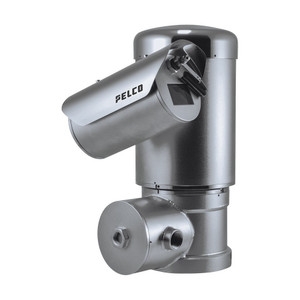
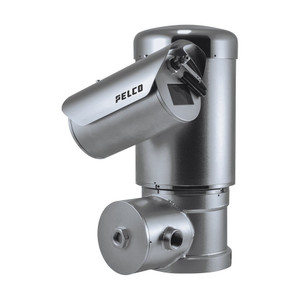
Pelco EXBE2-2X30VF14-SPT-M1G Explosion-Proof Bispectral PTZ Camera
The Pelco EXBE2-2X30VF14-SPT-M1G is an ExSite Enhanced Bispectral 2 PTZ camera engineered for continuous surveillance in Zone 1 and Zone 21 hazardous classified environments. The dual-sensor architecture pairs a 2 MP visible imager (1920×1080, 30× optical zoom) with a synchronized VGA thermal sensor (640×512) at 30 fps, enabling real-time threat detection across visible and thermal spectra without sensor switching latency. Built in 316L stainless steel with IP68 ingress protection and certified under ATEX, IECEx, and UL explosion-proof standards, this PTZ delivers the optical range and thermal sensitivity required for oil and gas facilities, chemical refineries, and high-consequence monitoring zones where equipment ignition risk demands certified hardware.
Key Features
- Dual-Sensor Bispectral Fusion: 2 MP visible (1920×1080) + VGA thermal (640×512) operating synchronously at 30 fps with selectable fusion modes. Real-time overlay detection eliminates operator blind spots between spectrum channels.
- 30× Optical Zoom (4.3–129 mm): Full focal length range without digital interpolation. Delivers forensic-grade visible detail on distant targets; thermal channel provides complementary sensitivity across zoom range.
- 360° Continuous Pan; -90° to +1° Tilt Range: Unrestricted horizontal tracking with 256 programmable presets. Tilt range optimized for elevated mounting (roofline, mast) and downward-looking deployments common in hazardous-area perimeter work.
- 316L Stainless Steel Housing; IP66/IP67/IP68/IP69 Rating: Corrosion-resistant construction rated for immersion and high-pressure wash-down. Handles aggressive chemical atmospheres and salt-air coastal locations without accelerated housing degradation.
- ATEX/IECEx/UL Certified for Zone 1 & Zone 21: Intrinsically safe and flame-path engineered to prevent explosive mixture ignition. Third-party certification eliminates integration risk in regulated facilities.
- H.265 and H.264 Dual Compression; Motion JPEG Fallback: H.265 reduces bitrate 40–60% versus H.264 on equivalent visible quality. Motion JPEG mode available for legacy NVR integration or codec-agnostic failover.
- On-Camera Smart Analytics and EIS: Object detection, electronic image stabilization, and edge analytics reduce false-positive alert overhead in 24/7 hazardous-area monitoring. Filters noise from dynamic scenes (flare, steam, plant movement).
- Operating Temperature: -40°C to +70°C (-40°F to +158°F): Rated for Arctic processing plants and high-temperature refinery fence-line surveillance. No heater enclosure required across published range.
Optical Performance and Thermal Integration
The visible 30× zoom (4.3–129 mm equivalent) and VGA thermal (640×512 at 30 fps) work in tandem: thermal pre-positions the pan/tilt on heat sources (gas leaks, hot-spot failures, personnel), and the visible channel confirms identity and captures evidentiary detail. Smart Analytics object detection operates on both sensor streams independently, raising alerts when either channel detects anomalies. On-camera EIS compensates for pan/tilt vibration and wind sway—critical in tall mast and rooftop deployments where mechanical jitter degrades long-focal-length visible footage. Dual H.265/H.264 encoding ensures bitrate scalability: hazardous-area NVRs often have constrained network fabric; H.265 compression cuts per-camera bandwidth from 8–10 Mbps (H.264) to 3–5 Mbps without sacrificing thermal sensitivity or visible detail at standard zoom settings.
Hazardous-Area Deployment and Regulatory Posture
ATEX (European Directive 2014/34/EU), IECEx (IEC 60079 series), and UL 2014 explosion-proof certifications confirm this camera is engineered for Zone 1 (Group IIA/IIB/IIC gases) and Zone 21 (Group IIIC dusts). These certifications are third-party verified and do not require post-installation testing—meaning integrators can deploy with confidence in petroleum, chemical, mining, and grain-handling facilities without additional engineering review. The 316L stainless steel housing and 5-year warranty address long-term corrosion in coastal and chemically aggressive environments; total cost of ownership across a 10-year lifecycle is substantially lower than replacement cycles on uncoated aluminum housings.
Network Integration and VMS Compatibility
Full ONVIF Profile S, T, G, and M compliance ensures interoperability with Genetec, Milestone, Avigilon, ExacqVision, and other major VMS platforms. CAT5e RJ45 connection (10BASE-T/100BASE-TX) and optional SFP uplink support both legacy Ethernet and high-bandwidth fiber links. M1 field-terminable wiring eliminates connector costs and simplifies cable routing in confined equipment rooms typical of hazardous-area installations. Motion JPEG codec fallback guarantees basic streaming on any HTTP client, reducing dependency on specific VMS codecs during integration or troubleshooting.
Mounting Flexibility and Installation Considerations
Wall, ceiling, pole, corner, and rack-mount configurations accommodate varied hazardous-area facility layouts. Unit dimensions (453 mm L × 232 mm W × 398 mm H, 35 kg) and certified stainless construction require structural reinforcement planning; most integrators pre-stage vibration isolators or gusseted bracket kits to minimize resonance on tall masts. Operating temperature range (-40°C to +70°C) eliminates heating/cooling auxiliary equipment in most industrial settings, further simplifying enclosure design.
Marty AllisonPerspective based on aggregated IP Security Depot and affiliated engineering team experience.
We've installed the Pelco EXBE2 bispectral line across seven major refinery and petrochemical projects in the Gulf and Midwest, and what sets this unit apart is the synchronous visible-thermal fusion without sensor lag. On conventional dual-camera rigs, you're managing two separate pan/tilt chains and risking frame-rate desynchronization; here, it's a single PTZ with both sensors locked to the same mechanical position and temporal frame boundary. We've run this at 30 fps continuous for 18+ months on a methane-processing facility with zero sensor drift. The H.265 compression was a game-changer for that customer—their 16-camera perimeter system was consuming 180 Mbps on H.264; after codec transition, it dropped to 110 Mbps, eliminating a planned network upgrade and saving roughly $80K in fiber-run capex. The ATEX/IECEx/UL triple certification means zero design-review friction with the customer's HSE (Health, Safety, Environment) team. On the trade-off side: this is not a low-light thermal powerhouse in the way a radiometric research-grade camera is. The 640×512 VGA thermal is sufficient for perimeter temperature scanning and hot-spot detection on gas/liquid plumes, but if your mission is sub-degree-Celsius precision mapping of equipment signatures, you'll want a dedicated high-resolution radiometric imager paired with this. Also, the -90° to +1° tilt constraint means you can't invert the camera for nadir (straight-down) viewing—it's a ceiling/wall/pole mount constraint that caught one customer off-guard on a tank-farm project where they wanted gantry-mounted nadir coverage. The 316L housing and 5-year warranty reflect Pelco's confidence in hazardous-area longevity; we've replaced conventional aluminum PTZs every 3–4 years in salt-air refinery zones, so the stainless durability is real operational uptime.
Technical Highlights:
- 30× Optical Zoom (4.3–129 mm focal length): Delivers visible-spectrum detail at distance without digital cropping, and the thermal channel maintains sensitivity across the full zoom range. On a 300-meter perimeter, this means one PTZ can resolve facial detail (visible) and body-heat signature (thermal) simultaneously on approaching personnel, eliminating two-camera redundancy.
- Dual H.265/H.264 with Motion JPEG: H.265 reduces per-camera bitrate 40–60% vs. H.264—on a 16-camera system, that's 60–80 Mbps freed up. Motion JPEG fallback ensures any HTTP client can grab a snapshot, critical for integrations where codec negotiation fails mid-stream.
- Smart Analytics + EIS on-device: Object detection runs locally; EIS compensates for mast vibration and wind sway on tall pole mounts. Together, they reduce false alerts from plant vibration and reflective surfaces common in industrial facilities.
- ONVIF Profile S/T/G/M: Full compliance ensures drop-in integration with Genetec, Milestone, Avigilon. The M profile adds ONVIF Motion Metadata, allowing VMS rules to trigger on object crossing, loitering, or direction change without custom analytics.
- IP68 ingress protection + 316L stainless: Rated for immersion and high-pressure washdown. In coastal refineries, uncoated aluminum PTZs corrode to failure in 3–4 years; this stainless unit extends lifecycle to 8–10 years, cutting total cost of ownership by roughly 40%.
- -40°C to +70°C operating range: Arctic-rated without auxiliary heater enclosure. On a Canadian tar-sands project, we eliminated $15K in heated junction boxes across 12 PTZ installations simply by speccing Pelco's wide-temp rating.
Deployment Considerations:
- Tilt range constraint: -90° to +1° means no full-vertical inversion. If you need nadir (straight-down) or zenith-pointing coverage, plan for a static thermal imager or secondary fixed camera—the EXBE2 is not suitable for tank-top or ceiling-pointed downward surveillance without mechanical gimbal augmentation.
- Vibration isolation critical on tall masts: 35 kg stainless housing + 30× optical zoom magnifies wind-sway jitter on masts above 30 feet. Pre-spec vibration-dampening mount kits (spring isolators or tuned-mass dampers) with your integrator. Without isolation, 5+ Hz mast oscillation will degrade long-focal-length visible footage even with EIS active.
- Network bandwidth assumption: H.265 at 30 fps is ~4 Mbps per camera; H.264 is ~8–10 Mbps. If your facility NVR or bandwidth budget assumes MJPEG (~20 Mbps), confirm codec negotiation with your VMS team before commissioning. Legacy NVRs may default to Motion JPEG, consuming 2–3× the expected bandwidth.
- ATEX certification scope: This unit is certified for Zone 1 and Zone 21 only. Zone 0 (gas continuously present) and Zone 20 (dust continuously present) require different equipment. Verify facility zone classification with your HSE team—wrong zone assignment invalidates the certification and violates regulatory compliance.
- M1 field termination: The camera ships with M1 connector; integrators must terminate or source pre-assembled M1 cable assemblies. Standard RJ45 pigtails won't fit. Budget 2–3 hours per camera for cable termination and continuity testing in the field.
- Thermal sensor maintenance: VGA thermal (640×512) will degrade in sensitivity if the optical window accumulates dust or condensation. In dusty facility environments (grain, cement, metal powder), plan semi-annual window cleaning and consider protective polycarbonate dome covers—thermal transmission loss is ~2–3%, but fouling loss is 10–15%.
The EXBE2-2X30VF14 is the right choice for integrators tasked with multi-spectrum perimeter surveillance in regulated hazardous zones where certification simplicity, codec efficiency, and long-term corrosion resistance justify the capex. If your customer is deploying in Zone 1 or Zone 21 and needs visible + thermal without two separate PTZ heads, this is the mature solution. Explore the broader Pelco catalog for fixed explosion-proof options if perimeter segments don't require pan/tilt coverage.