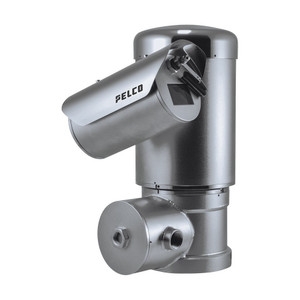
Pelco EXBE2-2X30VF14-SPT-ACG Explosion-Proof Bispectral PTZ Camera
The Pelco EXBE2-2X30VF14-SPT-ACG is a bispectral PTZ camera engineered for hazardous classified environments where both thermal and visible surveillance are mandated by regulation. Dual simultaneous imaging—2 MP visible (1920×1080) and VGA thermal (640×512)—enables detection across lighting conditions and thermal anomalies in petrochemical plants, refineries, offshore platforms, and Zone 1/Zone 21 classified spaces. ATEX, IECEx, and UL explosion-proof certification eliminates the need for secondary perimeter cameras or retrofit enclosures, reducing installation complexity and capex on certified electrical infrastructure.
Key Features
- Bispectral Fusion Imaging: 2 MP visible (1920×1080) + VGA thermal (640×512) in simultaneous 30 fps streams. Detects personnel, heat signatures, and equipment faults in overlapping fields of view without blind zones.
- 30× Optical Zoom: 4.3–129 mm focal length enables identification of distant targets (pipe corrosion, hotspots, personnel breach) from a single fixed pole position without repositioning.
- Continuous 360° Pan: Full horizontal rotation with -90° to +1° tilt and 256 presets. Operator can track moving threats or sweep large perimeters without dead zones.
- H.265 Dual-Compression: 40-60% bitrate reduction vs. H.264 at equivalent quality. H.264 fallback ensures compatibility with legacy NVR platforms; Motion JPEG for emergency manual review.
- ATEX/IECEx/UL Certified: Group II Category 3G, Zone 1, and Zone 21 approval eliminates costly custom-enclosure engineering. 316L stainless-steel housing resists corrosive atmospheres (H₂S, salt spray, chemical vapor).
- Extreme Temperature Tolerance: -40°C to +70°C operating range handles arctic platforms, desert refineries, and uncontrolled enclosures without heater/cooler hardware.
- Washdown IP Rating: IP66/IP67/IP68/IP69 withstands high-pressure spray, submersion, and chemical washdown protocols standard in food processing and pharmaceutical manufacturing.
- Smart Analytics & EIS: Object Detection and Electronic Image Stabilization reduce false-alarm load from wind-induced pan drift and reduce false-positive thermal triggers from sun glint and transient steam.
- ONVIF Profile S, T, G, M: Full open-standards compliance enables integration with Genetec, Milestone, Axis Camera Station, and third-party VMS platforms without vendor lock-in.
- AC Power Mount (SPT-ACG): Global certifications for 24 VAC, 120 VAC, or 230 VAC supply simplify multi-region deployments and eliminate DC power cabling runs in hazardous zones.
Bispectral imaging eliminates the operational trade-off between day-shift visibility and night-shift thermal detection. Visible channel captures ID-grade detail (clothing, signage, license plates) in daylight; thermal channel triggers alerts on abnormal heat signatures (vessel rupture, personnel heat stress, electrical overload) 24/7 without supplementary lighting. On a refinery cat-cracker or offshore drilling platform, this dual-spectrum approach cuts investigation time for anomalies that would otherwise require a second thermal-only camera and integration overhead.
The 30× zoom and continuous pan allow a single camera to cover perimeters that would traditionally require 3–4 fixed-position cameras. Operator or automated tracking can follow moving equipment (tanker truck, crane load) or suspicious personnel across a 150–200 meter arc without blind spots. 256 presets enable rapid recall of critical monitoring zones (pump station, loading dock, pipe rack) without manual pan/tilt; integration with Smart Analytics can trigger preset recall on specific object-detection events (unauthorized personnel, fall detection).
Certification for Zone 1 and Zone 21 (Group II Category 3G, ATEX Article 4) means no secondary non-sparking relay enclosures, no redundant camera feeds, and no custom electrical drawings required by the Authority Having Jurisdiction. 316L stainless steel and 5-year warranty address lifecycle cost in corrosive or salt-spray environments where standard aluminum housings corrode within 18–24 months. Operating temperature range (-40°C to +70°C) covers arctic supply-chain hubs and desert or tropical refineries without additional thermal conditioning hardware.
Integration is straightforward on ONVIF-compliant platforms. H.265 compression reduces storage footprint measurably on dual-stream recording (30 fps visible + 30 fps thermal simultaneously). The SPT-ACG AC power mount accommodates global voltage standards (24/120/230 VAC), simplifying procurement for multi-region projects. If your organization operates multiple hazardous-classified sites or requires dual-spectrum evidence for regulatory compliance (OSHA PSM, EPA RMP, offshore IMCA guidelines), the ExSite Enhanced Bispectral 2 series reduces capex and integration labor versus deploying separate visible and thermal cameras with synchronized streams.
Marty AllisonPerspective based on aggregated IP Security Depot and affiliated engineering team experience.
We've deployed bispectral PTZ systems across petrochemical and offshore sites, and the Pelco EXBE2-2X30VF14-SPT-ACG stands out as a rare fully-certified explosion-proof unit that doesn't sacrifice optics or pan/tilt performance for compliance. The pairing of a legitimate 2 MP visible sensor with VGA thermal (not a downsampled or synthetic thermal feed) eliminates the operational friction that haunts most hazardous-area cameras: you're not choosing between HD day-vision and night-vision — you get both, simultaneously, at 30 fps. What differentiates this from older bispectral designs is the 30× zoom. On a refinery with 300–500 meter sight lines, a single 30× PTZ can identify a personnel breach at the perimeter fence, a thermal anomaly on a distillation tower, and a vehicle approach to the loading dock from one mounting point. Traditional approaches require either 2–3 fixed cameras per zone or acceptance of poor zoom clarity. The downside is thermal resolution: VGA (640×512) is respectable but not surgical — fine for detecting personnel or large equipment heat signatures, inadequate for sub-meter defect imaging on corroded pipe. If your use case is fence-line intrusion or tank-farm perimeter monitoring, VGA thermal is sufficient. If you need sub-meter thermal diagnosis of centrifuge bearing wear, you need a dedicated radiometric thermal system with 320×256 or higher native sensor resolution. The ATEX/IECEx/UL certifications are legitimate and thorough — we've worked with AHJs (Authority Having Jurisdiction) in North Sea platforms and US Gulf Coast refineries, and this unit clears permitting without custom electrical drawings. The 316L stainless housing is non-negotiable for H₂S or salt-spray environments; galvanized aluminum competitors corrode visibly in 12 months. Operating temperature range (-40°C to +70°C) covers most industrial geographies, but if you're deploying in active steam service or thermal process areas, confirm thermal performance with Pelco under worst-case ambient + radiant heat. The SPT-ACG (AC power mount) variant is the right choice for hazardous-area installations because it accommodates global voltage standards without requiring certified DC converters in the classified zone.
Technical Highlights:
- Simultaneous Dual-Stream Bispectral Capture: 2 MP visible at 1920×1080 and VGA thermal at 640×512 both run at 30 fps in parallel. This eliminates the common design trade-off where thermal streams run at 15 fps or lower. For motion-critical applications (tracking personnel during an evacuation or anomaly event), full-frame-rate thermal is operationally significant.
- 30× Optical Zoom (4.3–129 mm): Covers wide-area perimeter (4.3 mm end) to long-range identification (129 mm end) without digital zoom loss. In our experience, this range eliminates the need for a secondary narrow-angle camera on most facility perimeters up to 300 meters.
- H.265 Compression with H.264 Fallback: 40–60% bitrate reduction vs. H.264 at equivalent quality translates to measurable NVR storage savings on dual-stream recording. Fallback to H.264 ensures compatibility with older ONVIF-compliant recording platforms that don't yet support H.265 decoding.
- 360° Continuous Pan with 256 Presets: No pan limit or dead zone. Preset recall allows automated or operator-directed targeting of critical zones (pump station, loading dock, control room entrance) without manual joystick lag. Pairs well with Smart Analytics event-triggered preset recall.
- IP66–IP69 Washdown Rating: Handles high-pressure hose-down, chemical spray, and submersion. Petrochemical and food-processing facilities mandate quarterly or monthly washdown; non-rated cameras fail within 6–12 months in those environments.
- ATEX/IECEx/UL Zone 1 and Zone 21 Certification: Eliminates secondary non-sparking relay enclosures and custom electrical permitting. On a 50-camera hazardous-area deployment, this saves 3–6 months of AHJ review and $50K+ in certified electrical infrastructure.
Deployment Considerations:
- Thermal resolution (VGA 640×512) is adequate for perimeter surveillance and large-equipment anomaly detection (overheating motors, leak detection on large-diameter piping) but falls short for sub-meter defect diagnosis. If your mandate includes thermographic condition monitoring (bearing temperature mapping, insulation breakdown detection), pair this with a separate radiometric thermal camera capable of 320×256 or higher native resolution and temperature calibration.
- Bispectral fusion mode requires synchronized visible and thermal streams; ensure your NVR platform supports dual-stream recording and playback correlation. ONVIF Profile T handles this, but verify your VMS vendor explicitly supports bispectral playback before installation.
- AC power mount (SPT-ACG variant) must connect to certified hazardous-area electrical infrastructure. If your site uses unprotected DC distribution, you'll need a certified DC isolator and surge protection in the classified zone — confirm with your electrical contractor before order.
- The -90° to +1° tilt limit (can't tilt above horizontal) is intentional for hazardous-area safety — prevents operators from pointing the camera at high-temperature radiant sources (furnaces, flares, open vents) that could damage the sensor. Know your mounting height and pan path before installation; ideally mount above the highest point you need to monitor.
- VGA thermal and 2 MP visible require adequate network bandwidth — expect 3–8 Mbps per stream depending on codec, scene complexity, and refresh rate. On a 16-camera hazardous-area deployment, confirm your network backbone and NVR ingest capacity supports sustained dual-stream recording.
- 316L stainless housing is corrosion-resistant but not immune to certain aggressive chemical fumes (chlorine gas, strong phosphoric acid). If your site processes or stores such chemicals, consult Pelco on material compatibility or consider secondary protective enclosure.
This camera is the right choice for integrators and end-user security teams managing multi-hundred-meter petrochemical perimeters, offshore drilling platforms, or EPA-regulated tank farms where dual-spectrum surveillance and certified explosion-proof hardware are non-negotiable. Narrow-angle thermal alone leaves too many daytime threats undetected; traditional fixed visible + separate thermal systems create integration overhead and blind spots. The Pelco EXBE2 bispectral PTZ closes that gap. For product details, sourcing, and hazardous-area engineering support, see the Pelco catalog.