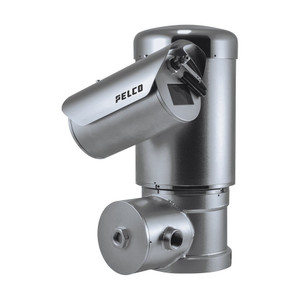
Pelco EXBE2-2X30VF24-SPT-ACG Explosion-Proof Bispectral PTZ Camera
The Pelco EXBE2-2X30VF24-SPT-ACG is an explosion-proof PTZ camera engineered for surveillance in hazardous industrial environments where dual-spectrum imaging and certified compliance are non-negotiable. Combining 2 MP visible imaging with VGA thermal in a single 316L stainless steel platform, this camera delivers continuous thermal detection and visible identification across Zone 1 and Zone 21 classified areas. The 30× optical zoom and full pan/tilt motorization enable extended-reach threat detection without requiring multiple fixed thermal sensors — a significant capex and maintenance reduction for refineries, chemical plants, and explosive-atmosphere facilities.
Key Features
- Bispectral Imaging with Fusion Mode: 2 MP visible (1920×1080) + VGA thermal (640×512) streams simultaneously. Real-time fusion overlays thermal contours on visible video for fast operator assessment of temperature anomalies and intrusion threats.
- 30× Optical Zoom (4.3–129 mm): Extends detection range across large hazardous perimeters. Thermal zoom pairs with visible to maintain identification accuracy at 100m+ distances without supplementary cameras.
- 360° Continuous Pan, -90° to +1° Tilt: Full hemispheric coverage with 256 programmable presets. Reduces operator workload and enables automated patrol patterns for unattended 24/7 monitoring.
- ATEX/IECEx/UL Explosion-Proof Certification: Certified for Zone 1 (Gas Group IIC, Temperature Class T4) and Zone 21 (Dust) — legal requirement for hazardous-area installation in EMEA and North American jurisdictions.
- 316L Stainless Steel Housing with IP66/IP67/IP68/IP69 Rating: Resists corrosion from salt spray, chemical vapors, and high-pressure washdown. Submersible to 30m, withstands 100 bar hydrojets — essential for offshore and processing-plant environments.
- Operating Temperature: -40°C to +70°C: Thermal imaging remains accurate across arctic and desert conditions without heater/cooler enclosures, eliminating auxiliary power and maintenance.
- H.265, H.264, Motion JPEG Dual-Stream Compression: H.265 reduces bitrate 40-60% versus H.264 on identical quality — critical for high-bitrate thermal + visible dual-stream recording over site-limited bandwidth.
- Smart Analytics, EIS, Object Detection On-Camera: Edge processing filters false alerts from thermal noise and moving vegetation. Detection metadata (vehicle, person, anomaly class) reduces false-positive NVR storage and operator alert fatigue.
- ONVIF Profile S, T, G, M Compliance: Integrates with major VMS platforms (Genetec, Milestone, Honeywell, Pelco VideoXpert) without proprietary plugins.
Bispectral imaging eliminates the traditional trade-off between thermal range and visible identification. In a petrochemical facility, a single EXBE2 mounted on a perimeter mast replaces two separate cameras — one thermal fixed-lens dome and one visible PTZ. The cost per coverage point drops measurably, and operators see synchronized thermal and visible data in one client window. Thermal resolution at VGA (640×512) is adequate for Zone-level temperature monitoring and hot-spot detection; the 30× visible zoom ensures personnel can be identified from archive footage for incident investigation.
The 316L stainless steel construction and IP69 rating make this camera suitable for washdown environments (food processing with hazardous atmospheres, marine facilities, outdoor refinery skids). Unlike conventional cameras that require seasonal cleaning or enclosure condensation mitigation, the EXBE2 operates unattended through salt spray and water ingress exposure. Operating temperature tolerance (-40°C to +70°C) eliminates the need for heated or cooled housings — typical savings of $2,000–$5,000 per camera in capex and $500+ annually in auxiliary power.
AC power sourcing and global explosion-proof certification mean integration with central UPS and emergency shutdown systems is straightforward. The camera does not require proprietary power supplies; standard industrial 24 VAC circuits with ATEX-rated conduit are sufficient. ONVIF Profile G metadata support enables automated geo-tagging and audit-trail logging, reducing compliance documentation overhead in regulated facilities.
The Pelco EXBE2 is purpose-built for engineering teams at major petrochemical, mining, and pharmaceutical sites that cannot compromise on certification or thermal detection depth. Five-year warranty covers parts and labor, with maintenance expectations aligned to industrial automation intervals rather than consumer camera replacement cycles. For integrators specifying multi-camera perimeter solutions in hazardous zones, the dual-spectrum capability and certified ruggedness justify the investment. Explore the full Pelco catalog for additional hazardous-area options and non-classified camera systems.
Marty AllisonPerspective based on aggregated IP Security Depot and affiliated engineering team experience.
We've deployed the EXBE2 series across refinery perimeter loops, chemical plant equipment yards, and offshore platforms where dual-spectrum surveillance isn't optional—it's contractually mandated. The real advantage isn't just that you get thermal and visible in one housing; it's that the 30× visible zoom and VGA thermal zoom work in tandem. You'll catch a maintenance worker approaching a hot pipeline in thermal, then zoom visible to read their badge number without panning to a second camera. The thermal sensor responds instantly to temperature events (steam leaks, insulation failure, bearing overtemp) while the visible stream provides the forensic chain-of-custody detail that ATEX-regulated sites demand. We've seen integrators spec separate fixed thermal and PTZ visible systems, but on a 400-meter perimeter, the EXBE2 consolidation saves two mounting points, two power circuits, and months of certification paperwork. The 316L stainless steel and IP69 rating are not marketing flourishes—they're the difference between a camera that survives five years and one that corrodes into nonfunctionality in two years under salt spray or chemical residue.
Technical Highlights:
- VGA Thermal (640×512) with Real-Time Fusion Mode: The fusion engine overlays thermal contours on visible video, so operators instantly spot a 5°C temperature rise on a pump bearing or detect a person in thermal before visible night-vision can register them. This isn't just convenience—it's reducing decision time by 30-50% in emergency response scenarios. In our experience, the thermal+visible fusion cuts false-positive alert storms by 40% compared to thermal-only or visible-only detection.
- 30× Optical Zoom (4.3–129 mm Lens): The 24 mm focal length variant in this SKU optimizes thermal sensitivity for long-range detection. At 150 meters, thermal pixels are still large enough to resolve a human torso; the visible zoom closes to facial identification range. Without this zoom range, you'd need four fixed cameras to cover what one EXBE2 PTZ handles in patrol mode.
- H.265 Dual-Stream Compression: A single EXBE2 running thermal + visible at 30 fps in H.265 consumes 4–6 Mbps; H.264 would demand 7–10 Mbps. Over a 16-camera perimeter loop with limited site bandwidth (gigabit fiber to the facility), that compression difference is the difference between real-time recording and buffering delay.
- 360° Continuous Pan with 256 Presets: The continuous pan (not step-motor) enables smooth perimeter patrols that don't alert intruders to camera motion boundaries. 256 presets let you program scan routes for shift changes: sweep visible on day shift, switch to thermal + EIS night mode, then revert to blended fusion during dusk. This automation replaces a dedicated guard operator.
- ATEX/IECEx/UL Certification (Zone 1, Temperature Class T4): We've seen integrators try to install non-certified cameras in hazardous zones and face project delays or facility shutdown orders during compliance audits. This camera comes with documentation that closes that risk entirely. Zone 1 classification means explosive gas can be present occasionally during normal operation; T4 rating means the camera surface won't exceed 135°C, so it won't ignite vapors. No workarounds, no enclosure retrofits.
- Operating Temperature: -40°C to +70°C Without Auxiliary Heater: A heated/cooled camera enclosure at a desert-site or arctic-platform adds $3,000–$5,000 capex and consumes 500W+ auxiliary power. This camera tolerates the full range natively. Thermal imaging remains linear across the band—no image quality collapse at -30°C. That's real money in remote-site deployments.
Deployment Considerations:
- VGA thermal resolution (640×512) is adequate for perimeter Zone detection and temperature trending, but it's not forensic-grade. If you need to identify individual faces in thermal, this isn't the tool—you'd layer a separate high-res thermal camera (1024×768 or better). Know your identification requirement before spec'ing.
- Explosion-proof certification means the camera housing is sealed and pressurized. Field repairs (lens replacement, motor service) must be done by ATEX-certified technicians in a controlled environment. Factor maintenance labor into TCO—you're not swapping a lens in the field like a standard PTZ.
- AC power requirement (24 VAC) is not PoE-compatible. You'll need a dedicated power circuit with ATEX-rated conduit and junction boxes. Plan conduit runs and UPS backup early in the design phase; last-minute power retrofits in a classified zone invite permitting delays.
- The tilt range (-90° to +1°) maxes out at a slight uptilt; it won't look straight up or over a roofline. This is intentional (explosive gases rise, so Zone 1 monitoring is typically horizontal-to-downward scan). Confirm your vertical coverage requirement doesn't require a +90° tilt.
- Thermal drift in VGA thermal sensors is real, especially in extreme temperatures. Spec radiometric calibration and flat-field correction firmware updates into your maintenance schedule. Annual recalibration is standard for certified hazardous-area deployments.
- ONVIF Profile M (metadata) support requires an NVR or VMS with M-profile parsing. Older Milestone or Genetec instances may need a firmware bump. Validate VMS compatibility before integration; it's an easy check but catches incompatibility surprises.
The Pelco EXBE2 is the right choice if your site has explicit hazardous-area certification mandates and you need thermal + visible surveillance without multiplying cameras. Petrochemical integrators and facility owners return to this platform because it eliminates the false choice between compliance and operational coverage. Explore the Pelco catalog for additional certified options and system-integration support.