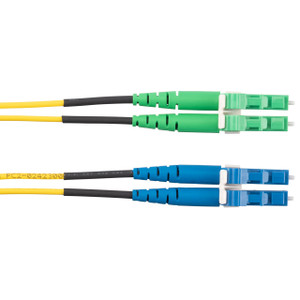
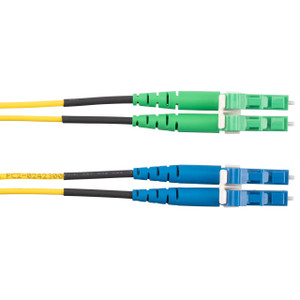
Panduit F91ER1NB1SNM004 OS2 Single-Mode Fiber Optic Patch Cord
The Panduit F91ER1NB1SNM004 is a 4-meter OS2 single-mode fiber optic patch cord engineered for long-haul, low-loss connectivity in structured cabling deployments, data center interconnects, and campus backbone applications. Built on Panduit's Opti-Core platform, this simplex cable terminates with an LC connector on one end and an angled-polished LC/APC connector on the other—ideal for bridging passive optical networks, CWDM/DWDM systems, and single-mode links where return loss and back reflection must be minimized. The 1.6 mm riser-rated (OFNR) jacket meets building-code requirements for vertical runs without conduit, while the compact cable diameter simplifies high-density patch-panel routing and reduces congestion in cable trays. Standard polarity and standard insertion loss ensure drop-in compatibility with existing fiber infrastructure, and the yellow jacket provides instant visual identification for OS2 single-mode circuits in mixed-fiber environments.
Key Features
- OS2 single-mode fiber rated for 10 Gb/s, 40 Gb/s, and 100 Gb/s Ethernet over distances up to 10 km or more
- LC Simplex to LC/APC connectors—angled-polished ceramic ferrule on APC end delivers <-60 dB return loss for passive-optical and DWDM applications
- 1.6 mm jacket diameter reduces bend radius and cable-tray fill compared to 2.0 mm or 3.0 mm cordage
- Riser (OFNR) flame rating per NEC Article 770 for vertical installation in non-plenum spaces without conduit
- Standard polarity (transmit-to-receive alignment) simplifies deployment in structured-cabling systems using TIA-568 conventions
- Standard insertion loss specification ensures predictable link budgets and compatibility with legacy single-mode infrastructure
- Yellow PVC jacket provides instant visual differentiation from OM3/OM4 multi-mode (aqua) and OM5 (lime green) cables
- 9-micron core diameter and 125-micron cladding conform to ITU-T G.652.D single-mode fiber standards
- 4-meter (13.12 ft) factory-terminated length eliminates field splicing and delivers repeatable optical performance out of the box
- EN 60332-1-2 flame-test compliance for international installations and export projects
Single-mode fiber patch cords occupy a critical position in the physical layer—one poorly manufactured connector or out-of-spec insertion loss can cascade into packet loss, CRC errors, or complete link failure at 10 Gb/s and beyond. The F91ER1NB1SNM004 addresses these risks with factory-polished LC and LC/APC connectors manufactured to sub-micron tolerances. The LC Simplex form factor on the standard end uses a push-pull latch and 1.25 mm ceramic ferrule, offering the same footprint as SFP/SFP+ transceivers and enabling direct connection to switches, media converters, and fiber-channel HBAs. The LC/APC end employs an 8-degree angled polish on the ferrule endface, which deflects reflected light into the cladding rather than back toward the transmitter—critical for coherent optics, PON ONUs, and DWDM mux/demux modules where return loss below -60 dB is mandatory. Standard insertion loss (typically <0.3 dB) ensures the cable will not eat into your link budget on campus backbone runs or data-center interconnects, and the OS2 fiber itself supports 10GBASE-LR, 40GBASE-LR4, and 100GBASE-LR4 applications over distances well beyond the 550-meter limit of OM4 multi-mode fiber. For integrators migrating legacy Fast Ethernet or Gigabit links to 10 Gb/s or designing greenfield networks with 25 Gb/s or 100 Gb/s uplinks, OS2 patch cords eliminate the need for future re-cabling—single-mode fiber installed today will carry 400 Gb/s and terabit speeds tomorrow with only transceiver upgrades.
The 1.6 mm jacket diameter makes a measurable difference in high-density patch-panel and switch-top-of-rack scenarios. Compared to 2.0 mm or 3.0 mm cordage, 1.6 mm cables occupy roughly 36% less cross-sectional area per strand, allowing tighter bend radii (typically 10× cable diameter, or 16 mm loaded) and reducing the likelihood of kinking or exceeding the fiber's minimum bend radius during installation. In 1U fiber patch panels with 24 or 48 LC ports, thinner cables mean cleaner cable management, less strain on horizontal managers, and improved airflow around densely populated racks. The riser (OFNR) flame rating satisfies NEC Article 770.113(B) for installation in vertical shafts, risers, and ducts without metallic conduit, provided the space is not used for environmental air (plenum). For plenum applications, you'll need OFNP-rated cordage; for general-purpose or outdoor runs, OFNG or ruggedized tactical cable is more appropriate—but for the vast majority of intra-building vertical fiber pulls connecting IDF to MDF or floor-to-floor switch stacks, OFNR delivers the right balance of cost, flexibility, and code compliance. The yellow jacket follows TIA-598-D color-coding conventions for OS2 single-mode fiber, preventing accidental cross-connection with aqua OM3/OM4 multi-mode links and ensuring that technicians can trace circuits visually during adds, moves, and troubleshooting. Standard polarity means Pin 1 transmit on one end aligns with Pin 1 receive on the other, matching the default pinout of structured-cabling systems and eliminating the need for polarity-reversing keystones or crossover adapters in point-to-point links.
Panduit's Opti-Core fiber platform is deployed in data centers, enterprise campuses, and critical infrastructure worldwide, backed by a structured warranty and third-party performance verification. This 4-meter patch cord ships in cartons of 10, simplifying inventory management for staged deployments or maintenance spares, and each cable carries a UPC barcode (61305680436) for asset tracking and automated bill-of-materials reconciliation. The angled-polished LC/APC connector on one end makes this cable particularly well-suited for PON feeder links, CWDM/DWDM channel connections, and any application where Fresnel reflection must be suppressed below -60 dB—conditions that would cause bit errors or signal degradation on standard UPC (ultra-polished) connectors. When deploying fiber-to-the-desk, storage-area networks over FC16 or FC32, or IP security backbones linking remote camera nodes to centralized NVRs, the F91ER1NB1SNM004 delivers the precision, durability, and standards compliance that commercial integrators depend on to pass acceptance testing and maintain SLA uptime commitments.