Panduit F92ELB1LNSNM002 Opti-Core 2-Fiber OS2 Single-Mode Patch Cord
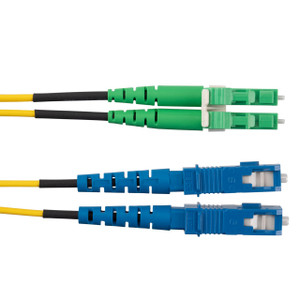
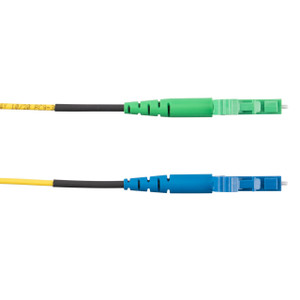
The Panduit F92ELB1LNSNM002 is a 2-meter duplex single-mode fiber patch cord engineered for datacenter and enterprise backbone links requiring asymmetric connector polishes. One end terminates in a green LC/APC duplex connector (8° angled physical contact) to interface with OLT equipment, DWDM mux/demux modules, or long-haul transmission gear demanding <-60 dB return loss. The opposite end uses standard LC duplex connectors (UPC polish) for direct connection to 10GBASE-LR switches, SFP+ transceivers, or server NICs that ship with UPC-terminated fiber ports. The 1.6 mm cable jacket diameter enables higher port density in 1U fiber patch panels compared to 2.0 mm or 3.0 mm cordage, and the LSZH (Low Smoke Zero Halogen) compound meets IEC 60332-3-24 flammability and toxicity requirements for installation in occupied spaces, return-air plenums, and datacenters governed by European fire safety codes or ASHRAE 90.1 air-quality mandates.
Key Features
- OS2 single-mode fiber (9/125 µm core) compliant with ITU-T G.652.D for 10G/40G/100G Ethernet transmission over distances up to 10 km (10GBASE-LR) or 40 km with appropriate optics
- LC/APC duplex connector (green housing, 8° angle polish) on one end reduces Fresnel back-reflection to <-60 dB, preventing bit-error-rate degradation in DWDM, CWDM, and long-span links
- LC duplex connector (blue housing, UPC polish) on opposite end matches the factory-installed connectors on SFP+, SFP28, and QSFP28 transceivers in switches, routers, and storage arrays
- 1.6 mm cable jacket diameter (vs. industry-common 2.0 mm or 3.0 mm) permits 40-60% higher port density in 1U LC quad patch panels and high-density fiber enclosures
- LSZH jacket compound produces <0.5% HCl gas and <100 m^-1 peak smoke density (IEC 61034) during combustion—critical for datacenters, hospitals, transportation hubs, and European commercial buildings where PVC cordage is prohibited
- 2-fiber duplex configuration provides full-duplex transmit/receive pair in a single cable assembly; polarity follows TIA-568 Method B (A-to-A, B-to-B)
- 2-meter (6.56-foot) length spans top-of-rack switch to end-of-row aggregation switch, or server to patch panel in standard 42U racks with 6-12 inches of service loop
- Yellow cable jacket per TIA-598-C color-coding convention for OS2 single-mode fiber—differentiates from orange OM1/OM2, aqua OM3/OM4, or lime OM5 multimode cordage in mixed-fiber installations
- Factory-terminated and factory-tested Opti-Core connectors deliver <0.25 dB insertion loss and >45 dB return loss (UPC end) per IEC 61300-3-4 / IEC 61300-3-6 test standards—eliminates field epoxy, polish, and cure-time variables
- Duplex LC connector format (2x 1.25 mm ferrules in SFF form factor) occupies 50% of the panel footprint vs. SC duplex, enabling 48-port LC panels in 1U vs. 24-port SC panels
The hybrid LC/APC-to-LC/UPC configuration solves a common interoperability problem in metro Ethernet and datacenter interconnect deployments: passive optical LAN (POL) OLTs, DWDM transponders, and carrier-grade GPON equipment ship with APC-polished LC or SC ports to minimize return loss in split-ratio and long-distance links, but enterprise switches, SAN storage controllers, and x86 server HBAs universally ship with UPC-polished LC ports. Directly mating APC-to-UPC with a standard duplex patch cord creates a 0.3-0.5 dB air gap at the angled interface, and repeated insertions damage the ferrule endface. This patch cord's factory APC/UPC pairing eliminates the need for bulkhead adapters, midspan conversion couplers, or mismatched mating that voids transceiver warranties. The 1.6 mm jacket diameter is a deployment-critical specification in high-density environments: a 1U LC quad panel with 96 ports (48 duplex) requires <1.8 mm bend radius per TIA-568.3-D; 2.0 mm or 3.0 mm patch cords exceed the 40 mm bend radius minimum at the panel egress, forcing 2U panel spacing or limited port population. The 1.6 mm Opti-Core jacket maintains >20x cable diameter bend radius (32 mm minimum) even in tightly bundled 48-strand trunk routes, preventing macrobend-induced attenuation spikes at 1310 nm and 1550 nm wavelengths. OS2 fiber's 9 µm core and <0.4 dB/km attenuation at 1310 nm supports 10GBASE-LR (10 km), 40GBASE-LR4 (10 km), and 100GBASE-LR4 (10 km) Ethernet variants without inline amplification, and the G.652.D zero-water-peak specification eliminates the 1383 nm absorption band that limits legacy G.652.A/B fiber to C-band and L-band DWDM channels.
The 2-meter length is purpose-matched to top-of-rack (ToR) switch architectures in 42U datacenters: a ToR switch mounted at U38-40 reaches an end-of-row (EoR) aggregation switch or spine switch in an adjacent rack 800-1200 mm away with 300-600 mm of service loop for future re-patching, maintenance slack, and cable-management arm travel. This eliminates the excess coil and zip-tie bundles created by 3-meter or 5-meter cordage in same-row links, which obstruct airflow through hot-aisle/cold-aisle containment systems and increase the failure risk during moves-adds-changes when technicians tug on over-length cables. The yellow LSZH jacket meets two datacenter mandates: TIA-598-C Annex A color-coding (yellow = OS2 single-mode) for rapid visual identification during troubleshooting and MAC work, preventing the insertion of OM3 multimode cordage into 10GBASE-LR single-mode links (which causes total signal loss), and IEC 60332-3-24 Category C vertical flame-spread limits plus IEC 60754-1 halogen-free compound certification required under ASHRAE 90.1-2019 for cables installed in ceiling return-air pathways, raised-floor supply plenums, or any space where building HVAC systems circulate air past cable bundles. European datacenters, hospitals, airports, and tunnels mandate LSZH under EN 50575 CPR (Construction Products Regulation); PVC-jacketed cordage is prohibited in these installations regardless of performance, and site inspections flag non-compliant cable for immediate removal.
Panduit's Opti-Core line differentiates from field-terminated or third-party bulk cordage through factory automation: each LC connector is epoxy-injected, fusion-cured, and endface-polished in a controlled environment with automated interferometric inspection, then factory-tested for insertion loss, return loss, and ferrule geometry per IEC 61300-3-4 (IL), IEC 61300-3-6 (RL), and IEC 61300-3-35 (geometry) before shipping. Field-terminated cordage requires on-site epoxy application, 15-30 minute oven cure cycles (or overnight ambient cure), manual polish with 1 µm and 0.3 µm lapping film, and handheld microscope inspection—introducing 0.4-0.8 dB insertion-loss variation and 5-10% connector-failure rates from contamination, incomplete cure, or polish scratches. The LC duplex form factor is the de facto standard for 10G/40G/100G datacenter deployments: SFP+, SFP28, and QSFP28 (via breakout) transceivers use LC connectors exclusively, and hyperscale operators have standardized on LC for 100GBASE-LR4 spine-leaf fabrics due to the 1.25 mm ferrule's 50% footprint advantage over SC duplex (2.5 mm ferrule) and MPO/MTP's higher per-port cost and polarity complexity. The APC polish's 8° angle eliminates the 4% Fresnel reflection (0.17 dB return loss) inherent in UPC's curved-but-perpendicular endface; in DWDM links where 40-80 wavelengths share a single fiber, that -14 dB return loss creates crosstalk and coherent interference, degrading OSNR (optical signal-to-noise ratio) and forcing inline amplification or reduced span lengths. APC's <-60 dB return loss pushes reflected energy below the transceiver's detection threshold, enabling unamplified 40 km links with 10GBASE-ER or 80 km links with 10GBASE-ZR optics in metro Ethernet and campus backbone applications.