Panduit F92ELB1LNSNM004 Opti-Core™ OS2 Single-Mode Fiber Patch Cord
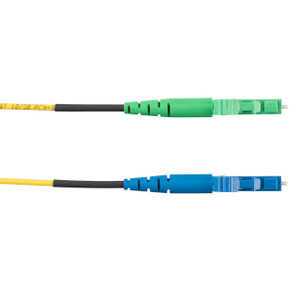
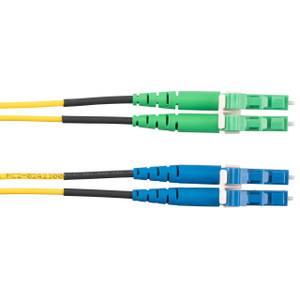
The Panduit F92ELB1LNSNM004 is a 4-meter duplex fiber patch cord engineered for high-performance datacenter, enterprise backbone, and storage area network deployments where low insertion loss and minimal back reflection are non-negotiable. This Opti-Core™ 2-fiber zipcord features OS2 single-mode fiber with LC/APC connectors (green, angled physical contact) on one end and standard LC duplex connectors on the other—a hybrid termination that bridges APC-equipped active gear to conventional LC patch panels or non-APC infrastructure. The 1.6mm LSZH jacket meets strict indoor fire-safety and low-toxicity requirements, making this cord suitable for plenum spaces, risers, and occupied areas where halogen-free materials are mandated. Datacenter technicians and fiber installers choose this patch cord when they need factory-terminated reliability, Panduit's insertion-loss guarantees, and the flexibility to deploy OS2 fiber in mixed-connector environments without field polishing or custom termination.
Key Features
- OS2 Single-Mode Fiber: 9/125 µm core optimized for 10G, 40G, 100G+ transmission over distances up to 10 km (and beyond with appropriate transceivers), delivering the bandwidth headroom required for modern datacenter and campus backbone links.
- Hybrid LC/APC to LC Termination: Green LC/APC duplex connectors on one end (8° angled endface) minimize back reflection to -60 dB or better, critical for high-speed coherent optics, DWDM, and analog RF-over-fiber; standard LC duplex on the other end simplifies integration with existing non-APC patch panels and legacy equipment.
- 1.6mm Zipcord Design: Compact, flexible dual-fiber construction routes easily through tight cable trays, patch-panel arms, and zero-U managers without kinking; the thin profile reduces congestion in high-density racks and simplifies moves/adds/changes.
- LSZH (Low Smoke Zero Halogen) Jacket: Meets IEC 60332-1 and 60754 flammability and toxicity standards; produces minimal smoke and no corrosive halogen gases during combustion, protecting personnel and sensitive electronics in enclosed spaces—required by many building codes for indoor horizontal and vertical fiber runs.
- Factory Pre-Terminated and Tested: Each cord ships with Panduit's standard insertion-loss specification (typically ≤0.3 dB at 1310 nm, ≤0.4 dB at 1550 nm) and return-loss performance verified at the factory, eliminating field termination errors and accelerating deployment.
- 4-Meter (13.12 ft) Length: Long enough for equipment-to-patch-panel connections in adjacent racks or across a row, yet short enough to minimize excess cable slack and maintain clean cable management in structured cabling environments.
- Yellow Cable Jacket: High-visibility color coding per TIA-598 standard for single-mode fiber; instantly distinguishable from multimode (aqua/orange) and simplifies troubleshooting in mixed-fiber installations.
- Duplex LC Connectors: Industry-standard small-form-factor interface compatible with SFP/SFP+/SFP28/QSFP transceivers from Cisco, Arista, Juniper, Dell, HPE, and virtually all enterprise networking and storage vendors; push-pull latch design prevents accidental disconnection.
- Panduit Opti-Core™ Quality: Precision-polished ceramic ferrules, tight fiber-to-ferrule concentricity tolerances, and rigorously controlled manufacturing processes ensure repeatable low-loss performance across thousands of mating cycles.
- Carton Quantity 10, Package Quantity 1: Sold individually; carton packs available for bulk orders when deploying dozens of identical-length links in a new build or refresh project.
Single-mode OS2 fiber is the backbone medium of choice for datacenter interconnects, SAN fabric links, and metro/campus fiber rings because it supports multi-gigabit and even terabit-scale transmission over kilometers with virtually no modal dispersion. The 9 µm core diameter confines light to a single propagation mode, eliminating intermodal delay and enabling the full bandwidth potential of 10GBASE-LR, 40GBASE-LR4, 100GBASE-LR4, and dense wavelength-division multiplexing (DWDM) systems. The Panduit F92ELB1LNSNM004's OS2 fiber exceeds the attenuation requirements of legacy OS1 (≤1.0 dB/km at 1310 nm, ≤1.0 dB/km at 1550 nm) and is fully backward-compatible, so this cord works seamlessly in OS1-rated structured cabling systems and provides margin for future upgrades to 400G and 800G optics. The LC/APC termination on one end is engineered specifically to suppress back reflection—an angled 8° endface causes reflected light to exit the fiber core rather than bouncing back toward the transmitter. This design is essential for analog CATV/RF-over-fiber systems, coherent 100G/400G optics, and passive optical network (PON) architectures where even -40 dB return loss can cause bit errors or signal degradation. By terminating the opposite end with standard LC (non-APC, 0° flat polish), Panduit gives installers a hybrid patch cord that bridges APC-equipped switches, routers, or media converters to conventional LC patch panels or equipment ports that lack APC connectors—eliminating the need for APC-to-UPC adapter modules and reducing insertion loss. The 1.6mm zipcord construction consists of two tight-buffered 900 µm fibers in a figure-8 or parallel configuration, bonded by a thin web that allows the cable to be split ("unzipped") for breakout fanouts or re-routing without tools. This design is far more flexible than 2mm or 3mm distribution cables, making it ideal for congested patch-panel environments, horizontal cable managers, and server-rack deployments where bend radius and cable-tray fill are constant concerns. Panduit's factory termination process—precision cleaving, ceramic ferrule insertion, epoxy curing, and automated endface polishing—delivers insertion loss well below the 0.5 dB budget most installers allocate per connection, leaving headroom for link loss margin and aging. Each cord is 100% optically tested at 1310 nm and 1550 nm wavelengths before leaving the factory, and performance data is available on request for mission-critical projects that require per-cord certification.
LSZH jacket material is a mandated requirement in many international markets (Europe, Asia-Pacific) and increasingly common in North American commercial and institutional installations due to stricter building codes and occupant-safety regulations. When exposed to fire, PVC-jacketed cables release dense black smoke and hydrochloric acid gas—both hazardous to building occupants and corrosive to electronics. LSZH compounds, by contrast, produce minimal visible smoke and no halogen acids, improving egress visibility during evacuation and protecting expensive IT infrastructure from acid-vapor damage. The Panduit F92ELB1LNSNM004's LSZH jacket meets IEC 60332-1 flame propagation limits and IEC 60754-1/2 halogen-acid gas emission limits, making it suitable for use in air-handling plenums (when installed in cable tray or conduit per NEC 770.113), vertical risers, and any indoor horizontal pathways where flame spread and smoke toxicity are regulated. Enterprise datacenters deploying this patch cord between top-of-rack switches and fiber distribution panels gain the benefit of simplified code compliance, reduced insurance liability, and future-proofed cabling that won't require replacement if building authorities adopt stricter LSZH mandates. Typical deployment scenarios include: connecting 10G/25G/100G SFP/QSFP transceivers in spine and leaf switches to MTP-to-LC breakout cassettes in structured cabling; linking Fibre Channel SAN switches to storage arrays in a redundant fabric topology; bridging APC-equipped DWDM mux/demux modules to standard LC patch panels for wavelength add/drop; and extending high-speed links between server racks and a meet-me room or main distribution frame (MDF) in a campus network. The 4-meter length is a sweet spot for intra-row connections—long enough to reach from the top of one rack to the bottom of an adjacent rack or across a hot/cold aisle, yet short enough to avoid excessive cable loops and service-loop clutter that complicates airflow management and future troubleshooting. Installers appreciate the yellow jacket color, which provides instant visual differentiation from multimode aqua (OM3/OM4) and orange (OM1/OM2) cables, reducing the risk of cross-connecting single-mode and multimode links—a common mistake that results in link-down alarms and wasted troubleshooting time. The duplex LC form factor is the de facto standard for small-form-factor transceivers; push-pull tab latches allow one-handed insertion and removal even in dense patch panels where fingers can't reach behind the connector body, and the small footprint enables 144-fiber density in a single rack unit of LC adapter panels. The LC/APC connectors feature green boots and often green dust caps (not specified but typical Panduit practice), providing a clear visual cue that these are angled-polish connectors—critical because mating an APC connector to a non-APC adapter (or vice versa) causes immediate physical damage to the endface, resulting in high insertion loss and potential fiber core fracture.
Panduit's Opti-Core™ product family represents the company's premium tier of pre-terminated fiber assemblies, backed by rigorous manufacturing QA, comprehensive optical testing, and the Panduit warranty program. Unlike commodity patch cords that may use offshore ceramics and inconsistent polishing processes, Opti-Core cords are manufactured to tight concentricity and geometry specifications—ferrule hole diameter, fiber protrusion (undercut or overcut), endface radius of curvature, and apex offset are all held within ANSI/TIA-604-10 (FOCIS-10) limits to ensure repeatable low-loss, low-reflection connections across the product's rated 500-mating-cycle lifespan. The factory test report available for this cord confirms insertion loss ≤0.3 dB at 1310 nm and ≤0.4 dB at 1550 nm (typical values; actual specs on the datasheet), return loss ≥50 dB for the LC end and ≥60 dB for the LC/APC end, and endface geometry passing IEC 61300-3-35 standards for scratches, pits, and contamination. When you deploy hundreds of fiber links in a new datacenter build or a legacy copper-to-fiber migration, these factory guarantees translate directly into faster installation (no field testing required for every cord), lower troubleshooting costs (pre-certified performance eliminates "bad cable" as a variable), and higher day-one link success rates. The hybrid LC/APC to LC configuration is particularly valuable in environments where you've invested in next-generation switches or DWDM gear with APC ports but need to integrate with an existing structured cabling plant that was built to older LC/UPC standards—this single cord eliminates the need for bulkhead APC-to-UPC conversion modules, saving a connector pair's worth of insertion loss (typically 0.3-0.5 dB) and reducing points of failure. Datacenter managers specify this Panduit MPN when they need a field-proven, code-compliant, low-loss fiber patch cord that installs fast, performs predictably, and carries the Panduit name—a brand synonymous with enterprise-grade infrastructure reliability and comprehensive technical support. This is the patch cord you pull out of the box, plug in, confirm link-up on your switch CLI, and move on to the next connection—no surprises, no field rework, no callbacks.