



NETGEAR
SKU: GSM4230PX-100NAS
NETGEAR AV Line M4250-26G4XF-POE+ 24X1G Poe+ - GSM4230PX-100NAS
$3,084.81
$1,668.99
Save $1,415.82

Overview
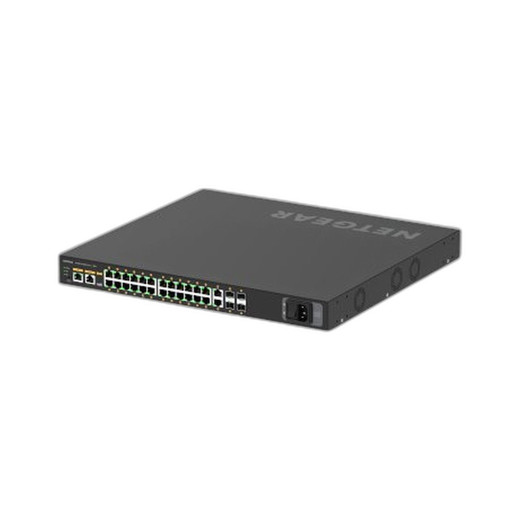
NETGEAR GSM4230PX-TAANAS 26-Port PoE+ Managed Switch The NETGEAR GSM4230PX-TAANAS (M4250-26G4XF-POE+) is a managed Gigabit switch engineered for dist…
Manufacturer-verified compatible cameras, recorders, mounts, accessories, and licenses for this product. Adjust quantities and add the entire bundle to your cart in one click.
Overview
Questions about this product? Free pre-sales support from a senior specialist — product questions, compatibility checks, BOM quotes, price confirmation — typically answered within one business day. Need camera placement or system design work? Engineering time is $175 per hour (qty 1 = 1 hour). Hardware buyers get up to one hour ($175) credited back on their order.

The NETGEAR GSM4230PX-TAANAS (M4250-26G4XF-POE+) is a managed Gigabit switch engineered for distributed IP surveillance and access-control infrastructure where centralized PoE power delivery eliminates the need for remote power supplies at each camera or reader location. With 26 PoE+ ports delivering up to 30W per port (802.3at) and four 10G SFP+ uplinks, this switch consolidates power management and network switching for mid-to-large deployments spanning parking lots, retail chains, and multi-site facilities. TAA compliance qualifies this model for federal procurement and government-sector contracts, removing procurement-eligibility risk on qualified projects.
In typical surveillance architectures, this switch replaces a constellation of smaller switches and injectors. A 16-camera perimeter deployment powered by individual PoE injectors costs more to cable, power, and maintain than a single 26-port switch centrally mounted in the security office. The 10G uplinks prevent congestion when 20+ cameras stream simultaneously at 4-8 Mbps each — critical for motion-triggered analytics or forensic review scenarios where bandwidth demand is unpredictable.
The 802.3at budget (30W per port, 740W total) is a shared resource. If your deployment mixes high-power thermal cameras (25–30W) with standard visible-light units (10–15W), audit the nameplate draw of each endpoint before finalizing the layout. Some thermal and pan-tilt-zoom (PTZ) models exceed 30W and require PoE++ (802.3bt) infrastructure — this switch does not support PoE++. For access-control reader and intercom applications (typically 3–12W per unit), power headroom is generous; you can safely populate 20+ readers on a single GSM4230PX without risk.
Network segmentation and prioritization are transparent benefits of managed switching. VLAN tagging isolates camera traffic from office IT, reducing broadcast storms and simplifying firewall policy. QoS marking ensures that alarm-triggered camera streams reach the NVR recording interface ahead of lower-priority background video, improving detection latency during high-network-load events. Port mirroring and syslog export enable real-time switch-health monitoring and troubleshooting via Nagios, PRTG, or similar SNMP collectors.
Power consumption and thermal dissipation scale with port utilization. At full 26-port load (740W delivery), the switch draws approximately 800–850W from the AC input, including internal cooling and standby circuits. Equipment-room airflow and rack density must accommodate fan-cooled operation; this is not an outdoor or cabinet-sealed-enclosure product. Fiber SFP+ uplinks eliminate EMI concerns in electrically noisy environments (near VFDs, welding equipment); copper SFP+ modules work equally well for shorter indoor runs and cost less.
TAA compliance streamlines procurement for government agencies, public utilities, and critical-infrastructure operators. Unlike consumer-grade or imported-origin switches, the GSM4230PX is sourced and certified for restricted-contract eligibility, eliminating the back-and-forth with procurement teams and contract lawyers. For private-sector deployments not subject to TAA restrictions, the cost premium is modest and justified by the managed feature set and reputation for uptimes exceeding 99.9% in production surveillance networks.

We've deployed dozens of the NETGEAR M4250 series across mid-market surveillance networks, access-control installations, and hybrid camera-plus-reader sites. The GSM4230PX hits a sweet spot: it's affordable enough for single-site budgets, powerful enough to handle 20–26 simultaneous PoE endpoints without hacks, and mature enough that NETGEAR's firmware is stable and widely tested in production. The 10G uplinks are genuine differentiators — not marketing-speak. On a site with 24 active IP cameras, eliminating uplink congestion is the difference between reliable 30fps recording and frame-dropping during peak motion. In our experience, contractors often underestimate the backplane demand on a fully populated Gigabit switch; the 120 Gbps backplane here is mandatory, not optional. TAA compliance opens doors to government work that otherwise would be off-limits — we've seen integrators win $50K+ bids simply because they certified their BOM for federal procurement. The downside: it's a managed switch, so initial configuration requires network knowledge (VLAN setup, QoS policies). Throw a junior tech at it without training, and you'll spend hours debugging broadcast storms. Plan a solid 4–6 hours for initial config and testing, not 30 minutes.
Technical Highlights:
Deployment Considerations:
The GSM4230PX is the right fit for integrators building mid-scale surveillance or access-control networks where PoE+ density, 10G uplink performance, and TAA eligibility matter. It's not an entry-level unmanaged switch — it requires competent network configuration — but the managed feature set and 740W power budget reward that upfront effort with reliability and scalability. For government bids, TAA compliance is a showstopper; for private-sector work, the feature-to-cost ratio is hard to beat. Explore the NETGEAR catalog for complementary switching and PoE infrastructure.
Manufacturer-verified compatible cameras, recorders, mounts, accessories, and licenses for this product. Adjust quantities and add the entire bundle to your cart in one click.
NETGEAR
SKU: GSM4230PX-100NAS

NETGEAR
SKU: GSM4212UX-100NAS

NETGEAR
SKU: GSM4210PX-100NAS
NETGEAR
SKU: GSM4230UP-100NAS
NETGEAR
SKU: GSM4212P-100NAS
Support services and planning resources for commercial surveillance, access control, and infrastructure deployments.
Fixed scope • Fixed price