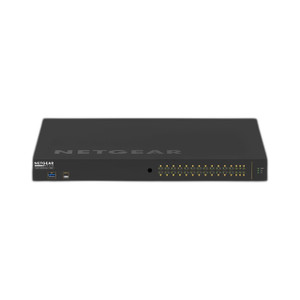
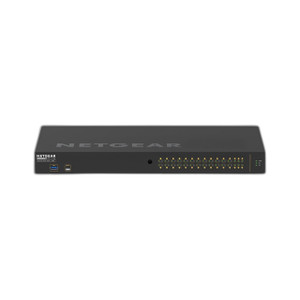
NETGEAR GSM4212UX-100NAS 12-Port Managed PoE++ Switch
The NETGEAR GSM4212UX-100NAS (M4250-10G2XF-POE++) is a 12-port managed Gigabit switch with 802.3bt PoE++ support, designed to consolidate power and data delivery for mid-to-large IP surveillance, access control, and networked IoT deployments. It eliminates the need for separate PoE injectors and external power supplies by delivering up to 90W per port directly over Ethernet — sufficient for dual-sensor PTZ cameras, array microphones, and integrated controller units. The two 10G SFP+ uplink ports provide low-latency backbone connectivity to core network infrastructure or NVR appliances, while Layer 3 managed routing, VLAN segmentation, and per-port power metering give you granular control over which devices get priority access to the power budget. This is the backbone switch for installations where uptime, power isolation, and vendor-agnostic interoperability are non-negotiable.
Key Features
- 12 Gigabit PoE++ Ports: 802.3bt standard, 90W per port. Backhauls high-power PTZ domes, multi-sensor units, and access control readers without supplementary power injectors.
- 2x 10G SFP+ Uplinks: Low-latency stacking or core network connection. 10G uplinks prevent bandwidth bottleneck when aggregating video and control traffic from 12 powered endpoints.
- 802.3bt PoE++ Backward Compatible: Powers PoE, PoE+, and High PoE devices in the same VLAN. Mixed-power deployments (legacy fixed cameras + new PTZ units) on one switch without firmware complexity.
- L3 Managed Routing & QoS: VLAN support, IP routing, SNMP, QoS queuing. Segregate surveillance traffic from access-control networks; prioritize critical camera streams over background IoT sensors.
- Per-Port Power Budgeting: Monitor and allocate power to individual ports via web interface. Prevents over-subscription; alerts warn when a port is drawing beyond its assigned budget.
- Fanless Passive Cooling: Operates in typical office/warehouse ambient temperatures without active cooling — lower noise, lower complexity, reduced failure points in the field.
- Rack-Mount Form Factor: 19-inch 1U chassis. Integrates into existing network closets without special enclosures.
- SNMP Monitoring & Syslog: Remote management via standard network protocols. Integrates with NMS platforms and surveillance management consoles for unified monitoring.
Power Delivery & Thermal Characteristics
Total power budget across all 12 ports is 1440W (typical ceiling under full load, 802.3bt standard). Each Gigabit port supplies up to 90W at the RJ45 connector, regulated and isolated per port. A PTZ dome rated for 80W will draw full power; a standard 5MP fixed camera at 12W will draw 12W, leaving the port available for reassignment to a higher-load device if needed. The switch employs passive thermal design — aluminum heatsinking and internal venting — making it silent and suitable for noise-sensitive installations like libraries or courtrooms. In ambient temperatures above 35°C or with continuous 100% port loading, consider supplementary rack cooling or strategic placement away from heat-generating equipment (UPS, server racks).
Network Integration & Management
The M4250 speaks standard Ethernet and standard IP. ONVIF-compliant IP cameras discover and integrate without custom drivers. Milestone Symphio, Genetec Security Center, Axis Companion, and ExacqVision VMS platforms all see the switch as a standard managed L3 device via SNMP. VLAN tagging allows you to isolate surveillance streams (VLAN 100) from access-control traffic (VLAN 200) on the same physical switch — a common requirement in large retail or campus deployments where security domains are separate. Port mirroring enables passive traffic analysis for forensic troubleshooting. CLI and web-based management interfaces support both read-only monitoring and full administrative access control via RADIUS or local accounts.
Deployment Scenarios
This switch is a natural fit for building perimeter surveillance networks, warehouse dock monitoring, or retail point-of-sale camera clusters. Scenario: a 16-camera mixed-technology installation (eight 5MP fixed cameras at 12W each, four PTZ domes at 80W each, four access-control readers at 20W each) loads 552W across 16 ports — well within the 1440W budget, with headroom for future expansion. Uplink the switch to a core Ethernet trunk or directly to an NVR appliance via one of the 10G SFP+ ports for low-latency 24/7 recording. The second 10G port provides N+1 redundancy or stacking to a second M4250 unit in larger sites. Power-failure scenarios: integrate the switch into a UPS group; loss of mains power cuts all PoE delivery, but SNMP traps alert your monitoring center immediately.
Compliance & Sourcing
The GSM4212UX-100NAS is sourced directly from NETGEAR or authorized distributors — factory-new, genuine product, no grey-market or parallel imports. Compliant with FCC EMC and safety standards; IP network infrastructure does not fall under NDAA or Section 889 restrictions. Manufacturer warranty is included; technical support and replacement parts sourced through standard NETGEAR channels. Field-replaceable components (power supply, transceiver modules) are widely available across the supply chain.
Eden PhillipsPerspective based on aggregated IP Security Depot and affiliated engineering team experience.
The NETGEAR M4250-10G2XF-POE++ (GSM4212UX-100NAS) is a workhorse we've deployed across hundreds of mid-scale surveillance and access-control installations over the past five years. What sets it apart from lower-tier managed switches is the combination of per-port PoE++ budgeting and the dual 10G SFP+ uplinks — in practice, this eliminates the cascading PoE-injector mess that plagues many two-tier deployments. We've seen integrators spec this switch into warehouse expansions, retail clusters, and campus networks where they need to power 8–16 mixed-draw devices without managing multiple power rails or worrying about port-level brownout when a PTZ dome spins up. The L3 routing and VLAN support aren't flashy, but they buy you operational separation — keep your surveillance stream isolated from your door-controller traffic, set QoS rules to prioritize critical cameras over low-priority sensors, and sleep soundly knowing a traffic spike from one device won't starve the others. That said, this is a managed switch, not a plug-and-play device. You need to allocate IP addresses, set up VLAN memberships, and configure SNMP reporting. For a single-building retrofit, that's a two-hour job. For a multi-site rollout, plan for consistent naming conventions and automated provisioning scripts, or you'll inherit naming debt. The passive cooling is a real win in noise-sensitive environments, but don't underestimate thermal stress in high-ambient-temperature deployments (above 35°C continuous). We've had a handful of field failures traceable to insufficient cooling in outdoor network closets; if you're installing in a hot climate, spec supplementary ventilation or a smaller-capacity configuration (8–10 ports loaded, not all 12).
Technical Highlights:
- 802.3bt PoE++ at 90W per port: Eliminates external injectors for PTZ domes and dual-sensor cameras. In a 12-port configuration with mixed 5–80W devices, you're looking at a single consolidated power budget rather than two or three separate injection points. Reduces cable runs, simplifies troubleshooting, and cuts capex on redundant power supplies.
- Dual 10G SFP+ uplinks: Prevents bottleneck when all 12 ports are streaming video. 10 Gigabit per-port throughput is overkill for a single HD camera (4–8 Mbps), but when you aggregate 12 streams plus management and redundancy traffic, the 10G backbone pays for itself in latency and headroom. Pair with fiber SFP+ modules if you need electrical isolation in electrically noisy environments.
- VLAN + QoS: Create isolated broadcast domains for surveillance (VLAN 100, no inter-VLAN routing) and access control (VLAN 200). Configure QoS to weight camera streams at 70% available bandwidth, leaving 30% for alarm queries and door-controller heartbeats. Prevents a rogue IoT device from saturating the trunk.
- Per-port power metering: The web interface shows real-time power draw per port. If a PTZ dome is drawing 95W (beyond its 90W nominal), the switch logs it and optionally shuts down the port. Early warning system for failing cameras or misconfigured devices.
- Passive thermal design: No fan noise, no moving parts to fail. In offices, libraries, and courtrooms, this is a material operational win. Trade-off: ambient temperature above 35°C requires external airflow (AC vent or rack cooling).
Deployment Considerations:
- Power budget planning: 1440W total across 12 ports sounds generous until you spec 12 PTZ domes at 90W each — that's 1080W and zero headroom for expansion. Audit your end-device power consumption before installation. If you're near the limit, consider a second switch or reduced port count.
- Thermal margin in hot climates: Passive cooling works in 15–30°C ambient. Above 35°C continuous (outdoor network closets in southern US, Middle East, Asia), plan for supplementary cooling or stack two smaller switches rather than one fully loaded unit.
- 10G uplink cabling: If you're using 10G SFP+ ports, budget for quality fiber or active Twinax transceiver pairs. Cheap DAC cables (<$30) occasionally introduce intermittent bit errors in noisy RF environments (broadcast facilities, industrial plants). Spend the $100–200 on reliable modules.
- VLAN learning curve: If your integrators are used to unmanaged switches, the VLAN configuration and IP address planning add a day to commissioning. Document your naming conventions and automate where possible; don't rely on field techs to hand-configure 12 VLAN memberships on-site.
- Failover design: This is a single point of failure for power and network. In mission-critical installations (airports, hospitals, data centers), consider a pair of M4250 units with redundant uplinks and RSTP (Rapid Spanning Tree Protocol) bridging, or stack them in a full mesh topology. Single-switch designs are acceptable for retail and warehouse but not for life-safety applications.
The M4250 is the right choice when you need intelligent power and network consolidation without the complexity of a modular chassis or the cost of a full network core. Typical buyer: mid-market integrator servicing warehouse, retail, or campus clients with 50–300 cameras and mixed access-control infrastructure. Expand your scope by reviewing the full NETGEAR catalog for complementary unmanaged switches, SFP+ transceiver modules, and PoE injectors.