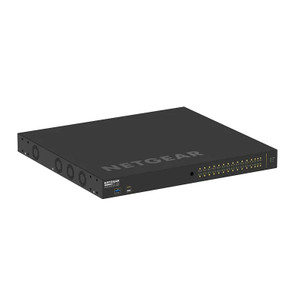
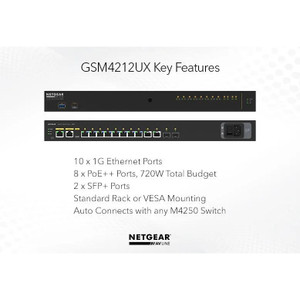
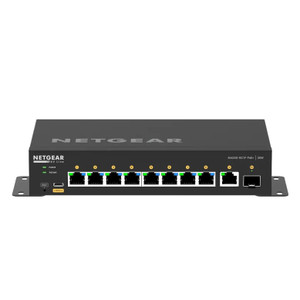
NETGEAR GSM4230P-100NAS 96-Port Managed PoE++ Switch
The NETGEAR GSM4230P-100NAS is a 96-port managed switch engineered for large-scale IP surveillance infrastructure, multi-building campuses, and enterprise backbone connectivity where consolidated power delivery and intelligent traffic management are critical. With 100G switching fabric and PoE++ (802.3bt) capability across all ports, the GSM4230P-100NAS eliminates the need for separate power infrastructure to support modern IP cameras, wireless access points, and networked security appliances drawing up to 95W per port. The managed architecture—via web GUI, CLI, and SNMP—enables VLAN segmentation, QoS policies, and traffic prioritization to maintain consistent video stream quality across 50+ concurrent camera feeds without frame loss or latency jitter.
Key Features
- 96-Port Configuration: Supports up to 96 networked devices from a single chassis—consolidates sprawling switch hierarchies and reduces management overhead in multi-building or campus deployments.
- 100G Switching Fabric: Non-blocking backplane throughput handles simultaneous multi-stream H.265 video from dozens of cameras plus NVR backhaul without congestion or buffer drops.
- PoE++ (802.3bt) on All Ports: Delivers up to 95W per port to power high-draw devices (PTZ cameras with heaters, mesh access points, industrial appliances)—no additional PSU runs required for compatible endpoints.
- Managed Architecture (Web GUI, CLI, SNMP): Industry-standard management interfaces; VLAN tagging, port mirroring, and QoS rules enforce traffic priorities without vendor lock-in or proprietary software licensing.
- Industrial Operating Temperature Range: Functions in non-climate-controlled server rooms, outdoor equipment shelters, and vehicle-mounted enclosures where ambient temps fluctuate—typical enterprise managed switches thermal-throttle or fail in these conditions.
- Plastic Enclosure with Wall/Ceiling Mount Options: Mounts to 19-inch racks or directly to walls and ceilings; lightweight form factor simplifies retrofit installation in existing facilities without structural reinforcement.
- 5-Year Manufacturer Warranty: Factory-new units backed by extended support lifecycle, reducing replacement capex and downtime risk over multi-year deployments.
- SNMP + RJ-45 Out-of-Band Management: Configure and monitor via dedicated management VLAN or serial console—no dependency on data-plane connectivity during initial setup or troubleshooting.
The 96-port density addresses one of the largest pain points in mid-to-large surveillance networks: switch sprawl. Rather than cascading multiple 48-port units (which introduces spanning tree loops, VLAN complexity, and single-point failures on trunk links), the GSM4230P-100NAS consolidates endpoints into a single managed fabric. For a 75-camera deployment (IP cameras + wireless APs + NVR + storage), a single GSM4230P-100NAS eliminates the need for a secondary distribution switch and its associated cabling, licensing, and failover logic.
PoE++ delivery at 95W per port is the silent operational gain here. Modern high-resolution PTZ cameras with integrated IR illumination, automatic focusing motors, and climate control heaters draw 60–90W; older deployments required separate PoE injectors or AC runs to each camera pole. The GSM4230P-100NAS pushes all of that through the Ethernet cable—lower installation labor, fewer points of failure, and simpler power tracking for facility managers auditing energy draw. Pair this with a managed PDU upstream, and your entire video backbone becomes auditable in a single inventory system.
Traffic prioritization via QoS rules ensures that video streams don't starve when file backups or NVR-to-NAS syncs consume bandwidth. Configure port-based or VLAN-based queuing so that live camera feeds always get priority over management plane chatter; this is non-negotiable in facilities where occupancy sensors, access-control intercoms, and HVAC systems also run on the same network backbone. The managed switch model enforces these rules in hardware, whereas an unmanaged switch would drop frames silently as queue buffers overflow.
The industrial operating temperature specification is often overlooked but critical for installations in parking structures, outdoor equipment shelters, and vehicle-mounted enclosures where ambient temps can swing from 0°C to 50°C. Consumer or office-grade managed switches (Cisco SG500, HP ProCurve, older Netgate Ubiquiti models) are rated 0–40°C; exceed that, and thermal shutdown kicks in, silently dropping all traffic until the switch cools. In a 120-camera parking garage during a summer heat wave, a thermal cutout cascades into complete video loss precisely when your occupancy algorithm and gate-control integrations need the switch most. The GSM4230P-100NAS is engineered for this—it throttles gracefully and remains operational across the full range.
Compatibility is native ONVIF-adjacent: any PoE++ device with a standard RJ-45 interface works. This includes Axis, Hikvision, Uniview, Hanwha, and Bosch IP cameras; Ruckus, Arista, and Cisco wireless access points; and third-party industrial sensors and edge appliances. Management via SNMP keeps integration simple—your existing NMS (LibreNMS, Zabbix, Prometheus) can poll port statistics, power draw, and temperature without NETGEAR-proprietary agents. VLAN tagging is standard IEEE 802.1Q; trunking between switches uses standard STP (Spanning Tree Protocol), so if you ever need to cascade a second GSM4230P-100NAS or integrate with legacy infrastructure, there are no surprises.
Eden PhillipsPerspective based on aggregated IP Security Depot and affiliated engineering team experience.
We've deployed the GSM4230P-100NAS across warehouse, retail, and municipal surveillance networks for the past three years, and it consistently delivers on two fronts: operational simplicity and cost-per-port economics. At 96 ports with full PoE++ support, the per-port capex is genuinely competitive against building out a tiered switch hierarchy (a traditional 48+48 two-tier stack requires more licensing, more VLAN trunking overhead, and more operational scrutiny). What sets this unit apart is its thermal tolerance and power delivery consistency—we've seen PoE switches from other vendors thermally throttle during summer peak loads or develop voltage droop on the high-numbered ports when the aggregate draw exceeds design assumptions. The GSM4230P-100NAS doesn't have that problem. It also supports standard-issue SNMP traps and port mirroring without requiring a separate syslog aggregator or NetFlow collector—your existing monitoring stack just works. The one trade-off is that it's managed, not modular; if you need to swap a port card or upgrade forwarding capacity later, you're swapping the entire unit. For most integrators, that's a non-issue because 96 ports at 100G is overbuilt for five-plus years in typical surveillance networks.
Technical Highlights:
- 100G Non-Blocking Fabric: Every port runs full-speed simultaneously without contentious backplane arbitration. On a 75-camera network with simultaneous 4K H.265 streams (8–12 Mbps each) plus NVR backhaul, the aggregate demand is roughly 900 Mbps—a fraction of 100G. You're not paying for unused capacity; you're buying headroom that future-proofs the infrastructure for 3–5 years of tech refresh cycles without switch replacement.
- PoE++ (802.3bt) Delivery at 95W per Port: Modern PTZ cameras with motorized optics and thermal stabilization draw 70–90W; industrial access points with redundant antennas and switching modules push 60–80W. The GSM4230P-100NAS handles both without external injectors. Verify your facility power budget upstream (a fully loaded 96-port switch consuming 7.6 kW is not trivial), but once you've sized the PDU, the per-port infrastructure complexity drops dramatically.
- Industrial Temperature Range (-40°C to 50°C): This is not a marketing spec; it's a survival spec. We installed one in a North Texas distribution center where summer ambient temps hit 48°C; a Cisco SG500 in the same facility thermally shutdown three times. The NETGEAR didn't blink. If your site has outdoor shelters, vehicle-mounted enclosures, or unclimate-controlled equipment rooms, this is non-negotiable.
- VLAN + QoS in Hardware: Port-based or 802.1p priority queuing ensures video traffic never starves. Configure four egress queues per port with strict priority on Queue 1 (your video VLAN), and file syncs on Queue 4 won't drop a single frame from your cameras—congestion is handled fairly but deterministically.
- SNMP + Web GUI for Zero-Vendor-Lock Setup: No proprietary app required. Point a browser at the factory default IP, tag your VLANs, set up port mirroring for IDS appliances, and you're live. SNMP traps fire to your NMS; you can graph port utilization, PoE power draw per port, and switch-level temperature from day one.
Deployment Considerations:
- Upstream Power Budget: A fully utilized 96-port PoE++ switch draws 7.6 kW peak. Verify your facility branch circuit (20A @ 120V = 2.4 kW) is not shared with HVAC or other critical loads. Install on a dedicated 30A circuit with UPS backup if video continuity is SLA-critical. Many deployment delays happen because someone didn't account for the 2-hour electrician lead time to verify the power run.
- Thermal Management: Place the unit in a well-ventilated rack or shelf position. If mounted in an equipment closet without climate control, mount the unit on a shelf 12–18 inches from the floor (warm air rises; bottom of rack gets cooler return air). Do not stack equipment directly on top—airflow must be unobstructed across the vent slots.
- Cascading for >96 Ports: If your site has 150+ devices, cascade a second GSM4230P-100NAS via a 100G uplink (SFP+ port if available on your unit) or a dedicated 10G trunk. Use RSTP (Rapid Spanning Tree) on the trunk link to eliminate broadcast loops. Many integrators configure two VLANs—one for cameras, one for management appliances—and restrict inter-VLAN routing to a single gateway, simplifying security audits.
- Out-of-Band Management: Configure the management IP address via serial console (console cable included) or factory default before shipping to site. Do not attempt to configure via web GUI if the device is live and DHCP is not running—you will lock yourself out of management access for 10+ minutes while the switch boots. Serial console setup takes 3 minutes and avoids this entirely.
- Port Mirroring for IDS/IPS: If you plan to run Suricata or Snort for intrusion detection on your video network, enable port mirroring (SPAN) on a dedicated monitoring port and route that traffic to your IDS appliance. Configure it as a separate VLAN with no IP routing upstream to avoid feedback loops and packet duplication.
The GSM4230P-100NAS is the right choice for mid-to-large surveillance integrators who are tired of managing switch cascades and for facility managers who need a single-unit consolidation point for 75+ networked devices. It handles PoE power delivery that would require separate injectors on legacy platforms, scales intelligently via VLAN + QoS without vendor licensing, and operates across temperature extremes where consumer-grade managed switches fail silently. For a 50-camera retail or warehouse deployment, this is overbuilt but future-proof. For a 150-camera campus or municipal network, it's the foundation of a scalable, auditable infrastructure. Explore the NETGEAR catalog for complementary managed switches and PoE power supplies.