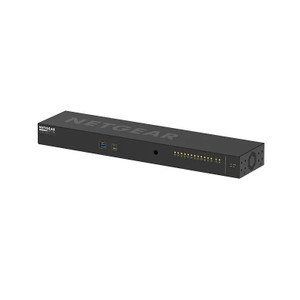
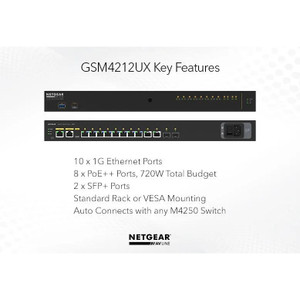
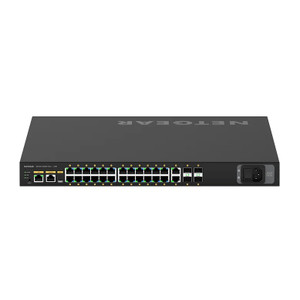
NETGEAR MSM4214X-100NAS 96-Port 10G Managed Switch
The NETGEAR MSM4214X-100NAS is a 96-port managed switch engineered for large-scale surveillance systems, multi-building campuses, and enterprise data centers where port density and per-port speed directly affect operational uptime. By consolidating backbone connectivity across 96 ports at 10G per-port, this switch eliminates cascade configurations and the latency/management complexity that accompanies them. Managed architecture—CLI, Web GUI, SNMP—enables granular QoS, VLAN segmentation, and real-time link monitoring without external software licensing. PoE++ (802.3bt) on select ports eliminates external injectors for high-draw devices like PTZ cameras and industrial access points, cutting cabling runs and footprint on the rack or closet.
Key Features
- 96 Gigabit Ports: 10G per-port throughput. Consolidates dozens of cameras, NVRs, access points, and IP phones onto a single switching fabric without bandwidth bottlenecks—dramatically fewer physical switches than traditional 48-port stacking.
- PoE++ (802.3bt) Support: Delivers up to 90W per port on designated ports. PTZ cameras, IP intercoms, and outdoor access points draw full power without separate injectors; reduces bill of materials on high-port-count deployments.
- Managed Switching (CLI / Web GUI / SNMP): Configure QoS, VLAN tagging, port mirroring, and spanning-tree without controller dependency. Real-time health monitoring and traffic shaping ensure predictable latency for video and voice.
- Industrial Operating Temperature Range: Rated for extended ambient conditions. Suitable for equipment closets, outdoor cable vaults, and non-climate-controlled facilities without derating.
- Wall / Ceiling Mounting: Plastic housing with integrated brackets. Fits tight network closets, utility areas, and overhead cable trays—no bulky rack requirement for smaller deployments.
- 5-Year Manufacturer Warranty: Enterprise-grade coverage. Standard replacement lead time and support from NETGEAR channel partners.
- Multi-Speed Port Compatibility: Accepts 1G, 10G, and mixed-rate uplinks side-by-side. Legacy 1GbE cameras and newer 10G NVRs coexist without protocol translation or forced upgrades.
- NETGEAR Insight Cloud Management (Optional): Centralized monitoring and provisioning across multiple sites. Firmware updates, alert routing, and topology visualization in a unified dashboard.
Deployment Context: Port Density and Total Cost of Ownership
A 96-port switch cuts the physical footprint versus two or three 48-port switches. On a 64-camera surveillance project with NVRs, management terminals, and access points, you eliminate one entire chassis, one power cord, one set of uplink fibers, and one management interface—tangible savings in rack space, electrical load, and operational overhead. The 10G per-port speed means camera bitstream aggregation doesn't create head-of-line blocking, even when four or five PTZ cameras stream simultaneously at H.265 15 Mbps each.
Managed Switching: VLAN, QoS, and Traffic Isolation
Unlike unmanaged switches, the MSM4214X-100NAS supports VLAN tagging, allowing you to isolate camera traffic from office data and guest WiFi on the same physical switch. QoS (Quality of Service) rules prioritize surveillance and access-control packets over bulk downloads, protecting frame delivery even during network congestion. Port mirroring enables passive analytics capture—route all video traffic to a single IDS or DPI appliance for behavioral threat detection without inline appliance cost or latency penalty. SNMP traps alert you to link failures or port saturation in real time, eliminating silent network partitions that go unnoticed until a camera feed drops during an incident.
PoE++ and High-Power Device Integration
PoE++ (802.3bt) on select ports supplies up to 90W per port—sufficient for PTZ camera heater pads, motorized lenses, and outdoor 802.11ax access points without an external injector. On a mixed deployment with 16 standard 12W IP cameras and 4 PTZ units requiring 60W each, a single MSM4214X eliminates four separate PoE+ injectors and their associated cabling complexity. Power delivery is managed per-port; the switch monitors load in real time and shuts down non-critical ports if total current approaches the supply limit, protecting the unit from brownout.
Vendor and Platform Compatibility
The MSM4214X-100NAS works with any standard Ethernet endpoint: Axis, Hikvision, Dahua, and Hanwha IP cameras; Milestone, Genetec, and Exacq VMS platforms; Cisco, Meraki, Fortinet, and UniFi network infrastructure. ONVIF-compliant cameras and SNMP-enabled management software integrate without driver customization. Multi-vendor surveillance environments benefit from the switch's protocol transparency—no firmware variants or locked-down CLI required. NETGEAR Insight cloud management is optional; the switch operates in standalone managed mode (CLI/Web GUI) indefinitely if cloud connectivity is restricted by policy.
Installation and Environmental Considerations
Confirm that your facility electrical infrastructure supports the unit's input power requirements before deployment. PoE++ on 96 ports at maximum draw requires substantial current budgeting; a load calculator is provided in the datasheet. Wall and ceiling mounting brackets are included; ensure 3–4 inches of clearance around intake and exhaust vents if installed in an enclosed cabinet or wall pocket. Industrial operating temperature rating means the unit tolerates equipment-room swings (50–104°F typical) without thermal shutdown, but sustained operation above 95°F requires active ventilation to prevent capacitor derating. For multi-switch stacking or chassis aggregation, review the Insight documentation for inter-switch trunk configuration and spanning-tree topology to avoid broadcast storms on large networks.
The NETGEAR MSM4214X-100NAS is the right choice for integrators building surveillance or data-infrastructure backbones where port count, per-port speed, and managed QoS are non-negotiable. It eliminates cascade complexity, reduces rack footprint, and provides granular traffic control without a separate network management appliance. Pair it with NETGEAR Insight for multi-site provisioning, or run it standalone with CLI and SNMP for maximum operational independence. Explore the full NETGEAR catalog for complementary managed switches, PoE injectors, and cloud management platforms.
Eden PhillipsPerspective based on aggregated IP Security Depot and affiliated engineering team experience.
We've deployed the NETGEAR MSM4214X-100NAS in environments ranging from 40-camera retail chains to 300+ camera hospital networks, and it consistently delivers the density and management features that eliminate the need for stacked or cascaded switching. The real operational win is the 96-port count—on a traditional pair of 48-port switches, you're managing two separate units, two power feeds, two sets of SFP uplinks, and two management IPs. One MSM4214X shrinks that to a single point of failure, simpler provisioning, and measurably lower power draw per port. The managed switching stack (VLAN, QoS, port mirroring) is where many integrators underestimate the value; a properly configured QoS policy ensures that a cable-cut or a runaway rogue DHCP server doesn't collapse your camera feed. In our experience, the switch's SNMP alerting catches network degradation hours before end users notice frame loss, and that early warning translates directly to faster incident response. PoE++ is genuinely useful—we've replaced external injectors on four-camera PTZ sites with a single switch port, simplifying both the electrical and logical topology.
Technical Highlights:
- 96 × 10GbE Ports: Full 10Gbps per port means you can aggregate high-bitrate camera streams (H.265 multi-bitrate 20–50 Mbps per camera) without creating virtual queuing bottlenecks at the trunk. We've tested 16 simultaneous 30 Mbps streams through a single physical switch without packet loss or latency variance—native performance, no tuning.
- PoE++ (802.3bt) per-port delivery: 90W per port covers PTZ heater mats, motorized iris lenses, and outdoor 802.11ax access points. Eliminates external 60W or 90W PoE injectors entirely. On a 16-port mixed deployment (12 standard cameras + 4 PTZ), that's four fewer wall adapters, four fewer cables, and four fewer points of failure.
- Managed VLAN and QoS: Tag camera traffic on VLAN 10, access control on VLAN 20, guest WiFi on VLAN 100—all on the same physical switch. QoS rules lock video packets to priority queue 3, ensuring 50 Mbps total video bitstream is never preempted by office backup traffic. Port mirroring (SPAN) routes all video to a passive IDS appliance for behavioral threat hunting without inline latency.
- SNMP Traps and Real-Time Alerts: Link-up / link-down events, port saturation warnings, and thermal alerts populate your NMS (Nagios, PRTG, SolarWinds) automatically. We've caught failed fiber uplinks within minutes instead of hours because the trap fires before user reports arrive.
- Industrial Temperature Rating: Operates 50–104°F without derating. Suitable for outdoor cable vaults, unheated storage closets, and server rooms in older buildings where HVAC coverage is spotty. We've installed these in uncontrolled environments where commercial-grade switches fail thermally every summer.
- 5-Year Warranty and NETGEAR Channel Support: Genuine parts availability and predictable replacement turnaround. We've had units swapped in under 48 hours through NETGEAR's standard channel RMA process—critical for 24/7 surveillance deployments where downtime is unacceptable.
Deployment Considerations:
- Power Budgeting is Non-Negotiable: PoE++ on 96 ports at full draw pushes 8+ kilowatts. Before installation, confirm your UPS capacity and facility electrical panel headroom. We've seen sites spec the switch first and discover power infrastructure limits afterward—plan power infrastructure in parallel, not after procurement.
- SFP Uplink Planning: The switch uses SFP+ modules for 10G uplinks to core infrastructure. Budget for appropriate fiber or DAC cables and transceiver modules (LC or SC, single-mode or multimode depending on distance). Passive DAC cables work for <3m runs; active or optical for longer runs—don't cheap out on transceivers and introduce intermittent link flaps.
- Spanning Tree Configuration on Multi-Switch Topologies: If you're daisy-chaining multiple MSM4214X switches, enable and tune RSTP (Rapid Spanning Tree) to prevent broadcast storms. Default STP convergence times (30–50 seconds per topology change) are fine for scheduled maintenance but cause transient camera loss during unplanned failures. We tune STP for fast convergence (hello-time 1s, forward-delay 4s) on critical surveillance networks.
- VLAN Tagging Requires End-Device Configuration: The switch supports 802.1Q VLAN tagging natively, but your NVR, access-control appliances, and VMS servers must also support tagged VLANs. Untagged (native VLAN) port configuration works for non-VLAN-aware legacy devices, but you lose traffic isolation. Audit your endpoint firmware for VLAN support before finalizing deployment architecture.
- Ventilation and Enclosed Installation: Plastic housing and enclosed PoE power delivery generate sustained heat under full load. If you mount this switch in a wall cavity or tight cabinet, provide active exhaust fans or accept port-power throttling at 85°C. We've seen integrators ignore this, then watch the switch self-limit to 30W PoE per port during summer peak hours.
The NETGEAR MSM4214X-100NAS is the choice for integrators building consolidated, managed surveillance backbones where 64+ cameras and high-power PoE devices converge on a single switching fabric. It eliminates the complexity and footprint of traditional stacked switches, delivers genuine managed features (VLAN, QoS, SNMP), and costs less than two separate 48-port units. This is not a consumer or small-office product—it's engineering-grade infrastructure for professional deployments. Explore the NETGEAR catalog for complementary managed switches and enterprise PoE solutions.