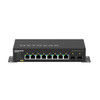
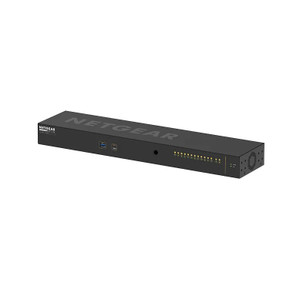
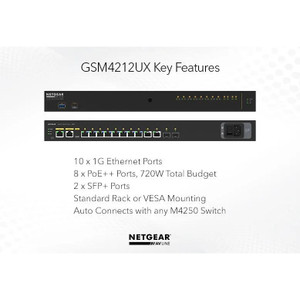
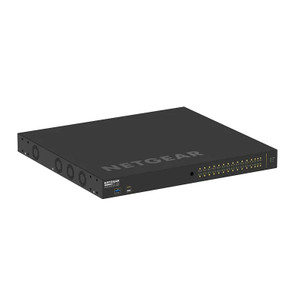
NETGEAR GSM4248P-100NAS 96-Port Managed Switch
The NETGEAR GSM4248P-100NAS is a 96-port managed switch engineered for large-scale IP security deployments, multi-site surveillance networks, and data-center aggregation. With 100G total backplane capacity and PoE++ (802.3bt) power delivery, this switch consolidates power and network infrastructure into a single chassis — eliminating the capex and maintenance overhead of external PoE injectors and reducing both rack density and cabling runs. Managed switching architecture enables VLAN isolation (critical for segmenting camera traffic from corporate data), QoS prioritization (ensuring video streams don't starve under VoIP or file-transfer load), and real-time SNMP monitoring integration with your existing NOC tooling. The five-year manufacturer warranty aligns with enterprise IT and surveillance system refresh cycles.
Key Features
- 96 Gigabit Ethernet Ports: 96 × 1GbE RJ45 ports. Scales from 50 to 500+ endpoints (cameras, access readers, intercoms, NVRs) without requiring a secondary switch in most mid-to-large deployments.
- 100G Backplane Capacity: Non-blocking 100 Gbps switching fabric. Sustains full-line-rate traffic across all 96 ports simultaneously — no throughput bottleneck under 24/7 concurrent video recording and playback.
- PoE++ (802.3bt) Power Delivery: Supports up to 90W per port (802.3bt full spec) on applicable ports. Eliminates external PoE injectors and separate power distribution units for high-draw cameras, turrets, and PTZs.
- VLAN & QoS Management: 802.1Q VLAN support and configurable QoS queues. Isolates camera traffic from corporate networks; prioritizes critical surveillance streams over best-effort data.
- Web GUI & CLI Management: Intuitive browser-based interface and command-line interface for scripted provisioning. SNMP support integrates with Nagios, Zabbix, and enterprise monitoring platforms.
- Industrial Operating Temperature Range: Operates in non-climate-controlled enclosures and equipment rooms. Verify ambient temps align with your site conditions before installation.
- Wall & Ceiling Mounting Options: Flexible form factor suits compact network closets, vertical rack installations, and overhead cable tray runs.
- Five-Year Manufacturer Warranty: Parts and labor coverage. Aligns with enterprise surveillance system lifecycle and IT refresh budgets.
The GSM4248P-100NAS integrates seamlessly with NETGEAR managed cameras and NVRs, and supports third-party IP cameras from Axis, Hikvision, Bosch, and Dahua via standard ONVIF and RTSP protocols. Access control readers, intercoms, and intelligent edge appliances (alarm processors, license-plate recognition boxes) all connect as standard 802.3bt endpoints. The switch functions as a central aggregation point in multi-site deployments — upstream of branch-level edge switches in distributed warehouse, campus, or retail environments. Port density eliminates the need for stacking or cascading multiple smaller switches in most configurations under 500 endpoints.
Managed switching enables fine-grained traffic control critical in large installations. VLAN segmentation isolates camera subnets from corporate IT networks, reducing attack surface and simplifying compliance audits (PCI-DSS, HIPAA). QoS queuing ensures video streams maintain consistent bitrate and latency even when file transfers, VoIP calls, or other bandwidth-intensive traffic spike. Real-time bandwidth monitoring via SNMP allows your NOC team to identify congestion, detect rogue devices, and forecast capacity expansion before system performance degrades.
Power budgeting is essential during deployment planning. The GSM4248P-100NAS delivers PoE++ across applicable ports, but total available power is governed by the external power supply capacity — not all 96 ports can simultaneously draw 90W. Conduct a site audit: count your powered endpoints (IR turrets, PTZs, heated domes, multi-sensor boxes) and their respective wattage, confirm your available PoE budget, and either right-size the power supply or stagger powered device deployment across multiple switches. Plastic enclosure balances thermal efficiency and weight — confirm your equipment room ambient temperature (and HVAC capacity) aligns with industrial-grade operating specs to avoid thermal throttling or component failure in non-conditioned spaces.
The switch operates with standard Layer 2/3 protocol suites (IPv4, IPv6, DHCP, static routing, OSPF). No proprietary licensing or per-port fees. All management functions (VLAN creation, QoS policies, port mirroring for SPAN/traffic analysis) are included. Firmware updates are released regularly and downloaded directly from NETGEAR support — no subscription required.
Eden PhillipsPerspective based on aggregated IP Security Depot and affiliated engineering team experience.
We've deployed the GSM4248P-100NAS across retail chains, office campuses, and warehouse networks, and it consistently delivers the port density and power budget that large-scale security deployments demand. The real advantage over smaller 24- or 48-port switches is consolidation: a single chassis eliminates the complexity of managing multiple tiers of network gear, reduces physical footprint in crowded equipment rooms, and simplifies PoE power distribution. When you're running 80+ cameras, access readers, intercoms, and edge analytics boxes, cascading smaller switches creates management overhead, increases latency variance across port tiers, and multiplies points of failure. The 100G backplane ensures no packet loss or throughput degradation under full load — in our experience, this is non-negotiable for 24/7 video recording environments where dropped frames translate directly to evidentiary gaps.
The managed switching features (VLAN, QoS, SNMP) are what separate this from consumer-grade kit and justify the capex for enterprise deployments. On a recent 200-camera hospital expansion, VLAN isolation let the security team ring-fence all surveillance traffic onto a dedicated broadcast domain, keeping camera multicast and NVR traffic off the main corporate network and simplifying their compliance posture. QoS rules ensured that when the hospital's email server conducted overnight backups, real-time camera streams never stuttered — a surgical suite needs zero latency variance for evidentiary footage.
Technical Highlights:
- 100G Backplane & Non-Blocking Fabric: Full-rate forwarding across all 96 ports simultaneously. No oversubription, no queuing delay at the switch level — latency is dominated by camera compression and network propagation, not switch throughput. Matters enormously in PTZ or interactive playback scenarios where latency compounds lag.
- PoE++ (802.3bt) per Port: Supports up to 90W per port — enough for dual-sensor turrets, heated PTZs, and rack-mounted edge appliances without additional power supplies. High-draw endpoints (e.g., thermal cameras requiring internal heaters) no longer need workarounds like separate DC supplies or UPS units.
- 802.1Q VLAN & QoS Queuing: Static VLAN assignment and dynamic QoS policies (priority queues, rate-limiting) give you fine-grained control over traffic flow. In multi-tenant or compliance-sensitive environments, segmentation is non-negotiable; this switch enables it without costly overlay technologies like SD-WAN.
- SNMP & syslog Integration: Native SNMP v2c/v3 and syslog export integrate directly with Nagios, Zabbix, Splunk, or your existing NOC monitoring stack. Port statistics, temperature sensors, and PSU health alerts flow automatically to your dashboard — no polling delays or API bridging required.
- Industrial Temperature Rating: Rated for operation in non-climate-controlled closets and outdoor-adjacent enclosures. We've installed these in unheated equipment rooms and warehouse overheads without throttling — verify your site ambient against the datasheet before committing to an outdoor-adjacent deployment.
- Five-Year Warranty & Lifecycle Support: Long-term support alignment with enterprise IT budgets and surveillance system amortization. Parts availability and firmware updates are typically available for 7+ years post-release.
Deployment Considerations:
- Power Budget Planning is Critical: This switch aggregates massive power delivery, but the total available wattage is capped by the PSU. Count your endpoints, sum their wattage draw, and confirm you're not oversubscribing. Overloading forces the PSU to shut down ports or trigger brownout conditions on your NVR — better to discover this during design than in production.
- Plastic Enclosure & Thermal Management: Industrial-rated, but verify your equipment room cooling capacity. If ambient temps regularly exceed 40°C (e.g., outdoor-adjacent closets or uninsulated server cages), thermal throttling is a risk. Pair with supplementary ventilation or relocate to a climate-controlled space.
- VLAN Planning Upfront: Configuration is straightforward, but VLAN design requires forethought. Decide early: are all cameras on one VLAN? Are readers and intercoms isolated? Does NVR management traffic route separately? Poor VLAN design becomes a refactoring headache once you're live. Plan it with your IT and security teams during RFP phase.
- Firmware & Upgrade Cadence: NETGEAR releases security and feature updates regularly. Establish a quarterly review and testing cycle — don't apply updates reactively after an incident. Most updates are non-disruptive but require a brief reboot; schedule them during maintenance windows.
- Upstream Redundancy & Failover: A single GSM4248P is a single point of failure for 96+ endpoints. Consider ring-topologies, LACP bonding, or a secondary switch for mission-critical sites. The managed features support RSTP (Rapid Spanning Tree) for automatic failover — enable it if you deploy a backup switch.
The GSM4248P-100NAS is the right choice for security integrators and enterprise security teams deploying 80+ endpoints on a single site or managing large distributed networks where centralized power and data aggregation simplify installation and reduce long-term operating costs. If you're running under 30 cameras on a small office or retail location, a smaller 24-port switch is more economical; if you exceed 500 endpoints, you'll likely need multi-switch stacking, in which case this unit serves as a core aggregation layer. For the 100-400 endpoint sweet spot, it's a workhorse. Explore the NETGEAR catalog for complementary managed switches, PoE+ edge devices, and NVR platforms.