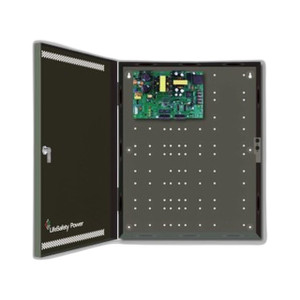
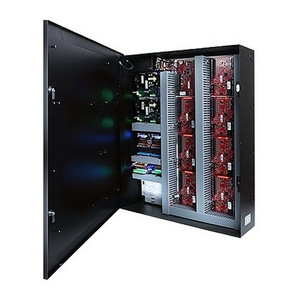
Lifesafety Power RD250-16 Rackmount Power Supply
The RD250-16 is a 2U rackmount power supply engineered for access control, alarm, and security system distribution. It delivers 250W across selectable 12VDC or 24VDC rails, with 16 independent fused outputs — a practical choice when you need to power multiple door controllers, readers, strike locks, or sensor arrays from a single protected source.
Key Features
- Dual voltage output (12V or 24V): Selectable at the supply allows you to match the input requirements of your control equipment without additional regulators or converters. Common in access control deployments where strike locks, mag locks, and readers operate at different voltage requirements.
- 20A @ 12VDC or 10A @ 24VDC output: Enough current budget for a distributed array of low-current devices — e.g., multiple relay modules, wireless transmitters, or door sensors — without cascading through additional distribution blocks. The current rating establishes a realistic load ceiling; oversizing beyond this introduces thermal and component stress.
- 16 independent fused outputs: Each output is individually fused, meaning a short or overcurrent on one device won't black out the entire rack. Isolation reduces troubleshooting time and prevents cascading failure in multi-zone deployments.
- 8-Zone fused front board (×2): The RD250-16 splits outputs into two front-facing zone groups, each with 8 positions. This layout simplifies cable routing and labeling, especially in dense installations where you're connecting dozens of end devices.
- 16-output rear board: Additional rear-facing distribution accommodates expansion or rerouting without forcing front-panel recabling. Practical in live environments where downtime costs money.
- Dedicated faults/FAI/battery connections: Rear board includes logic-level outputs for alarm reporting and a battery backup connector, allowing the supply to trigger supervision events or integrate with remote monitoring when mains power drops.
- 2U form factor: Vertical footprint fits standard 19-inch racks alongside your control panels, switches, and recorders. Standard mounting depths reduce cable bend radius and keep wiring organized in crowded equipment cabinets.
Integration & Compatibility
The RD250-16 works as a centralized power node in any security system that uses relay logic, distributed DC inputs, or analog sensor chains. It pairs well with access control systems using hardwired door readers, alarm panels with zone supervision, and remote I/O modules that draw modest current. The fused output architecture is especially common in installations with multiple independent power zones — each zone gets its own fuse, so a wiring fault in one sector won't cascade.
Deployment Considerations
When sizing the RD250-16, verify your device load against the 20A (12V) or 10A (24V) ceiling. A single mag lock can draw 0.6–1.2A; four locks plus a reader and some sensors will consume 4–5A. The 16 outputs are finite — if you need more than 16 zones or sub-circuits, plan a second supply or use external relay banks. Battery backup connectors are present, but a compatible battery module must be sourced separately. Confirm your control equipment can accept either 12V or 24V; mixing voltage rails requires external regulation.
The RD250-16 is a workhorse in small-to-medium access control and alarm installs. Sixteen independently fused outputs eliminate the single-point-of-failure risk you get with non-isolated supplies, and the dual voltage rails save you from carrying two separate units to the job site.
Technical Highlights:
- 250W total capacity at 20A/12V: Sufficient for distributed arrays of door controllers, readers, and relay modules without requiring external boost supplies. The 10A/24V variant trades amperage for higher available voltage, useful in longer runs where voltage drop becomes a factor.
- 16 independently fused outputs: Isolation is critical in supervision-heavy systems; a single short on one zone won't trigger a full power loss. Reduces mean-time-to-repair and lets you isolate faults faster in multi-tenant or multi-zone facilities.
- Integrated faults/FAI/battery connectors on rear board: Native supervision and battery integration points mean less custom wiring and fewer external relay boards. The RD250-16 can report power loss to your panel directly without needing an intermediary I/O module.
Deployment Considerations:
- Current headroom is finite — 16 outputs sharing a 20A budget means you can't run four 5A mag locks simultaneously. Plan your load distribution and consider a second RD250-16 if load exceeds 15A sustained.
- Battery backup is not built-in; sourcing a compatible battery module and charger is a separate line-item cost. Confirm power-loss supervision expectations with your integrator before installation.
- Dual voltage capability is handy, but switching between 12V and 24V rails requires physical reconnection — this is not a hot-switchable supply. Plan your voltage scheme before commissioning.
Best fit: multi-zone access control installations, alarm panel expansions, and distributed reader networks where isolation and independent fusing prevent zone lockouts. Avoid if you need a single high-current output (>20A) or if your devices require 5V logic supply.
Frequently Asked Questions
Q: Can I run the RD250-16 at both 12V and 24V simultaneously?
A: No. The supply is configured for either 12V or 24V output via jumper or selector. Both rails cannot be active at the same time without external regulation or a dual-supply setup.
Q: How do I integrate battery backup with the RD250-16?
A: The rear board includes dedicated battery connectors and faults/FAI signaling terminals. You will need to source a compatible 12V or 24V battery backup module and charger separately; they connect to the designated connectors on the RD250-16 rear board.
Q: What happens if I exceed 20A on the 12V rail?
A: The supply's internal current limiting will engage, reducing available voltage and power to the outputs. Individual fuses on each zone will begin to blow if loads remain high. Operating above the rated current voids thermal margins and will shorten component lifespan.
Q: Are the 16 outputs truly isolated from each other?
A: Each output has its own fuse, so a short on one output will not immediately affect the others. However, all outputs share the same 250W power budget, so a sustained high load on one output reduces available power for the rest.
Q: Does the RD250-16 fit in a standard 19-inch rack?
A: Yes. The 2U form factor (3.5 inches tall) is standard for 19-inch equipment racks. Mounting hardware and proper cable routing are recommended to prevent strain on connectors.
Q: What certifications or approvals does the RD250-16 carry?
A: Confirm with the manufacturer's documentation; approval and compliance information is not detailed in the available product data. Contact the manufacturer or a pre-sales engineer for full certification details relevant to your jurisdiction.