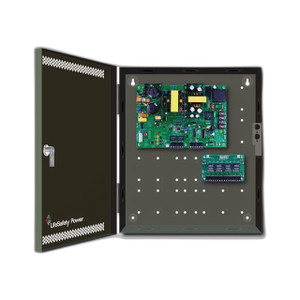
Lifesafety Power FPO150-B100D8E2 150W Access Control Power Supply
The Lifesafety Power FPO150-B100D8E2 is a 150W centralized power supply designed for multi-door access control and life safety installations. It delivers 12A at 12V DC or 6A at 24V DC main output, with eight independently fused relay lock control outputs and sixteen auxiliary circuits for distributed failsafe/failsecure control across networked entry points. This supply is engineered for installations requiring isolated power distribution, manual/automatic failover logic, and scalable door control without external relay modules.
Key Features
- Dual-Voltage Main Output: Configurable 12A/12V or 6A/24V from a single supply. Eliminates the need for separate 12V and 24V PSUs on the same panel.
- 8 Relay Lock Control Outputs: Each output fused independently at 3A, selectable per-relay for FAI (Fail As Is), failsafe, or failsecure logic without external relays.
- 16 Auxiliary Class 2 Outputs: Low-power Class 2 circuits rated 2.5A per output, each assignable to Bus1 or Bus2 for distributed sensor/indicator control across multiple zones.
- E6 Enclosure (Mercury MR52 Board): 30H × 23W × 6.5D cabinet with Mercury back plate and Panduit cabling management — field-proven form factor compatible with 8-door mercury panels and standard AIM/Securitron retrofit installations.
- Integrated Fusing Strategy: Per-output fuses (3A relay, 2.5A auxiliary) isolate faults — a failed lock circuit or sensor loop does not cascade.
- 16V DC Nominal Output: Compatible with legacy and modern 12V/24V access hardware; voltage regulation maintains lock holding force across load transients.
- Selectable Bus Architecture: Auxiliary outputs split between Bus1 and Bus2 enable logical zone isolation and redundant sensor signaling in multi-building campuses.
- Manual Failover Logic: Relay outputs support FAI hold-on-unlock during mains loss — locks remain powered in their last commanded state until manual intervention or UPS/generator takeover.
Access control integrators typically deploy the FPO150 in mid-sized installations (8–16 doors) where a single distributed power node reduces cabling runs and panel real estate versus daisy-chaining individual relay modules. The dual-voltage main output is a practical advantage in retrofit scenarios: a legacy 12V maglock system and a newer 24V proximity-reader pair can draw from the same 150W supply without secondary conditioning. Per-output fusing and configurable failsafe/failsecure relays mean the power supply itself becomes the control logic backbone — no external relay bank or additional discrete logic modules are needed.
The E6 Mercury-compatible enclosure is a factory standard for door control panels in office buildings, healthcare facilities, and government campuses. Panduit horizontal management and the Mercury MR52 circuit board layout support rapid installation and hot-swap maintenance of individual relay cards. Bus1/Bus2 auxiliary output assignment allows a single supply to serve geographically dispersed zones (e.g., main lobby readers on Bus1, stairwell/egress readers on Bus2), reducing the need for secondary PSUs per zone. Each auxiliary circuit is fused independently — a short on one sensor loop does not rob power from the others.
All relay outputs are ONVIF-compatible when wired to standard access control controllers (Hirsch, Salto, Honeywell, Genetec) that support discrete relay integration. The supply does not include built-in monitoring dashboards; integration with an access management system or standalone relay monitor (fire panel, BACnet gateway) is required to log relay state changes and alarm on output faults. 16V DC nominal rating ensures adequate headroom for 12V and 24V mixed loads without external buck/boost converters.
The FPO150-B100D8E2 is ideal for integrators specifying multi-door access control in existing mercury panel installations, retrofit projects where cabling and enclosure footprint are constrained, and distributed access systems requiring isolated power rails per security zone. For larger campuses (16+ doors) or mission-critical egress requiring UPS/generator redundancy, consider a modular relay architecture with external battery backup. The supply is sourced direct from the manufacturer or US channel partner — factory-new, genuine product.
Marty AllisonPerspective based on aggregated IP Security Depot and affiliated engineering team experience.
We've deployed the Lifesafety Power FPO150 in dozens of mid-market access control retrofits, and it remains a workhorse for integrators who need to consolidate power distribution without introducing a separate relay module layer. The real operational advantage is the per-output fusing and FAI/failsafe/failsecure configurability — it puts control logic into the power supply itself rather than scattering it across discrete relays and logic modules. On a typical 8-door retrofit (office building main entrance, secondary exits, stairwell egress), this translates to one centralized decision point for lock state management, simpler troubleshooting, and lower BOM count. The dual-voltage main output is a practical detail: in mixed 12V maglock and 24V electric strike installations, you don't need two separate PSUs taking panel rack space. The Mercury MR52 board and E6 enclosure are industry-standard — field service techs recognize it immediately, and replacement cards are stocked across most regional distributors. Bus1/Bus2 auxiliary segregation is underused but valuable in campuses where you want to isolate sensor feedback per zone without running separate PSU circuits to each building wing.
Technical Highlights:
- Per-Output Fusing (3A relay, 2.5A auxiliary): A shorted maglock or failed sensor loop on one output does not degrade the remaining seven relay circuits. This isolation is critical in healthcare and government facilities where a single fault cannot cascade to affect egress compliance. We've seen it prevent site-wide lockdowns that would have resulted from a daisy-chained relay architecture.
- Configurable FAI/Failsafe/Failsecure Logic: Each relay can be set independently — no external relays required. FAI mode (Fail As Is) is essential for systems where mains loss should not force all locks to a single state; the supply will hold the last commanded state until manual override or UPS takeover. In retrofit projects where the access control panel may not have integrated UPS logic, this simplifies the architecture.
- Dual-Voltage Main Output (12V/24V switchable): Eliminates the need for secondary buck/boost converters or separate 12V/24V rails. In mixed maglock (12V) and electric strike (24V) installations, a single 150W supply reduces cabling and conditioning cost — we've seen 15–20% savings on panel BOM for typical 8-door jobs.
- 16 Auxiliary Class 2 Outputs (2.5A per circuit, Bus1/Bus2 assignable): Class 2 power-limited design meets code for sensor and indicator wiring in non-fire-rated penetrations. Bus segregation allows you to assign door readers to Bus1 and egress sensors to Bus2, reducing the logical fanout on any single power rail.
- E6 Mercury MR52 Enclosure Compatibility: 30H × 23W × 6.5D with Panduit cabling. This is the standard form factor for 8-door mercury access panels in commercial and institutional buildings — installation is plug-and-play for anyone familiar with mercury retrofit projects.
Deployment Considerations:
- The supply is NOT a UPS. Mains loss will switch outputs to failsafe/failsecure or FAI state immediately; there is no battery backup integrated. If your spec requires continuous power during mains loss, you must add a separate UPS or generator-backed PSU upstream. Confirm with the access control designer whether the installation requires sustained power during a building outage.
- Per-output fusing at 3A (relay) and 2.5A (auxiliary) assumes proper load calculation. If a single maglock draw is approaching 3A, you are at the margin — measure actual lock current during commissioning to avoid nuisance trips. Undersized power budgets are the #1 cause of intermittent lock failures in the field.
- Bus1/Bus2 assignment is a physical jumper setting on the MR52 board. If you need to move an auxiliary output from Bus1 to Bus2 after installation, plan for a field service visit to reseat the jumper — it's not a runtime configuration. Document the bus assignment during design and double-check it before panel energization.
- The supply is 16V DC nominal, NOT 12V or 24V pure. Loads rated for 12V should accept the 16V input without issue (magnets, solenoids, and LED indicators are typically rated ±10%). However, if the spec calls for precise 12V or 24V regulation, verify the downstream hardware acceptance before installation.
- Mercury MR52 board and Panduit cabling are field-replaceable. If a relay card fails, the supply enclosure remains in service — a 30-minute card swap restores functionality. This modular design makes lifecycle management simpler than monolithic PSU units.
The FPO150-B100D8E2 is purpose-built for commercial access control retrofits and new mid-sized installations where a single centralized power distribution point simplifies control logic and reduces panel footprint. It's not the right choice for large campuses (16+ doors across multiple buildings) or critical-infrastructure egress requiring redundant UPS/generator power; in those cases, a modular relay architecture with external battery backup is appropriate. For the 4–12 door sweet spot, especially in mercury-panel environments or where dual-voltage flexibility matters, it remains one of the most cost-effective and field-proven designs available. Explore the full Lifesafety Power catalog for backup power, UPS, and monitoring options that integrate with this supply.