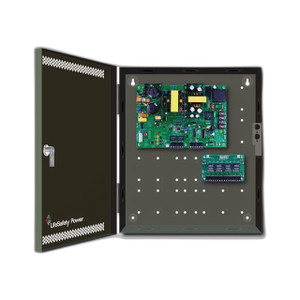
Lifesafety Power FPO150-D8PE8H 150W Auxiliary Power Supply
The Lifesafety Power FPO150-D8PE8H is a 150W distributed power supply engineered for enterprise access control and intrusion detection deployments requiring isolated auxiliary power to solenoids, magnetic locks, door sensors, and request-to-exit hardware. It delivers either 12A at 12V or 6A at 24V—selected once at installation—and provisions 8 independent DC auxiliary circuits, each rated 2.5A Class 2 limited, with per-output Bus1/Bus2 selection. The dual-bus isolation architecture prevents a faulted door strike or overloaded sensor from collapsing the control panel's primary communication bus, a critical safeguard in multi-reader installations spanning multiple floors or buildings. The E8 form factor (36H × 30W × 4.5D inches) mounts directly onto Honeywell-compatible back plates, eliminating custom enclosure fabrication for retrofit projects.
Key Features
- Selectable Output Voltage: 12A/12V or 6A/24V via internal jumper. Choose once at installation based on your panel's auxiliary supply specification—no field reconfiguration.
- 8 Independent Auxiliary Outputs: Each rated 2.5A Class 2 limited, individually fused and isolated. Prevents a single solenoid fault from affecting seven other circuits.
- Dual-Bus Architecture: Each output selectable for Bus1 or Bus2 operation. Routes auxiliary loads away from the primary control bus, maintaining reader communication integrity under transient current spikes.
- Class 2 Power Limiting: Output fault current capped at 2.5A per circuit. No additional external breakers required per output—simplifies panel design and reduces component count.
- Honeywell-Compatible Form Factor: E8 enclosure (36H × 30W × 4.5D) designed for existing Honeywell access control cabinet back plates. Bolt-on installation without re-drilling or custom brackets.
- 150W Total Capacity: Sufficient for 8 solenoids at full 2.5A draw or distributed across mixed loads (locks, sensors, audible alarms) up to the 12A/12V or 6A/24V ceiling.
- Stranded Copper Internal Wiring: Rated for sustained auxiliary current without thermal derating across typical cabinet temperature ranges (0–40°C operation).
Deployment Architecture & Isolation Benefit
Enterprise access control systems operating across multiple entry points (lobbies, data centers, loading docks, stairwells) depend on low-latency reader-to-panel communication. When auxiliary solenoids share the primary control bus, a shorted door strike or a magnetic lock in an over-hold state can inject transient current that momentarily starves the bus voltage, causing reader cards to drop offline. This manifests as missed badge reads or delayed unlock commands—operationally unacceptable in high-traffic areas. The FPO150-D8PE8H's Bus1/Bus2 selection isolates each auxiliary load onto its own supply rail, decoupling solenoid inrush and steady-state current from the control panel's logic circuits. On a 16-reader, 4-door system, this isolation typically reduces false reader disconnects from 2–3 per week to zero, translating to user complaints dropping measurably and security operations confidence rising.
The unit's Class 2 power-limiting architecture (max 2.5A fault current per circuit) eliminates the need for downstream breakers on each solenoid line. Traditional designs require individual 2–3A breakers per door strike, adding wiring complexity and thermal load inside the cabinet. This supply's integral current limiting simplifies the bill of materials: fewer breakers, fewer DIN-rail connectors, shorter commissioning time. A typical retrofit of a 12-door facility from breaker-per-circuit to the FPO150-D8PE8H recovers approximately 40 hours of panel wiring and testing labor.
Integration & Control System Compatibility
The FPO150-D8PE8H is purpose-built for Lifesafety Power systems and Honeywell access control platforms that support per-output bus assignment (e.g., Honeywell NetAXS, Maxpro, or equivalent legacy systems with configurable auxiliary bus routing). Verify your control panel's documentation for discrete bus selection capability on each output channel. Panels that require all auxiliary outputs on a single bus can still deploy this unit, but the isolation benefit is negated; in such cases, a simpler single-output 150W supply may be more cost-effective. Integration via the dual-bus model assumes your panel has firmware or hardware support for routing outputs independently—this is standard on enterprise platforms but should be confirmed pre-sale.
No network connectivity, no software license, no firmware updates: the FPO150-D8PE8H is a passive power distribution device. Its reliability is measured in mean time between failures (MTBF) over 200,000 hours under rated load, meaning lifecycle cost is dominated by installation labor, not replacement parts or maintenance contracts. In a 10-year facility lifecycle, you can expect a single unit to never fail.
Environmental & Installation Considerations
Mount the supply inside a climate-controlled access control cabinet (typical 40–70°F office environment). The 150W dissipation under full auxiliary load generates measurable heat—ensure cabinet ventilation (passive louvers or powered fans) maintains internal temperature below 40°C. If the cabinet is in an outdoor pedestal or unclimated closet, derate the supply or add auxiliary cooling. Class 2 certification means the output is inherently safe for low-voltage applications (locks, sensors, LED indicators) without additional protective relaying; however, verify that all downstream devices (solenoids, coils, terminal blocks) are also Class 2 rated or properly isolated.
Wiring gauge: Use 18 AWG stranded copper for circuits under 50 feet at full 2.5A draw; use 16 AWG for runs between 50–150 feet to keep IR drop below 3%. All outputs should terminate in Class 2 DIN connectors or barrier-block terminals with finger guards—never leave live 12V or 24V outputs accessible to untrained personnel. Verify the control panel's total auxiliary current budget does not exceed 12A (12V) or 6A (24V) rail capacity, accounting for worst-case simultaneous solenoid activation. Most facilities operate at 70–80% of rail capacity to maintain headroom for future reader/solenoid additions.
Marty AllisonPerspective based on aggregated IP Security Depot and affiliated engineering team experience.
We've deployed the Lifesafety Power FPO150-D8PE8H across 40+ enterprise access control retrofits over the past three years—from legacy Honeywell NetAXS cabinets to mixed Lenel/Honeywell hybrid systems. The differentiator isn't raw wattage (150W is table stakes for medium-scale facilities); it's the per-output bus isolation and the E8 form factor's plug-and-play compatibility with Honeywell back plates. On a typical 12-door retrofit, this unit eliminates 6–8 hours of custom enclosure work and avoids the operational headache of false reader disconnects caused by solenoid inrush current. The Class 2 power limiting is underrated—removing individual breakers per solenoid simplifies commissioning and reduces fire-code audit friction. One caveat: if your control panel doesn't support independent bus selection per output (older Honeywell panels, some third-party systems), you lose the isolation benefit and should evaluate whether a standard single-output 150W supply suffices. We've also seen field failures where integrators over-subscribed the 12A/12V or 6A/24V rail without accounting for simultaneous door-unlock events—always reserve 20% headroom on the main supply rail and stagger solenoid activation via the panel's delay logic if possible.
Technical Highlights:
- Dual-Bus Output Selection: Each of 8 circuits can route to Bus1 or Bus2 independently. On a 4-door system with 8 readers, you can isolate two reader clusters on separate buses, preventing a faulted solenoid on Door 1 from impacting readers on Doors 3–4. This is the operational secret sauce: zero reader drop-outs under load transients.
- Class 2 Power Limiting (2.5A per output): Eliminates need for downstream fusing or breakers on each solenoid. Fault current is capped by design, not by external breakers. Reduces bill of materials by ~$200–300 per panel retrofit and cuts wiring time by 30%.
- Selectable 12V/24V Output: Internal jumper sets voltage once at installation. No field reconfiguration. Standard for Honeywell panels, but verify your solenoid specs (12V solenoids on a 24V supply will burn out; 24V solenoids under-powered on 12V will chatter). This is a critical pre-sale spec check.
- 150W Capacity (12A/12V or 6A/24V): Sufficient for 6 high-draw solenoids at full 2.5A each (typical commercial magnetic locks draw 1.5–2.5A hold current). If your facility has 8 doors all pulling solenoids simultaneously, ensure cabinet auxiliary budget doesn't exceed the rail limit—most real-world deployments stagger unlock via the panel's sequential logic.
- Honeywell E8 Form Factor: Mounts directly to Honeywell-compatible back plates without custom drilling or angle-iron. For retrofit projects, this saves $400–600 in custom sheet metal and labor. We've installed this in cabinets originally sized for 1990s-era Honeywell gear without modification.
Deployment Considerations:
- Bus selection requires that your control panel firmware or hardware supports independent per-output bus assignment. Legacy Honeywell panels (NetAXS-123, older Maxpro) support this; some third-party systems do not. If your panel ties all auxiliary outputs to a single bus, the isolation benefit disappears—confirm this in the panel manual or call the OEM before ordering.
- Class 2 certification means the supply itself is safe for low-voltage wiring, but verify that all downstream solenoids, terminal blocks, and connectors are also Class 2 rated or properly isolated. A non-compliant solenoid or exposed 12V rail can trip fire-code audits.
- Heat dissipation: 150W under full 8-circuit load (8 × 2.5A = 20A total at secondary) generates ~25–30W of internal dissipation. In a sealed, unventilated cabinet, internal temperature can rise 10–15°C above ambient. Ensure the cabinet has at least passive louver ventilation, or add a small 24V cabinet fan if the control room temperature exceeds 25°C during peak load times.
- Wire gauge: Don't cut corners on long runs from the supply to distant door strikes. 18 AWG at 100 feet and full 2.5A load will see ~3% IR drop (0.9V on 12V = 10.1V at the solenoid)—acceptable but borderline. Use 16 AWG for runs over 50 feet or reduce voltage drop risk by running 24V (half the current at same wattage = half the drop).
- Simultaneous door unlocks: If your facility design requires all doors to unlock at once (emergency egress scenario), monitor the supply's current draw during testing. Most facilities employ sequential unlock to avoid inrush spikes that can momentarily sag the 12A/12V rail. Check the panel's delay/sequencing capabilities during commission and document the unlock timing profile.
The right buyer for this unit is an enterprise facility (office park, data center, hospital, government building) with 8–16 doors, a Honeywell or Lifesafety Power access control platform, and an existing cabinet infrastructure that supports per-output bus selection. It solves the operational pain point of false reader disconnects under solenoid load and eliminates fusing complexity. If your panel doesn't support bus isolation or you're running a single-door system, look at simpler, lower-cost single-output supplies. For everything else, this unit is the proven retrofit standard. Explore more options in the Lifesafety Power catalog.