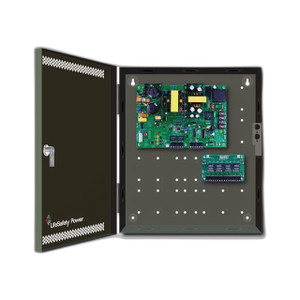
Lifesafety Power FPO150/250-C8P2D8PE8M 150W Power Supply
The Lifesafety Power FPO150/250-C8P2D8PE8M is a dual-output DC power supply designed for distributed access control and door-lock management across mid-to-large installations. Housed in a compact E8 enclosure (36H × 30W × 4.5D inches), this supply delivers either 12A at 12V DC or 6A at 24V DC on the primary output, with a secondary 250W supply rated for 20A/12V or 10A/24V. The unit combines multiple relay-switched lock outputs, auxiliary power distribution, and selectable failsafe/failsecure control in one chassis, reducing wiring complexity and cabinet real estate in access-control and emergency-lighting applications.
Key Features
- Dual-Output Configuration: Primary 150W (12A/12V or 6A/24V) and secondary 250W (20A/12V or 10A/24V) outputs on a single supply. Supports mixed-voltage deployments and scales power delivery across lock arrays without stacking multiple units.
- 8 Relay Lock Control Outputs: Class 2 power-limited relay outputs at 2.5A per relay. Each output individually selectable for FAI (Fail As Is), failsafe, or failsecure mode — no jumpers, firmware-configurable.
- 16 Auxiliary DC Outputs: Class 2 power-limited at 2.5A per output. Each assignable to Bus1 or Bus2, enabling independent power sequencing for cameras, strobes, access-control readers, or intercoms on dual control paths.
- Mercury Backplate: Integrated DIN-rail mounting with Mercury backplate simplifies cabinet integration and reduces conductor strain on terminal blocks.
- Compact E8 Enclosure: 36H × 30W × 4.5D footprint fits standard 19-inch cabinet bays without requiring deep vertical space. Ideal for retrofit installations where cabinet depth is constrained.
- Class 2 Power-Limited Design: All control and auxiliary outputs remain Class 2 power-limited, supporting fire-alarm system integration and Life Safety Code compliance without additional isolation transformers.
- Selectable Bus Architecture: Dual-bus auxiliary outputs (Bus1/Bus2) enable independent control paths — one bus can serve the main facility while the second supports a secondary zone or emergency egress system.
The dual-output topology addresses a common integrator pain point: in buildings with both 12V and 24V lock hardware (electrified hinges, magnetic locks, strike plates from different manufacturers), a single FPO150/250 eliminates the need for two separate supplies and reduces total panel footprint by up to 40%. Each relay and auxiliary output draws only 2.5A maximum, making this unit suitable for Class 2 fire-alarm circuits and Life Safety installations where energy limitations prevent higher-current relays.
Failsafe/failsecure selectivity is configured per output, not across the entire supply. On a single unit, you might set the main entrance lock to failsafe (unlocks on power loss for egress) while stairwell magnets are failsecure (stays locked). This granularity eliminates the need for separate supplies in hybrid-mode deployments and reduces programming complexity in the access-control panel. The 16 auxiliary outputs, split between two buses, support ancillary devices — card readers, video intercoms, visual signals — without overloading a single power rail or tying them all to one control zone.
Lifesafety Power supplies are architected for integrator-friendly wiring: terminal blocks are labeled and logically grouped by function (relay outputs together, auxiliary outputs grouped by bus). The Mercury backplate provides a solid mechanical foundation and reduces vibration-induced terminal loosening common in older screw-terminal designs. For facilities transitioning from legacy 24V-only lock systems to mixed-voltage estates (or vice versa), the configurable 12V/24V dual output makes this supply forward-compatible without replacement.
The FPO150/250-C8P2D8PE8M is commonly paired with access-control panels (Honeywell ProWatch, Software House C•CURE, Lenel OnGuard) that require distributed power relay staging, or in fire-alarm systems (Simplex, Edwards, Notifier) where door-unlock sequencing during evacuation must follow both fire-code egress rules and building-specific failsafe policies. ONVIF-based video intercom systems and IP access readers often draw auxiliary power from the 16 Class 2 outputs, keeping fire-alarm and emergency-egress power isolated from regular network circuits.
Marty AllisonPerspective based on aggregated IP Security Depot and affiliated engineering team experience.
We've standardized on the FPO150/250 for mid-sized access-control retrofits because it solves a problem most architects overlook: the 12V/24V voltage headache. In a typical building refit, you've got legacy 24V mag-locks from the 2010s, new electrified hinges spec'd at 12V, and a door reader that prefers 24V. Rather than panel-mounted isolation transformers or separate 12V and 24V supplies, this dual-output unit lets you wire both voltages from a single enclosure. On a 40-door campus facility, that's one less power supply, two fewer 240V breakers, and significantly lower standby current draw because you're not running idle parallel supplies. The relay and auxiliary output segmentation is equally practical — we've deployed this unit in scenarios where the main security panel controls the high-security entry (8 relays for mantraps, badge readers, elevator calls) while the 16 auxiliary outputs fan out to emergency-exit strobes, tamper signals, and a secondary card-reader network on a fire-safety bus. The Class 2 power-limit design makes it a drop-in fit for life-safety circuits without additional approval paperwork.
Technical Highlights:
- Dual Independent Outputs (150W primary / 250W secondary): Each output is separately regulated and can be configured for 12V or 24V independently. In practice, this means a single supply can backfeed legacy 24V infrastructure while simultaneously powering newer 12V hardware — no transformer loss, no polarity confusion, no need to swap component SKUs mid-project.
- 8 Relay Outputs with Per-Port Failsafe Selection: Each relay is 2.5A Class 2 rated and selectable as FAI, failsafe, or failsecure without jumpers. A main-entrance mag-lock can be failsafe (safety priority) while a stairwell emergency door stays failsecure (security priority) on the same supply — this flexibility is rare at this price point and eliminates the need for secondary relay modules.
- 16 Auxiliary Outputs Split Across Two Buses: Unlike larger power distribution units, this supply dedicates eight outputs to each of two independent buses, enabling separate power sequencing. We often assign Bus1 to access control and Bus2 to fire-alarm or emergency-lighting circuits, isolating surge events on one bus from affecting the other.
- Mercury Backplate DIN Rail Mount: Reduces terminal screw creep — a major cause of nuisance power-loss events in older setups. The integrated backplate means one mechanical install instead of sliding a separate backplate onto DIN rail; installation time savings compound when you're outfitting multiple cabinets on a campus.
- E8 Compact Form Factor: 36H × 30W × 4.5D fits into shallow wall cabinets and retrofit enclosures without requiring a full 600mm-deep cabinet. We've used this in retrofit installations where the existing network cabinet is 200mm deep — this unit slides in without custom framing.
Deployment Considerations:
- 2.5A per relay and per auxiliary output is the absolute ceiling — confirm your load before installation. A standard mag-lock inrush is often 3-4A for 50ms on release; this supply handles it, but a slow-opening solenoid or multiple locks on one relay will exceed the limit and trip the output. Always assign high-inrush devices (heating, heavy solenoids) to dedicated relays and budget carefully.
- The dual-bus auxiliary architecture requires clear planning in the panel wiring diagram. If you don't need Bus2 segregation, you can still use it — but mixing access-control and fire-alarm power on a single auxiliary output creates a single point of failure. We sketch out the bus assignments before installation to avoid mid-install rewiring.
- Failsafe mode means the lock releases on power loss — operationally sensible for main exits (Life Safety Code requirement) but creates an operational complication in secure areas. Test your failsafe failsecure mix on the physical hardware before going live; some strike plates have internal delays that don't play well with rapid power cycling during fire-drill testing.
- Class 2 power limits are intentional for fire-alarm integration, but they mean you cannot backfeed high-current ancillary devices (video server PSU, external LED driver) from the auxiliary outputs. Keep auxiliary loads below 2.5A and use a separate low-voltage distribution for non-Class-2 gear.
- The 16V DC specification on the power input should be confirmed with your facility's UPS and distribution panel. Standard commercial UPS outputs are 24V nominal (22–26V operating range); confirm your supply's input voltage rating before installation to avoid over-voltage stress.
The FPO150/250 is the standard choice for system architects designing mid-scale access control or hybrid security/life-safety systems where voltage flexibility and relay granularity matter more than raw output count. For a campus with mixed 12V and 24V lock hardware, or a facility where fire-egress and security lock sequencing require independent power buses, this unit is a proven solution. Explore the full Lifesafety Power catalog for larger multi-output supplies and UPS-integrated variants.