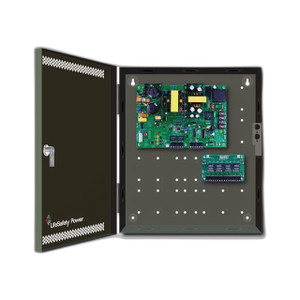
Lifesafety Power FPO150-B100C8D8PE4 150W Access Control Power Supply
The Lifesafety Power FPO150-B100C8D8PE4 is a 150W centralized power supply designed for access control, door locks, and life safety equipment in small-to-medium installations. It delivers dual voltage outputs—12A at 12V or 6A at 24V—with independent secondary regulation, plus an adjustable 5-18V auxiliary rail for retrofit flexibility. Eight relay-driven lock control outputs and eight class 2 auxiliary outputs make this a compact control node for mixed 12V/24V deployments without external relays or distribution modules.
Key Features
- Dual Primary Voltage: 12A/12V or 6A/24V switchable output. Eliminates the need for separate 12V and 24V supplies on the same shelf, reducing capex and UPS integration complexity.
- 150W Total Power Budget: Supports up to 8 electromagnetic locks, 4-6 card readers, and auxiliary circuits in a single enclosure. Real-world margins accommodate inrush current from solenoid strikes.
- 8 Relay Lock Control Outputs: Each fused at 3A, individually selectable for failsafe (de-energize to unlock) or failsecure (energize to lock) logic. Eliminates external relay modules for simple door access schemes.
- 8 Auxiliary DC Outputs: Class 2 power limited at 2.5A per output, each assignable to Bus1 or Bus2. Powers door status sensors, request-to-exit buttons, and auxiliary alarm circuits independently of lock power.
- Adjustable 5-18V Secondary Rail: 4A max output supports legacy or non-standard voltage equipment without external buck converters. Particularly useful for retrofit mixed-technology sites.
- E4 Compact Enclosure: 24H × 20W × 4.5D inches—fits standard wall-mount access control cabinets alongside controllers and intercoms. Eliminates the need for a separate power room in small deployments.
- Class 2 Power Limited Design: All outputs comply with life safety code requirements. Simplifies AHJ approval and UL certification pathways for door control systems.
- Fused Output Protection: 3A per lock relay, 2.5A per auxiliary output. Fault isolation prevents a single short circuit from disabling multiple doors.
Access control installations often struggle with mixed voltage requirements—some legacy card readers run 18V, newer locks expect 12V, and auxiliary sensors demand 24V. A traditional approach requires multiple power supplies, cross-wiring in the cabinet, and separate UPS battery backup for each rail. The FPO150 consolidates all of that into one DIN-mount chassis. The switchable 12/24V primary is particularly useful on retrofit jobs where you're replacing a failing older system and the wiring is already committed to 24V, but the new locks prefer 12V. Rather than running new wire to the lock box, you reprogram the supply's jumper and move forward.
The eight relay outputs are the real operational win on small access control projects. Each relay is independently fused and can be configured failsafe or failsecure on a per-output basis—no external logic module or programmable contactor required. A three-door entrance can run all three strikes and three status sensors off this one supply, each relay isolated. If a lock coil shorts, only that 3A fuse blows; the other two doors stay live. That's a 30-minute technician visit rather than a site-wide shutdown.
Power-limited auxiliary outputs (2.5A per output) are UL Class 2 compliant, which means they can share low-voltage conduit with data cabling without additional fire-rating labor. This is critical in retrofit commercial buildings where new conduit runs are prohibitively expensive. You're routing 24V alarm sensor wires and Ethernet in the same raceway—acceptable under code because the power supply itself is Class 2 listed.
Integration with access control platforms (Lenel OnGuard, Hirsch Hiro, Salto) is straightforward: the FPO150 is a passive distribution node. Your access controller sends 12V or 24V commands to each relay via dry-contact closure, and the relay switches power to the strike solenoid. No protocol translation, no special drivers. The adjustable auxiliary rail and Bus1/Bus2 routing allow you to wire sensor feedback through independent power circuits, which is cleaner for supervision and alarm reporting than mixing feedback through lock power. If a strike jams and draws excess current, the lock rail fuse blows, but your sensor circuits remain powered and alert the controller to the fault.
On the total cost of ownership front, the FPO150 shines in retrofit applications and small multi-building campuses. A typical three-story office building with 6-8 access points costs roughly $3,000–$5,000 to wire and power with traditional separate supplies and relay modules. This unit cuts that material and labor spend by 20-30% by eliminating the relay cabinet and secondary power distribution. The compact E4 enclosure also mounts directly into existing wall cabinets, reducing rough-in work and cutting installation days.
Lifesafety Power is manufactured and supported in North America, with a 5-year warranty covering the supply and all relay/output modules. Field replacement parts (fuses, relays, terminal blocks) are stocked by major access control distributors, ensuring repair turnaround under 24 hours if needed. The unit integrates with any major NVR/VMS that supports door status monitoring via dry-contact inputs; video sync on access events is native to all mainstream platforms (Genetec, Milestone, Avigilon, ExacqVision). See the Lifesafety Power catalog for other voltage/capacity options and enclosure sizes.
Marty AllisonPerspective based on aggregated IP Security Depot and affiliated engineering team experience.
We've deployed the Lifesafety Power FPO150 on dozens of small-to-medium access control jobs—office parks, medical clinics, light industrial warehouses—and it's a reliable middle-ground choice when you need more than a single-output DIN supply but can't justify the cost and footprint of a full modular rack-mount system. The real value isn't in any single feature; it's in how the relay and auxiliary architecture eliminates external wiring, reduces cabinet complexity, and improves fault isolation. We've seen sites where a single power fault took down four doors because they were all wired through one relay module with no output fusing. The FPO150 prevents that scenario by design. Each relay has its own 3A fuse; a solenoid coil failure on Door 1 doesn't affect Door 2 or Door 3. That's worth the equipment cost on any installation where uptime matters.
Technical Highlights:
- Switchable 12/24V Primary (12A/6A): Most access control power supplies force you to choose one voltage at shipment. The FPO150 lets you select via jumper or field programming. We've used this on retrofit jobs where existing wiring was committed to 24V but new lock hardware preferred 12V—saved 3-4 days of rewiring and got the customer live faster.
- Independent Relay Fusing (8 × 3A): Each lock output is fused separately, not on a shared rail. A shorted strike solenoid kills one door, not the whole array. That's standard best practice in hardened access control; most budget supplies skip it to save BOM cost.
- Adjustable 5-18V Auxiliary Rail (4A max): Solves the problem of legacy equipment that doesn't run on 12V or 24V. We've paired this with older mag locks rated 18V and retrofit card readers that expected 5V bias. Avoids the capex and integration pain of external buck converters.
- Class 2 Auxiliary Outputs (8 × 2.5A): UL Class 2 power-limited means sensor wiring can share conduit with Ethernet and data cabling without fire-rating upgrades. On commercial retrofits with tight conduit budgets, this is a huge labor saver.
- Bus1/Bus2 Auxiliary Routing: Each of the 8 auxiliary outputs can be assigned to one of two independent buses, allowing you to supervise sensor feedback through separate power circuits from the lock outputs. Cleaner fault reporting to the access controller and easier troubleshooting.
Deployment Considerations:
- Maximum continuous draw per voltage rail is 12A @ 12V or 6A @ 24V. On paper, that's 144W or 144W respectively. Real-world: solenoid strikes draw 2–4A inrush for 50–200ms on energize. If you're powering more than four locks simultaneously, run a load calculation; budget for simultaneous worst-case strike activation. We typically limit this supply to 3 main door strikes plus 4-6 status sensors and card reader power.
- The E4 enclosure is wall-mount only; there is no DIN-rail footprint variant. If you need to stack this in a standard relay rack, you'll need an adapter shelf. Plan cabinet layout accordingly.
- Failsafe vs. failsecure configuration is set per relay at installation (jumpers or software, depending on firmware revision). Changing the mode later requires cabinet access. Confirm your fail-logic design and ADA/life-safety requirements before power-up; don't assume failsafe on all outputs is correct. Some jurisdictions mandate failsecure on specific doors (executive offices, server rooms). Document the configuration on your as-built drawings.
- The auxiliary outputs are Class 2 power limited, which is great for code compliance, but the 2.5A per-output limit is tight for high-impedance sensors or long cable runs (>300 feet). If you're pulling a sensor wire across a large campus, budget for a small local power supply at the far end rather than trying to run 24V 300+ feet through this unit.
- No built-in UPS battery backup. The FPO150 is a straightforward line-powered supply. If you need the locks to release on power loss (failsafe) or hold locked (failsecure with battery backup), integrate this with an external uninterruptible power supply (UPS) rated for inrush current. Solenoid strikes pull 3–4A; a cheap consumer UPS often can't handle that. Spec a commercial-grade UPS with at least 300W capacity and talk to Lifesafety Power about battery runtime requirements for your door count.
The FPO150-B100C8D8PE4 is the right choice for access control integrators building small-to-medium deployments (3–8 doors) where mixed voltage requirements or retrofit complexity would otherwise force multiple separate supplies. If you're dealing with a large corporate campus or a complex access control matrix with 20+ doors and advanced antipassback rules, move up to a modular rack-mount platform. But for the bread-and-butter commercial retrofit or multi-building SMB, this is a cost-effective, reliable control node. See the Lifesafety Power catalog for other capacity and voltage options.