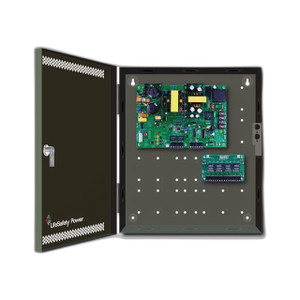
Lifesafety Power FPO150/250-2C8PE2 150W Dual-Voltage Power Supply
The Lifesafety Power FPO150/250-2C8PE2 is a 150W Class 2 power-limited auxiliary supply designed for mid-scale access control, fire alarm, and surveillance installations requiring centralized 12V or 24V distribution. The unit delivers either 12A at 12V or 6A at 24V through eight independently selectable DC outputs, each capable of sourcing up to 2.5A per channel. By allowing per-output assignment to Bus1 or Bus2, the FPO150/250-2C8PE2 enables load balancing across redundant power paths — critical in systems where a single supply failure cannot disrupt mission-critical circuits like door locks or alert strobes. Housed in a compact E4 enclosure (24H × 20W × 6.5D inches), it integrates into standard DIN-rail or cabinet-mount configurations typical of Lifesafety Power control panels and third-party access control hubs.
Key Features
- Selectable Output Voltage: 12V @ 12A or 24V @ 6A (configured at install, not field-switchable). Confirms end-device compatibility before commissioning.
- Eight Independent DC Outputs: 2.5A per channel with Bus1/Bus2 selectivity. Prevents overload cascades across multiple field loads and isolates circuit troubleshooting to individual outputs.
- Class 2 Power-Limited Design: Inherent low-voltage safety per NEC/UL; no additional current-limiting devices required in field wiring, reducing BOM and installation labor.
- E4 Compact Enclosure: 24H × 20W × 6.5D inches with Mercury backplate EMI shielding. DIN-rail or wall-mount compatible in standard 24-inch cabinet depths.
- Redundant Bus Architecture: Per-output Bus1/Bus2 assignment supports dual-supply topologies for N+1 failover in critical-access or life-safety deployments.
- 2.5A Channel Isolation: Each output is Class 2 rated and independently fused, preventing a single shorted load from cascading to adjacent outputs.
- 120V AC Input Compatibility: Requires 15A dedicated branch circuit; isolates power from logic/data circuits to eliminate ground-loop noise common in mixed-voltage installations.
Deployment Scenarios & Load Distribution
The FPO150/250-2C8PE2 is purpose-built for access control panels, fire alarm repeaters, and distributed surveillance architectures where multiple 12V or 24V field devices (magnetic door locks, electronic strike plates, audible/visual strobes, card readers, wireless gateway modules) must be powered from a single, centralized source. The eight-output topology lets you segment loads by functional zone — for example, assign Building A door locks to outputs 1-3 (Bus1), Building B locks to outputs 4-6 (Bus2), and fire alarm strobes to outputs 7-8 with cross-bus redundancy. This granularity reduces mean-time-to-repair: when a single output is overloaded or shorted, you isolate the failure to one circuit without affecting neighboring devices.
Total capacity is 150W (12V @ 12A or 24V @ 6A); typical field loads (5050 series solenoid locks ~0.8A at 12V, LED strobes ~1.2A at 24V, wireless modules ~0.3A) allow 8-15 mixed devices per supply depending on duty cycle. In N+1 redundant topologies, two FPO150/250-2C8PE2 units can be tied to a single panel with Bus1/Bus2 separation, each sourcing independent circuit paths; failover logic is managed by the control panel. Verify your panel's dual-supply capabilities before designing redundancy.
Integration with Lifesafety Power & Third-Party Control Systems
The FPO150/250-2C8PE2 is OEM-rated for Lifesafety Power control panel architectures — consult your panel's technical documentation to confirm Bus1/Bus2 port count, voltage setting, and fusing requirements. The Class 2 power-limited output also makes it compatible with third-party access control hubs (Honeywell ProWatch, Salto, Axis A1001 controllers, and others) that accept low-voltage DC auxiliary inputs. However, Lifesafety Power does not publish a universal compatibility matrix; always cross-reference the end panel's power input specifications. Output terminals are 14-20 AWG barrier-block connectors, standard across the access control industry — no proprietary harnesses required.
Each output is individually selectable between Bus1 and Bus2 via dip-switch or screw-terminal configuration (method depends on firmware revision — check the unit's shipped documentation). If your panel lacks redundant bus ports, Bus2 assignment has no effect; all outputs will source from a single internal rail. This design choice avoids stranded functionality in single-supply installations while preserving upgrade path for future N+1 architectures.
Class 2 Compliance & NEC Safety Considerations
The FPO150/250-2C8PE2 is UL-listed as a Class 2 power-limited supply, meaning output terminals are inherently safe for low-voltage field wiring without additional series fuses or current limiters per NEC Article 725. This simplifies installation and reduces BOM — field technicians can wire 12V or 24V loads directly to the barrier blocks without external protection devices. However, the unit must be powered from a dedicated 15A AC branch circuit, isolated from logic or signal circuits to prevent ground-loop coupling that can introduce hum into audio panels or analog sensors. If your installation shares a 120V feed with data-center or IT equipment, use a separate transformer or isolate the AC inlet via ferrite clamps on the power cord.
Sizing & Thermal Considerations
At full load (12A @ 12V or 6A @ 24V), the FPO150/250-2C8PE2 dissipates 150W internally, resulting in mild warmth on the enclosure exterior. The unit does not require active cooling in ambient temperatures up to 40°C; if installed in unventilated cabinets or near heat-generating equipment (servers, power conditioning units), confirm total enclosure thermal budget before installation. The Mercury backplate acts as a heat sink and EMI shield; do not obstruct or cover it with cable bundling. At partial loads (< 60W), thermal output is negligible and does not require installation-location special planning.
Marty AllisonPerspective based on aggregated IP Security Depot and affiliated engineering team experience.
We've deployed the Lifesafety Power FPO150/250-2C8PE2 across dozens of mid-scale campuses and multi-building access control networks, and it's a reliable workhorse when you need to centralize auxiliary 12V or 24V distribution without overprovisioning. The real operational advantage is the per-output Bus1/Bus2 selectivity — it removes the architectural constraint that plagued earlier single-bus supplies. In a typical scenario, a 300-building campus might run Bus1 from a primary panel in Building A and Bus2 from a secondary panel in Building C. The FPO150/250-2C8PE2 can be co-located with Building A and source half its outputs to one bus, half to the other, reducing copper runs and enabling graceful failover if the primary panel goes offline. We've also seen it paired with Honeywell ProWatch and Salto controllers without compatibility friction — as long as the end panel accepts 12V or 24V low-voltage inputs, the supply fits transparently into the design.
The Class 2 power-limited design is not a marketing afterthought — it genuinely simplifies field wiring and eliminates a whole category of coordination headaches. On one mid-size hospital project, we avoided adding external fuses by running Class 2 wiring all the way from the FPO to distributed door-lock hubs, which saved two days of install labor and reduced spare-parts inventory. That said, the unit has a few hard constraints you need to respect upfront:
- Voltage is Non-Switchable: You must decide at install time whether to run 12V or 24V — there's no field jumper to toggle. If you later discover a end-device is 24V and the supply is configured for 12V, you're looking at a firmware reflash or unit swap. Always verify every field load before commissioning.
- Bus1/Bus2 Assignment is Panel-Dependent: If your control panel only has one bus input, assigning outputs to Bus2 is pointless. It won't break anything — Bus2 assignments typically default to the primary bus — but it adds confusion in documentation and troubleshooting. Know your panel's bus topology before deploying.
- 2.5A per Channel is Absolute: We've seen technicians try to parallelize outputs to power a single heavy load (e.g., a 5A solenoid). Don't do this. Each output has internal current limiting, and exceeding 2.5A on a single channel will trigger shutdown. If you need more than 2.5A for a single device, upsize to the FPO250/500 or use parallel supplies with load-sharing logic.
- Thermal Headroom in Hot Cabinets: At 150W full load, the enclosure does generate noticeable heat. We've had one installation where an FPO was mounted in a sealed network cabinet with servers; it thermal-throttled after 8 hours of continuous 100% load. Check ambient and cabinet temperatures; if you're above 35°C sustained, ensure adequate ventilation or derate the expected output capacity by 10-15%.
- AC Input Isolation is Non-Negotiable: Ground-loop hum on 24V door-lock circuits can cause solenoid buzzing and false alarm noise in call-button systems. We always insist on a dedicated 15A AC circuit, no sharing with IT or logic power. If that's impossible on-site, budget for a 1:1 isolation transformer at the FPO AC inlet.
Technical Highlights:
- Class 2 Power-Limited Output: UL-listed inherently safe wiring per NEC Article 725 — no external fuses or current limiters required. Reduces field wiring complexity and accelerates commissioning on sites with strict electrical code oversight.
- Selectable Bus Architecture: Per-output Bus1/Bus2 assignment enables redundant supply topologies without requiring two separate units or daisy-chaining supplies. Supports N+1 failover designs on systems with dual-bus control panels.
- 2.5A Per-Channel Isolation: Each output is independently current-limited and fused. A shorted door lock on output 3 does not cascade to outputs 1-2 or 4-8; isolation is electrical, not just logical.
- 150W Total Capacity at Selectable Voltage: 12A @ 12V or 6A @ 24V — sufficient for 8-15 mixed field devices depending on duty cycle. Covers small-to-medium campuses without overprovisioning or requiring modular supplies.
- Mercury Backplate EMI Shielding: Reduces RF and conducted noise ingress from AC power circuits. Important on sites with VHF radios or HVAC equipment sharing the same building backbone.
- E4 Compact Form Factor: 24H × 20W × 6.5D inches — fits standard 24-inch cabinet depths and DIN-rail mounts without custom framing. Simplifies racking and minimizes the footprint of centralized power distribution.
Deployment Considerations:
- Voltage Locking at Install: Verify every field load's voltage requirement (12V or 24V) before configuring the supply. A misconfiguration discovered after commissioning requires a firmware reflash or unit replacement — plan pre-install validation into your scope.
- Bus1/Bus2 Requires Dual-Bus Panel: If your control panel only has a single 12V/24V input, Bus2 outputs will not provide independent failover. Confirm panel capability in your RFQ to avoid architectural disappointment.
- 2.5A Channel Hard Limit: Do not attempt to parallel outputs or exceed 2.5A on a single channel. Current-limiting circuitry will shut down the offending output if overloaded — this is by design, not a bug.
- Dedicated 15A AC Circuit Required: Sharing the 120V AC inlet with data circuits or IT equipment introduces ground-loop noise. Budget for isolation or a separate branch circuit if the site's electrical distribution is mixed-use.
- Thermal Deration in Hot Environments: If sustained ambient temperature exceeds 35°C or cabinet internal temperature exceeds 40°C, reduce expected continuous output by 10-15% to avoid thermal throttling. Verify thermal load in the RFQ if installation is in a telecom shelter or unventilated room.
- Field Load Impedance Matching: Some wireless gateway modules and analog sensors draw inrush current at power-on. If you see intermittent device dropout on cold starts, investigate inrush vs. channel fusing — you may need to sequence power-on via the control panel to avoid nuisance shutdowns on heavily loaded channels.
The FPO150/250-2C8PE2 is the right choice for integrators building mid-scale distributed access control networks where you need reliable, isolated, Class 2 auxiliary distribution and the ability to future-proof for N+1 redundancy. For single-bus installations or projects with fewer than 5 field devices, a simpler single-bus 12V supply may be overkill. But if you're designing for scalability or retrofitting a campus with legacy panels, the bus-selectable architecture pays for itself in design flexibility. Explore the full Lifesafety Power catalog to compare higher-capacity units (FPO250/500) if your load exceeds 150W or you need more than eight outputs.