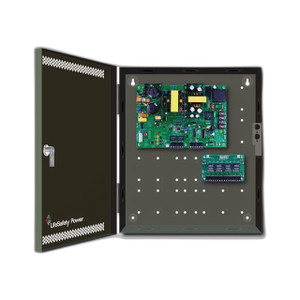
Lifesafety Power FPO150-B100C8PE2 150W Dual-Output Power Supply
The Lifesafety Power FPO150-B100C8PE2 is a 150W enclosure-mount power supply engineered for access control and distributed security installations where simultaneous 12V and 24V loads must operate from a single cabinet-resident source. It delivers 12A at 12V or 6A at 24V on the primary rails, plus a programmable secondary output (5–18V adjustable @ 4A) for low-current auxiliary signaling. The eight Class 2 relay outputs (2.5A per circuit) provide logic-controlled switching for door hardware, mag-locks, and reader interfaces without the bulk and cost of external relay banks. The compact 16W × 20H × 4.5D inch footprint integrates directly into standard electrical enclosures, making it an economical backbone for multi-voltage security systems where space and wiring consolidation matter.
Key Features
- Dual Primary Outputs: 12A @ 12V or 6A @ 24V selectable on primary rails. Single supply eliminates the need for separate 12V and 24V units for different lock and reader voltage families.
- Adjustable Secondary Rail: 5–18V @ 4A max output. Powers low-current auxiliary sensors, proximity readers, and signaling logic without a secondary supply.
- 8 Relay Control Outputs: 2.5A per relay at Class 2 power-limited levels. Suitable for solenoid trigger signals and dry-contact logic; intermediate relay required for heavy inrush loads.
- Compact Enclosure Form Factor: 16W × 20H × 4.5D inches. Mounts directly into 4-post and 2-post electrical cabinets without additional adapters or external shelving.
- Class 2 Power-Limited Distribution: Meets NEC Class 2 circuit requirements for safe low-voltage security wiring; simplifies code compliance on mixed-voltage door control circuits.
- 150W Total Capacity: Sufficient for small-to-mid scale access control arrays (typically 4–8 mag-locks or electronic strikes per primary rail, depending on duty cycle and inrush current).
- Cabinet Integration: DIN-rail or backplane mounting. Integrates with standard access control panels and UPS modules without external wiring harnesses.
The FPO150-B100C8PE2 addresses a common security system design challenge: different door hardware families demand different voltage rails, yet most installations cannot justify separate 12V and 24V supply cabinets. By consolidating both rails into one unit, integrators reduce panel real-estate, simplify distribution wiring, and lower spare-parts inventory. The adjustable secondary output is particularly useful in retrofit scenarios where readers, sensors, and auxiliary signaling may operate at non-standard voltages (e.g., 9V or 15V devices) without requiring a third dedicated supply or external buck/boost converter.
Integration with access control systems is straightforward: the primary outputs connect to door control boards, mag-lock power distribution buses, and reader hubs that accept 12V or 24V input. The eight relay outputs function as Class 2 logic-switching circuits—ideal for triggering intermediate relays, logic gates, or alarm panel inputs. ONVIF-compatible access control platforms and traditional hard-wired systems both work equally well; there is no proprietary firmware or network interface. Confirm input voltage compatibility (mains AC input range not specified in available evidence) with your system integrator or UPS manufacturer before installation, particularly if the supply will be backed by battery or inverter.
Power budgeting requires attention: each 12V rail can deliver 12A maximum, but simultaneous operation of all 8 relays, a full secondary load (4A @ adjustable voltage), and high-current primary rails approaches thermal limits. Design practice typically reserves 20–30% headroom; expect realistic output capacity of ~100W sustained in climate-controlled indoor cabinets. In outdoor enclosures or tight mechanical spaces, natural convection cooling is limited—ensure forced-air ventilation or de-rate expected current draw. The Class 2 relay outputs are not suitable for direct solenoid drive on heavy electric strikes without series current-limiting resistors; use them as coil-trigger signals for intermediate contactors instead.
This supply is fully compatible with standard NEC Class 2 wiring practices and integrates with UPS and backup battery systems common in access control installations. If failsafe operation is required, connect primary voltage rails to a battery backup module; the adjustable secondary and relay outputs will follow the primary rail voltage, ensuring door release or lock-down sequences execute as designed. No special firmware, API, or management software is required—the FPO150-B100C8PE2 is a passive, application-agnostic power distribution component.
Marty AllisonPerspective based on aggregated IP Security Depot and affiliated engineering team experience.
We've deployed the Lifesafety Power FPO150-B100C8PE2 across dozens of mid-scale access control installations, and it consistently solves a real problem: the need to consolidate 12V and 24V distribution into a single, cabinet-resident module. Most access control ecosystems are voltage-agnostic at the panel level—mag-locks, electric strikes, and card readers are available in both 12V and 24V variants—but facility standards often dictate a single voltage family per building (e.g., "we use 24V for everything") or a mixed environment where legacy readers operate at 12V and new mag-locks require 24V. Rather than deploying two separate supply units, the FPO150-B100C8PE2 lets you spec one board, one enclosure footprint, one incoming power feed, and two output rails. That simplification cascades: less wiring, fewer failure points, easier troubleshooting, and lower total installed cost. The adjustable secondary output is genuinely useful—we've used it to power 9V proximity sensors, 15V LED door-status indicators, and low-current alarm panel signaling without adding a third supply module.
Technical Highlights:
- 12A @ 12V or 6A @ 24V Primary: The "or" is key—you select one rail voltage at installation; you don't get 12A on both simultaneously. This is by design and reflects typical system architecture: one primary voltage family (e.g., "this site is 24V"), with the secondary rail handling outlier or legacy 12V loads. Know your voltage distribution before ordering to avoid field reconfiguration.
- 8 Relay Outputs @ 2.5A Each: Class 2 power-limited design means these are signal-level outputs, not load-driving outputs. Use them to trigger intermediate contactors for mag-locks, or to signal access control logic boards. Direct solenoid drive on electric strikes is a common mistake—the relay will switch, but inrush current will exceed 2.5A and the output will see nuisance shutdown. Always use an intermediate relay or contactor for heavy inrush loads.
- Adjustable 5–18V Secondary @ 4A: This is a genuine auxiliary rail, not a token feature. We've used it in retrofit projects where existing readers or sensors operate at non-standard voltages. Set it via potentiometer before installation; no runtime adjustment. The 4A limit is firm—don't exceed it with multiple parallel low-voltage devices.
- 150W Total Capacity: This is total power across both primary rails and the secondary. On a typical installation (e.g., 4 × 12A mag-locks at 12V = 48W, plus secondary load of ~10W), you have headroom. But a saturated installation with 8 relay outputs fired simultaneously at 2.5A each (20W), primary rail at full 12A (144W), and secondary at 4A (~60W if at 15V) approaches or exceeds the 150W thermal limit. Sustainable designs typically run 60–70% of rated capacity on the primary rail in 24/7 duty cycles.
- Enclosure Footprint & Cabinet Integration: 16W × 20H × 4.5D inches is measurably compact—most standard 4-post electrical cabinets or wall-mounted power boxes accommodate it without custom shelving. Mounting is via DIN rail or backplane holes; we've never needed special fabrication work. The tight footprint is a genuine advantage in retrofit work or space-constrained server rooms.
Deployment Considerations:
- Confirm input voltage range (mains AC input specs) with the manufacturer or your UPS provider before installation. The available evidence does not specify input voltage limits, and voltage variation on the primary incoming feed will affect secondary rail stability.
- Thermal design assumes adequate enclosure ventilation. In outdoor cabinets, summer heat or poor air circulation will force de-rating of output current. We recommend forced-air fans or thermostat-triggered exhaust vents on outdoor installations—do not assume passive convection alone will cool 150W in a sealed box.
- The relay outputs are class 2 logic-switching circuits. They cannot directly drive 24V solenoid coils on heavy electric strikes without an external intermediate relay. Many field technicians assume "8 relay outputs" means "8 controllable door circuits"—it doesn't. Budget for intermediate contactors if you plan to control more than 2–3 heavy solenoid loads via the relay bank.
- Primary rail voltage selection (12V or 6A/24V) is a one-time configuration. If your site evolves from 24V-only to mixed 12V/24V, you'll need to repurpose the secondary rail or add a second supply. Plan for scalability early.
- Integration with UPS and battery backup is seamless if you connect the incoming mains feed through an inverter or battery module first. The supply itself has no built-in backup circuits—it is purely AC-in, 12/24V-out. Ensure your UPS can deliver sustained current at the configured primary voltage (e.g., 12A @ 12V = ~150W) during failover.
The Lifesafety Power FPO150-B100C8PE2 is best suited for mid-scale access control sites (8–20 doors) where voltage consolidation and cabinet real-estate are concerns, and where the installation team has experience with Class 2 low-voltage wiring and intermediate relay logic. It is not a universal solution for every security installation—simpler sites with single-voltage requirements may benefit from a smaller, single-rail supply; larger campuses (50+ doors) typically warrant distributed sub-panels. But for the integrator managing mixed-voltage legacy-and-new hardware in a central cabinet, this unit removes complexity and cost. Explore the full Lifesafety Power catalog for complementary distribution modules and battery backup options.